

 中文简体
中文简体
LED Curtain Style Lights: A Professional Guide to Flexible, Low-Energy Decorative Illumination
LED curtain style lights are designed to create a broad, evenly distributed lighting effect across windows, walls, stages, storefronts, event spaces, and seasonal displays. Instead of concentrating light in a single line, this format uses a flexible horizontal wire with multiple vertical drops. LEDs are distributed along these drops to form a curtain-like illumination pattern that can transform a large surface quickly and attractively.
The LED 200 LED Curtain Style Lights product, model MDSLI001, is a commercial-oriented lighting solution developed for indoor and outdoor decorative applications. It combines a white wire, white light sources, and multi-bulb construction with a total length of approximately 13 feet. Its listed power consumption is 9.6 watts, making it suitable for users who want a visible decorative effect without the relatively high energy demand associated with many conventional lighting products.
LED curtain lights have become increasingly popular because they balance visual impact, installation flexibility, operating efficiency, and application versatility. They can be installed as a permanent seasonal feature, used for temporary event decoration, or incorporated into commercial displays. When manufactured with appropriate materials, controlled assembly procedures, and suitable certifications, they can also provide a dependable solution for professional buyers seeking consistent quality in volume.
What Are LED Curtain Style Lights?
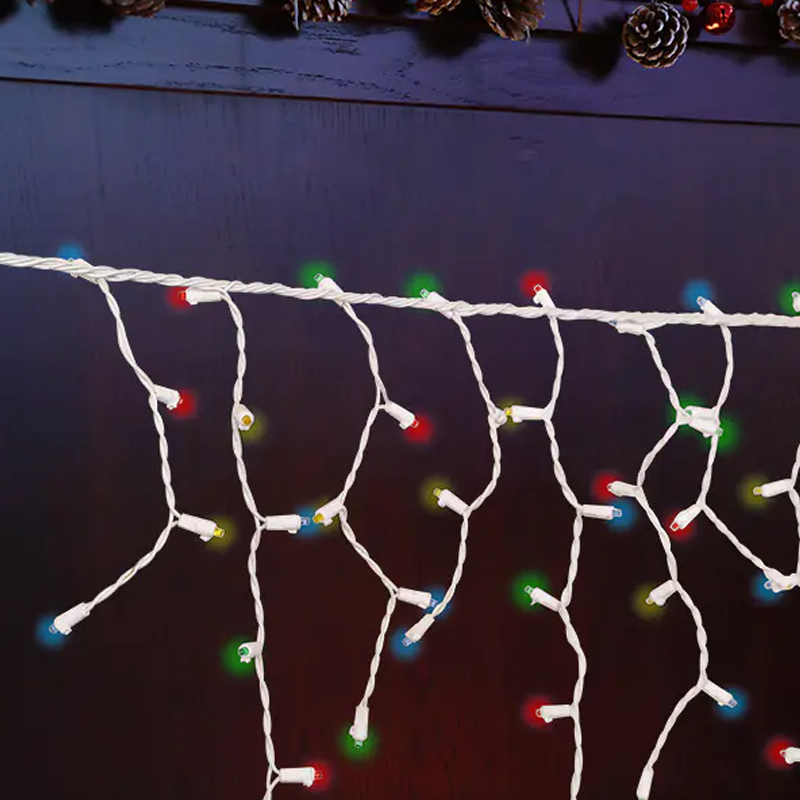
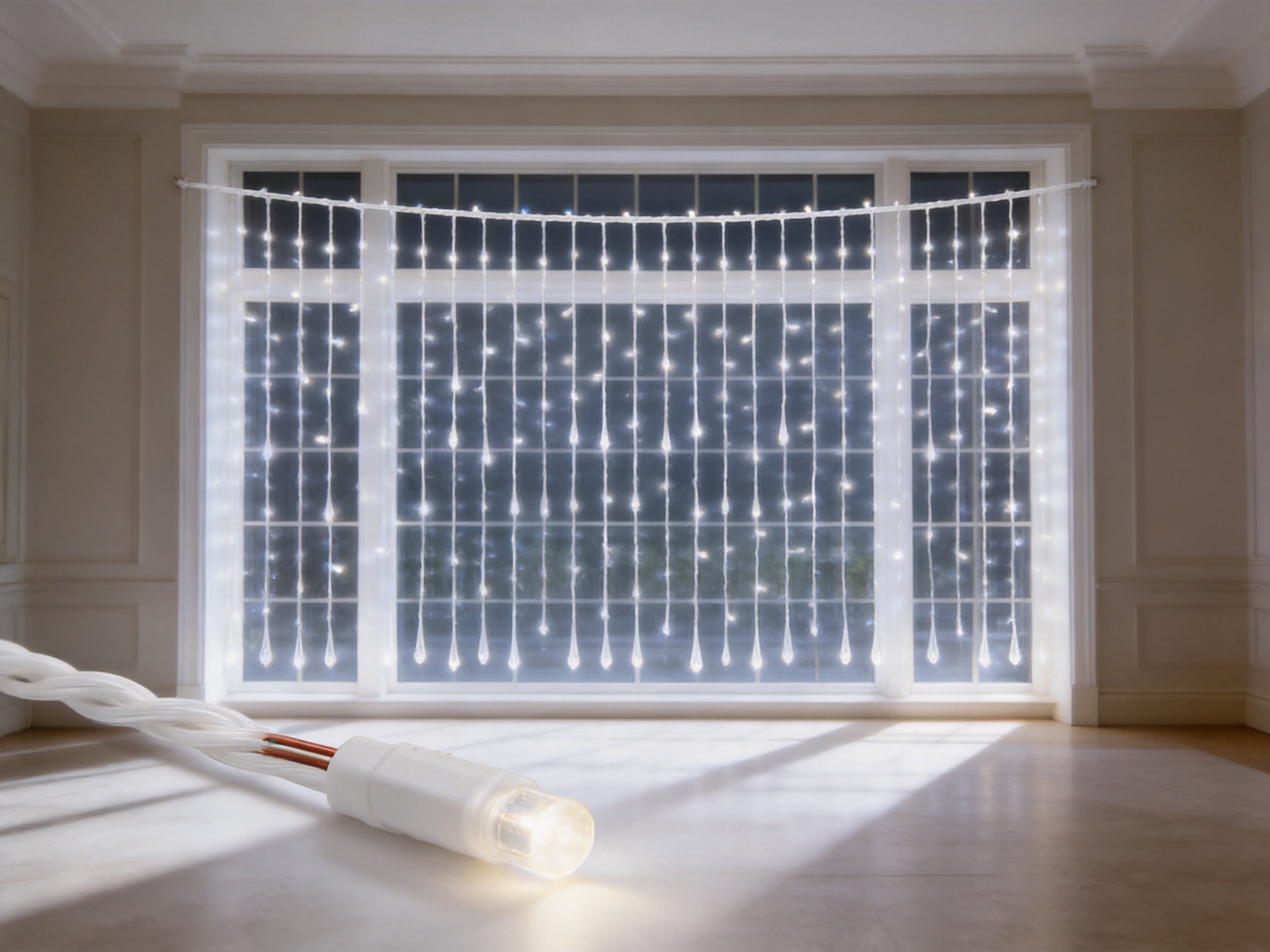
LED curtain style lights are decorative lighting systems arranged in a vertical configuration. A main flexible wire is suspended horizontally, while several lighted strands hang downward at regular intervals. LEDs are placed along the hanging strands, producing a pattern that resembles a glowing curtain.
The standard vertical arrangement is one of the most important characteristics of this lighting category. Even spacing helps create a neat and balanced visual effect, particularly when the product is installed across a window, wall, stage background, entrance, or retail display. Compared with loose string lights that may require careful manual positioning, a curtain-style design allows a broad area to be decorated in a relatively short time.
The MDSLI001 model is identified as a 200-LED curtain style light. Its 13-foot total length makes it suitable for medium-sized windows, wall sections, display areas, and event backdrops. Depending on the installation layout, multiple sets can be arranged side by side to cover larger surfaces while preserving a consistent visual rhythm.
The product uses PP, PVC, and copper as its principal materials. Polypropylene can contribute to lightweight structural components, PVC can provide insulation and protective covering for wires, and copper can support electrical conductivity in the internal wiring. This material combination is commonly used in decorative lighting because it can help balance flexibility, electrical performance, weight, and production efficiency.
Product Specifications at a Glance
The following table summarizes the available specifications for the LED 200 LED Curtain Style Lights.
| Specification | Product Information |
|---|---|
| Model | MDSLI001 |
| Product name | LED 200 LED Curtain Style Lights |
| Category | LED Curtain Lights |
| Main materials | PP, PVC, and copper |
| Wire color | White wire |
| Light color characteristic | White light with a multi-bulb arrangement |
| Total length | Approximately 13 feet |
| Application | Indoor and outdoor decorative use |
| Power consumption | 9.6 watts |
| Minimum order quantity | 1,000 units |
| Available certifications and compliance references | UL, NOM, CE, REACH, and BSCI |
Specifications should always be reviewed together with the final purchase documentation, packaging instructions, regional electrical requirements, and the exact configuration selected by the buyer. Light color, control mode, connector type, power supply, and environmental protection details may vary between product versions or destination markets.
Design Features That Improve Decorative Performance
Even Vertical Distribution
The vertical arrangement of LED curtain lights is intended to provide a uniform curtain effect rather than an irregular cluster of points. Regular spacing is especially valuable for professional decoration because it helps create a clean appearance when many products are installed together.
In a commercial window display, unevenly positioned light strands can make the installation look unfinished. A standardized curtain structure reduces this problem by providing a repeatable layout. It also makes planning easier because buyers can estimate how many sets are needed to cover a particular width or height.
Flexible Main Wire
The flexible main wire can be hung, fixed, adjusted, and arranged according to the shape of the installation area. This makes the product suitable for windows, partitions, stage structures, shop fronts, railings, walls, and temporary event frameworks.
Flexibility is an important advantage over rigid decorative fixtures. A rigid light panel may produce a strong visual effect but can be difficult to transport, store, and adapt to different spaces. A flexible curtain light can be folded or gathered for handling and then opened during installation.
Large-Area Coverage
One of the primary advantages of curtain lights is their ability to illuminate a relatively broad surface with a compact product format. A single set can create a recognizable decorative effect across a window or backdrop, while multiple sets can be combined to produce a larger continuous display.
This broad coverage can reduce the time needed to install individual strands one by one. For event decorators, retailers, hospitality venues, and holiday display contractors, faster deployment can improve labor efficiency and make it easier to complete projects under tight schedules.
Low Power Consumption
The listed power consumption of the MDSLI001 is 9.6 watts. LED light sources generally consume less electricity than traditional incandescent bulbs that provide a comparable decorative function. Lower energy use can be beneficial for displays that operate for many hours each day, particularly during holiday seasons, exhibitions, celebrations, and commercial operating hours.
Energy efficiency can also support more flexible installation planning. When many sets are used together, buyers still need to calculate the total electrical load, but an LED-based system can offer a more manageable demand than a comparable incandescent arrangement. Lower heat generation is another practical benefit, although all lighting products should be installed with appropriate ventilation and according to the manufacturer’s instructions.
Long Service Potential
LED technology is widely valued for its long service potential and resistance to frequent replacement compared with many traditional decorative lamps. A longer operating life can reduce maintenance interruptions and the need to replace individual lamps during a display period.
Actual service life depends on factors such as operating hours, voltage stability, ambient temperature, moisture exposure, mechanical stress, and product handling. Appropriate storage and careful installation remain essential even when the light source itself is designed for extended use.
LED Curtain Style Lights
Advantages Compared with Conventional Decorative Light Systems
More Efficient Than Incandescent Decorative Lights
Traditional incandescent decorative lights convert a significant portion of their electrical energy into heat. LED products are generally more efficient because they produce illumination with lower power consumption. For a display containing many light points, this difference can become meaningful over an entire operating season.
LED curtain lights can therefore be attractive to buyers who want strong decorative coverage while controlling electricity consumption. This is particularly relevant to hotels, shopping centers, restaurants, event venues, and public spaces that operate lighting for long periods.
Faster Installation Than Individual Light Strings
Individual string lights may need to be attached, spaced, and aligned one strand at a time. Curtain lights use a pre-arranged vertical structure, allowing installers to create a wide illuminated area with fewer separate placement decisions.
This does not eliminate the need for careful installation, but it can simplify the process. The horizontal support wire establishes the basic layout, while the hanging strands provide a consistent visual pattern. The result can be more orderly than a display made from loosely arranged strings.
More Adaptable Than Rigid Light Panels
Rigid panels can be effective for fixed architectural installations, but they may be expensive to transport and difficult to adapt when the display area changes. Flexible curtain lights can be folded, repositioned, and stored more easily.
Their adaptable construction is useful for seasonal displays that are installed in different locations from year to year. It is also suitable for rental companies and event production teams that need products capable of serving multiple venue layouts.
Suitable for Both Decorative and Commercial Applications
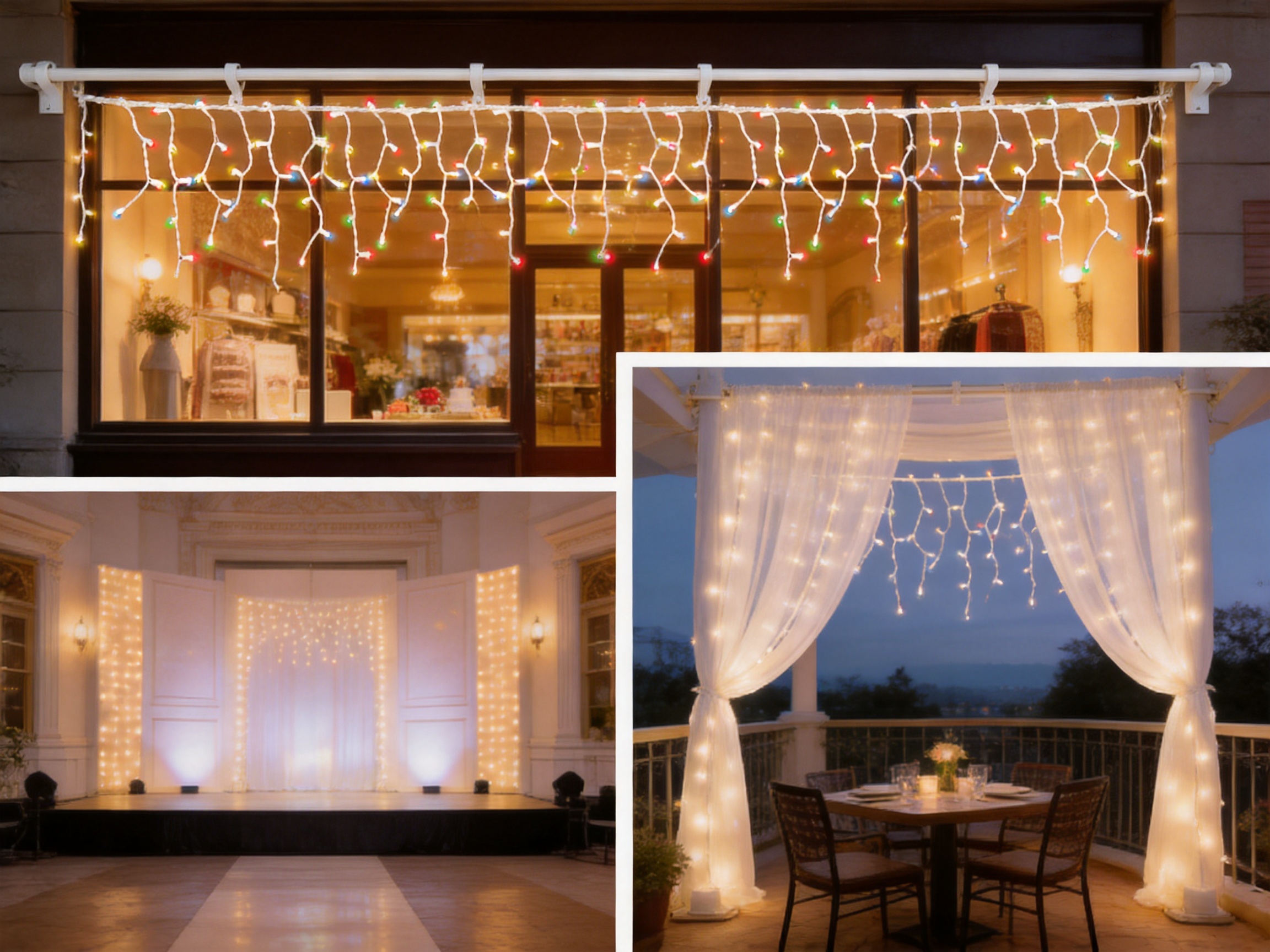
Many decorative lighting products are designed primarily for domestic use. LED curtain lights can also serve commercial applications when the product specification, electrical system, and installation conditions are appropriate. Their neat arrangement and broad coverage make them useful for retail windows, hospitality interiors, exhibition booths, wedding venues, and promotional displays.
For professional buyers, the availability of recognized certification and compliance references can be an important part of supplier evaluation. The listed UL, NOM, CE, REACH, and BSCI references provide useful information for discussions about target markets, product compliance, materials, social responsibility, and purchasing requirements.
Indoor and Outdoor Applications
LED curtain lights can be used in both indoor and outdoor environments, but the installation conditions are not identical. Buyers should select a version designed for the intended environment and verify the relevant protection, connector, power supply, and installation requirements before use.
Indoor Applications
Indoor applications include living room windows, bedroom walls, dining areas, retail stores, restaurants, shopping displays, hotel lobbies, exhibition booths, photo areas, and stage backdrops. Indoors, the product is generally protected from direct rain and severe wind, allowing installers to focus on secure hanging, neat cable management, and visual alignment.
White curtain lights can create a clean and elegant atmosphere in interior spaces. They may be used behind sheer curtains, around windows, across a feature wall, or as a background for a celebration. In commercial spaces, the lights can draw attention to merchandise, seasonal themes, brand presentations, and entrance areas.
Outdoor Applications
Outdoor applications include patios, balconies, garden structures, covered walkways, event tents, exterior windows, wedding venues, restaurant terraces, and seasonal building displays. Outdoor installation requires greater attention to weather exposure, wind movement, moisture, grounding, extension cords, and physical anchoring.
Outdoor products should be evaluated for weather resistance and used only within the conditions specified by the manufacturer. A product described as suitable for indoor and outdoor use should still be installed carefully. Outdoor electrical connections should be protected from water, and the light strands should be secured so that wind does not cause excessive movement or mechanical strain.
Important Environmental Differences
Outdoor lighting may need greater resistance to rain, wind, dust, temperature changes, and ultraviolet exposure than indoor lighting. Outdoor spaces may also require brighter illumination or a different color temperature so that the display remains visible against daylight or surrounding lighting.
Indoor lighting is often selected for softness and atmosphere, while outdoor lighting may be selected for visibility and impact. The same white light product can serve both environments, but its perceived brightness will depend on the surrounding conditions, installation height, background color, and viewing distance.
Power supply requirements may also differ. Buyers should confirm whether the selected model is intended for a standard electrical outlet, a specific voltage system, a transformer, a controller, or a battery pack. The product information provided for MDSLI001 lists power consumption but does not by itself define every regional power-supply detail. These details should be confirmed before purchase and installation.
Applications Across Different Industries
Retail and Shop Windows
Retailers can use curtain lights to create seasonal window displays, highlight new collections, and increase visual interest after dark. The vertical light arrangement can frame merchandise without completely covering the display. White light is particularly useful when the retailer wants a clean, premium, or winter-inspired appearance.
Because the product can be installed across a broad area, it can help transform an ordinary window into a recognizable focal point. Retail managers can also combine curtain lights with ornaments, signage, artificial snow, display trees, or other decorative elements.
Hotels and Restaurants
Hotels, restaurants, cafés, and banquet venues often need lighting that can change with the season or event schedule. Curtain lights can be used in lobbies, dining areas, outdoor terraces, wedding halls, and private function rooms.
The low-power LED design is suitable for displays that remain illuminated for extended service hours. The flexible structure also allows venues to adapt the lights to different room arrangements, provided that the installation does not obstruct walkways, emergency equipment, exits, or ventilation systems.
Weddings and Celebrations
Wedding decorators and event planners use curtain lights to create luminous backgrounds for ceremonies, photographs, stages, sweetheart tables, and reception areas. The regular vertical drops can produce a three-dimensional visual effect behind the main event space.
For temporary installations, the ease of hanging and removing the product is especially important. Installers should use suitable hooks, clips, or support systems rather than placing excessive weight on the electrical wire. After an event, the product should be gathered carefully to reduce tangling and stored in a dry location.
Stage and Exhibition Backdrops
Stage designers can use LED curtain lights to add depth to a backdrop or create a bright border around a performance area. Exhibition organizers can use them to make booths more visible in busy halls, especially when the surrounding environment contains many competing displays.
For stage and exhibition use, the cable route should be planned in advance. All wires should be managed to prevent tripping hazards, and light placement should not interfere with cameras, microphones, screens, fire safety equipment, or audience movement.
Residential Decoration
Home users can install curtain lights around windows, balconies, bedrooms, entertainment areas, patios, and holiday displays. Their broad coverage makes them useful when a homeowner wants more than a single illuminated line.
White LED curtain lights can complement modern, traditional, minimalist, and festive interiors. They can also be combined with warm furnishings, natural materials, greenery, or seasonal decorations to create a layered lighting effect.
Materials and Construction
The MDSLI001 uses PP, PVC, and copper. Each material has a different functional role in the overall product construction.
Polypropylene Components
Polypropylene, commonly known as PP, is a lightweight polymer used in many electrical and decorative products. It can contribute to the structure of lamp holders, protective parts, connectors, or other molded components. Its low weight can make the finished light set easier to handle and install.
For manufacturers, PP can also support efficient injection molding and repeatable component production. Consistent molded parts help maintain dimensional accuracy across large production runs, which is important when the same product is supplied in substantial quantities.
PVC Wire Protection
PVC is commonly used as an insulating and protective material for electrical wires. It can help separate conductive elements from the external environment and provide a flexible covering suitable for decorative light installation.
The quality of PVC processing matters. The insulation should be applied consistently, without visible damage, weak areas, or irregular thickness. Production controls should also include checks for cutting, stripping, terminal attachment, and connector assembly.
Copper Conductors
Copper is valued for its electrical conductivity and flexibility. In a curtain light system, copper conductors help carry electrical current to the LEDs distributed along the main wire and vertical drops.
Reliable conductor preparation is essential because poor connections can lead to intermittent operation, localized heating, flickering, or premature failure. A professional production process should include appropriate connection methods, insulation checks, and electrical testing before shipment.
Advanced Manufacturing and Quality Control
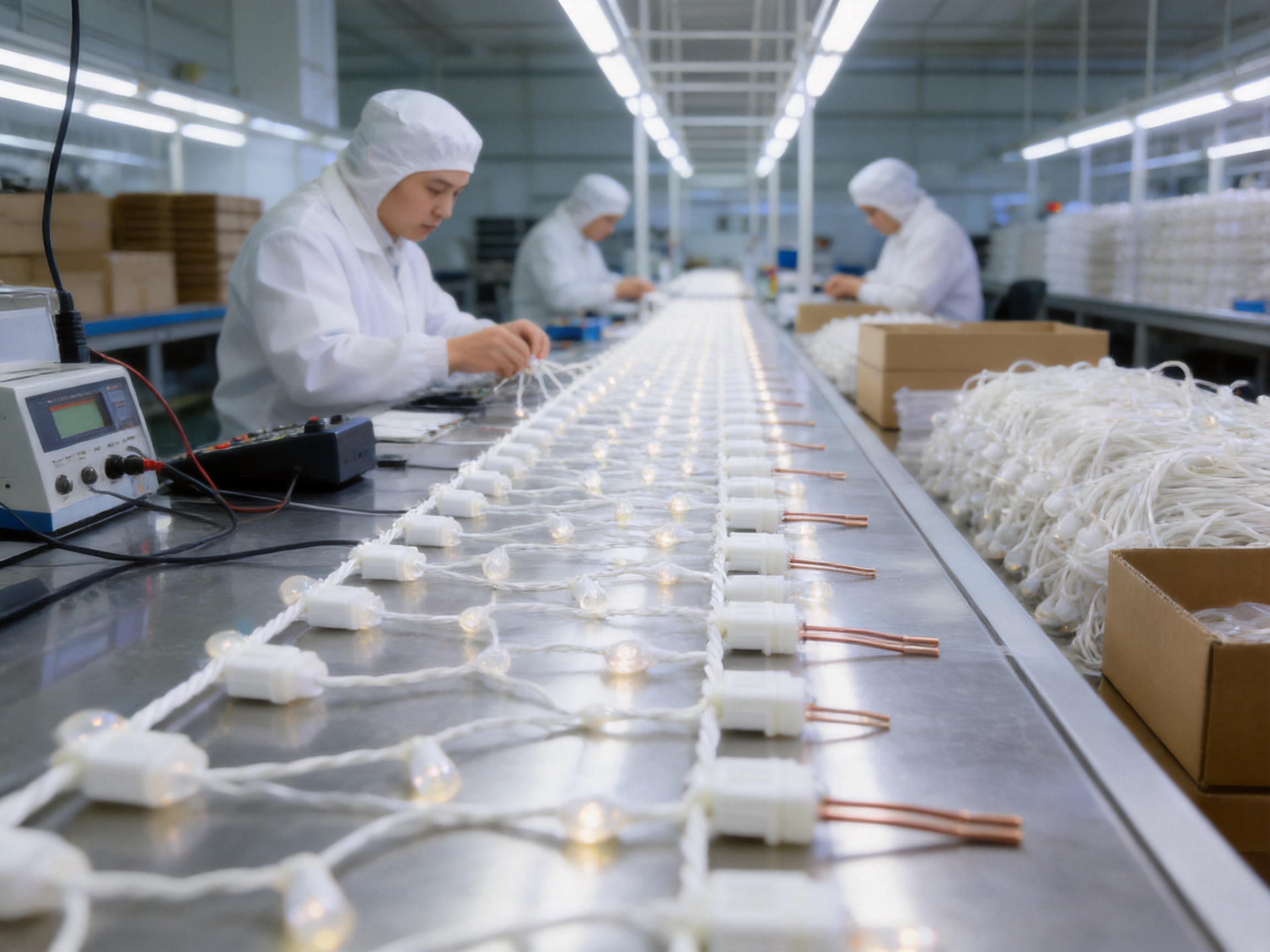
The reliability of a decorative lighting product depends not only on its visible design but also on the manufacturing processes behind it. A curtain light includes molded components, insulated conductors, LED light sources, connectors, assembly points, packaging materials, and sometimes control components. Each stage can influence the final product’s performance.
Taizhou Mingde Decorative Lighting Co., Ltd. reports an annual production capacity of 10 million strings of festive lights. This scale indicates an established production system capable of supporting large-volume orders and repeat manufacturing. The company’s product range includes linear lights, icicle lights, net lights, circular lights, spiral trees, LED string lights, copper wire lights, and cord lights.
Integrated Production Capability
An integrated lighting enterprise can coordinate multiple stages of manufacturing instead of relying entirely on unrelated external suppliers. The company describes quality control covering component manufacturing, final assembly, and shipment. This type of control structure can improve traceability and help maintain consistency between production batches.
Integrated operations may include component preparation, wire processing, LED placement, soldering or terminal assembly, testing, inspection, packaging, and final dispatch. When these activities are managed under a coordinated system, production teams can respond more efficiently to technical issues and customer requirements.
Component Manufacturing
Component quality is important because small parts can affect the performance of the complete lighting string. Molded holders and protective pieces should be produced with stable dimensions. Wire assemblies should be cut to the required lengths. LED components should be positioned consistently along the vertical drops.
For a curtain light, visual uniformity is particularly important. If the LED spacing, drop length, or connector position changes significantly from one set to another, the installed display may look irregular. Controlled component production helps reduce these differences.
Assembly Process
Assembly teams must connect the main wire, vertical branches, LEDs, connectors, and protective elements in the correct sequence. Proper polarity, connection strength, insulation, and spacing should be verified during production.
Professional assembly can include work instructions, fixture-assisted positioning, visual inspection, electrical tests, and sampling procedures. Standardized work helps reduce errors when large quantities are manufactured for export markets.
Electrical Testing
Electrical testing is a critical part of decorative light manufacturing. Testing may include continuity checks, voltage verification, insulation assessment, operating tests, and inspection for abnormal heating or flickering. The exact testing program depends on the product design, power supply, market requirements, and applicable certification standards.
Testing should be conducted not only on individual components but also on completed products. A finished curtain light should be evaluated as a complete system so that problems caused by assembly, connectors, or wiring can be identified before shipment.
Visual Inspection
Visual inspection can identify damaged insulation, loose parts, uneven LED placement, incorrect wire color, surface defects, missing components, and packaging issues. Because curtain lights are highly visible decorative products, appearance quality is an important part of customer satisfaction.
Inspection teams may compare finished products against approved samples, production drawings, color requirements, and packing specifications. Consistent visual standards are particularly valuable for distributors and retailers that need products to look identical across multiple cartons or purchase orders.
Quality Management Experience
The company states that it established an ISO 9001 quality system in 1997. A quality management system can provide a framework for documented procedures, corrective actions, process monitoring, customer feedback, and continual improvement.
Quality certification does not replace product-specific testing, but it can demonstrate that the manufacturer has experience operating a structured quality management process. For buyers, it is still advisable to request current certificates, inspection records, product samples, and destination-market documentation during the purchasing process.
Export-Oriented Manufacturing
The company has a long history in the festive lighting industry and serves markets including the United States, Central America, and South America. Export experience can be valuable because different markets may require different plugs, voltages, labels, packaging formats, language instructions, and certification documentation.
A supplier familiar with international shipments may also be better prepared to coordinate carton specifications, loading plans, production schedules, inspection arrangements, and documentation. These operational details are important for distributors and importers that manage seasonal inventory.
Certification and Compliance Considerations
The product information lists UL, NOM, CE, REACH, and BSCI among the applicable certification or compliance references. These references cover different aspects of market access, product safety, material management, and social responsibility.
UL is widely associated with product safety evaluation in the United States and other markets. NOM is associated with Mexican standards and conformity requirements. CE marking relates to applicable European Union product requirements. REACH addresses the control of chemical substances in the European market, while BSCI is associated with social compliance and responsible supply-chain practices.
Buyers should confirm which specific certificate applies to the exact model, voltage, plug, controller, and destination market. Certification details can vary by configuration. Importers should also review labeling, user instructions, packaging marks, electrical ratings, and national requirements before placing a commercial order.
Compliance documentation can help reduce uncertainty during supplier evaluation, but safe installation remains the responsibility of the purchaser and end user. Products should be used according to the instructions, and modifications to the wiring or power system should not be made without appropriate technical knowledge.
Installation Recommendations
Plan the Layout
Before installation, measure the width and height of the area to be decorated. Determine where the main horizontal wire will be supported and how the vertical drops will be arranged. For a large display, decide whether multiple sets will be aligned side by side or separated into individual design zones.
Planning helps prevent excessive tension on the wire and reduces the need to move the product after it has been connected. It also allows the installer to identify the nearest suitable power source and plan cable routing safely.
Use Appropriate Supports
Use hooks, clips, cable ties, curtain tracks, or other support accessories suitable for the installation surface. The support system should hold the product securely without cutting into the insulation or placing excessive force on individual branches.
Do not suspend the entire weight of the product from a plug, connector, or single delicate wire point. The main support should be distributed across the horizontal wire so that the curtain hangs evenly.
Protect Connections
For outdoor use, connectors and power connections should be protected from rain and standing water in accordance with the product instructions. Extension cords should be suitable for outdoor use when required. Electrical connections should never be placed where water can collect.
Indoor users should also avoid placing connections near sinks, wet floors, heating appliances, or areas where the cable could be crushed. Proper routing protects both the product and the people nearby.
Check the Product Before Use
Inspect the product for visible damage before installation. Check the wire, LED holders, connectors, insulation, and plug or power-supply components. Do not use a product with exposed conductors, broken insulation, cracked housings, or signs of overheating.
It is good practice to test the light set before hanging it in a difficult-to-reach location. This can save time and help identify problems before the display is fully installed.
Prevent Mechanical Stress
Avoid pulling, twisting, crushing, or sharply bending the wires. Although the product is designed to be flexible, flexibility does not mean that the wiring can withstand unlimited force. When removing the lights, release clips carefully and gather the branches in a controlled manner.
Maintenance, Storage, and Service Life
Routine maintenance for LED curtain lights is generally simple. Dust can be removed with a soft, dry cloth when the product is disconnected from power. Harsh chemicals, abrasive materials, and excessive moisture should be avoided unless specifically permitted by the manufacturer.
Outdoor installations should be inspected periodically for loosened supports, damaged insulation, water exposure, or wind-related movement. Seasonal displays should be switched off and removed when the environmental conditions exceed the product’s intended use.
For storage, allow the product to dry completely before packing it away. Gather the vertical strands loosely rather than forcing them into a tight bundle. Store the light set in a cool, dry place away from sharp objects, excessive heat, direct sunlight, and heavy items that could crush the wires.
Proper handling can help preserve the appearance and electrical integrity of the product. It can also reduce tangling, which is a common source of installation damage for decorative light strings.
Why This Product Is Suitable for Bulk Buyers
The listed minimum order quantity is 1,000 units, indicating that the product is positioned for wholesale, distribution, project, and commercial purchasing rather than only individual retail orders. Bulk buyers can use this product for seasonal inventory, event rental operations, chain-store decoration, hospitality projects, and large-scale holiday programs.
A standardized model simplifies procurement. Buyers can establish a repeatable product specification, request consistent packaging, plan warehouse quantities, and coordinate installation across multiple locations. The 13-foot format can also make it easier to estimate coverage and calculate the number of sets needed for a project.
Large-scale production capacity may support better supply continuity during peak holiday periods. Since festive lighting is often seasonal, production scheduling and early order planning are important. Buyers should discuss lead times, sample approval, packaging, shipping terms, spare quantities, warranty conditions, and inspection procedures before confirming a purchase.
For distributors, the combination of low power consumption, flexible installation, white illumination, and indoor and outdoor suitability can make the product appealing to several customer segments. It can be marketed for Christmas displays, weddings, retail decoration, home atmosphere lighting, stage design, and event rental applications.
How to Evaluate LED Curtain Lights Against Competing Products
Product comparison should not be based only on the number of LEDs or the lowest unit price. Buyers should examine the total value, including materials, spacing, light consistency, wire construction, electrical safety, documentation, packaging, defect rates, and supplier responsiveness.
| Evaluation Area | Questions for Buyers | Why It Matters |
|---|---|---|
| Light arrangement | Are the vertical drops evenly distributed? | Uniform spacing improves the finished curtain effect. |
| Energy use | What is the rated power consumption? | Lower consumption can reduce operating costs. |
| Materials | What wire insulation, conductors, and molded components are used? | Materials influence flexibility, durability, and safety. |
| Application range | Is the product intended for indoor, outdoor, or both environments? | Environmental suitability affects reliability and safe use. |
| Testing | Are completed products electrically and visually inspected? | Finished-product testing helps identify assembly defects. |
| Compliance | Are documents available for the target market and exact model? | Documentation supports import and distribution requirements. |
| Production capacity | Can the supplier support the required order quantity and schedule? | Capacity affects seasonal supply continuity. |
| Packaging | Does the packaging protect the wires and prevent tangling? | Good packing reduces damage during transport and handling. |
Compared with lower-cost products that may use inconsistent spacing, weaker wire protection, or limited inspection, a professionally manufactured curtain light can offer greater predictability. Predictability is especially important for wholesale buyers because a high defect rate can create returns, installation delays, and damage to the distributor’s reputation.
Visual Atmosphere and Lighting Design
White LED curtain lights can create a calm, refined, or festive visual atmosphere depending on the surrounding decoration. The effect can be soft when installed behind translucent fabric or more prominent when placed against a dark wall or outdoor background.
Designers can use the product as a background layer rather than the only light source. Combining curtain lights with spotlights, lanterns, architectural lighting, candles, or illuminated signs can create depth. The regular vertical lines provide structure, while other lighting elements provide focus and contrast.
Installation height also influences the visual result. A curtain mounted close to eye level can become a direct decorative feature. A curtain installed high above a stage or entrance can act as a background glow. Multiple sets installed in parallel can produce a denser effect, while wider spacing between sets can create a lighter and more open appearance.
White light is suitable for applications where color accuracy and a neutral appearance are important. For festive or entertainment-focused projects, buyers may also consider versions with multi-color, flashing, color-changing, or programmed effects if those options are available in the selected configuration.
Optional Effects and Control Possibilities
Some LED curtain light systems are available with built-in flashing, color-changing, or programmable modes. These functions can add movement and visual variety to party venues, festivals, stage displays, holiday windows, and promotional events.
When selecting a controlled version, buyers should verify the controller type, number of modes, remote-control range, memory function, dimming capability, timer settings, power-supply requirements, and compatibility between connected sets. These features should be confirmed for the specific model because the basic product description for MDSLI001 identifies white light and does not specify a particular controller.
Control options should be selected according to the intended use. A restaurant may prefer a steady light for a refined atmosphere, while an entertainment venue may benefit from animated effects. In a retail window, excessive flashing may distract from merchandise, so a steady or gently changing mode may be more appropriate.
Frequently Asked Questions
What is the total length of the MDSLI001 curtain light?
The listed total length is approximately 13 feet. Buyers should confirm the exact horizontal span, drop length, spacing, and power-lead dimensions in the final product drawing or order confirmation.
How many LEDs does the product contain?
The product is identified as the LED 200 LED Curtain Style Lights model, indicating a 200-LED configuration. The precise distribution of LEDs across the horizontal wire and vertical drops should be confirmed with the supplier if the installation requires exact spacing.
What color is the product?
The listed configuration uses a white wire and white light sources. The specification also refers to a multi-bulb arrangement. Other colors or effect modes may be available for different configurations, but these should be confirmed before ordering.
Can the lights be used outdoors?
The product information identifies the lights for indoor and outdoor use. Outdoor installation must still follow the manufacturer’s instructions, including requirements for weather exposure, connections, extension cords, support, grounding, and protection from wind and water.
How much power does the product consume?
The listed power consumption is 9.6 watts. Total system consumption will depend on how many sets are connected and the characteristics of the selected power supply or controller. Buyers should calculate the combined load before installing multiple sets.
Are the lights suitable for commercial projects?
Yes. The product’s broad coverage, flexible structure, low listed power consumption, bulk-order positioning, and commercial manufacturing background make it suitable for retail, hospitality, events, exhibitions, stages, and seasonal displays. The exact application should match the product’s certified configuration and installation requirements.
What materials are used?
The listed materials are PP, PVC, and copper. PP may be used in molded components, PVC may protect and insulate wires, and copper may serve as the electrical conductor. The exact function of each material should be confirmed in the technical documentation for the selected version.
What certificates are associated with the product?
The listed certification and compliance references are UL, NOM, CE, REACH, and BSCI. Buyers should request current and model-specific documentation for the destination market, voltage, connector, and product configuration.
What is the minimum order quantity?
The listed minimum order quantity is 1,000 units. This makes the product appropriate for distributors, importers, project purchasers, event companies, and retailers planning seasonal or commercial inventory.
Can multiple sets be installed together?
Multiple sets may be arranged together for larger displays, but connection limits and power requirements must be confirmed before installation. The combined electrical load, connector compatibility, spacing, and support structure should all be evaluated.
How should the lights be stored?
The lights should be disconnected, checked, dried if necessary, gathered loosely, and stored in a cool, dry place. Avoid crushing the wires or placing heavy objects on top of the product. Careful storage helps reduce tangling and damage.
Does the product include flashing or color-changing modes?
The general product information mentions that multi-color or flashing modes may be available, but the listed MDSLI001 specification identifies white light and does not state a specific control system. Buyers should confirm available modes and accessories for the exact order.
Supplier Strength and Industry Experience
Taizhou Mingde Decorative Lighting Co., Ltd. is described as a large Chinese manufacturer and export base for festive lighting. The company was formerly associated with Zhejiang Festival Lighting General Factory and was founded in 1968. Its long operating history indicates substantial experience in the seasonal lighting field.
The company reports annual production capacity of 10 million strings of festive lights. This capacity can be important for buyers that require significant quantities during concentrated purchasing seasons. It may also support product development across several lighting categories, including linear lights, icicle lights, net lights, circular lights, spiral trees, LED strings, copper wire lights, and cord lights.
The company states that it was among the first domestic festive lighting companies to obtain United States UL certification and that it established an ISO 9001 quality system in 1997. These milestones suggest familiarity with international product requirements and structured manufacturing management.
Its stated manufacturing approach covers component production through final assembly and shipment. Such an integrated process can help coordinate quality checks, production scheduling, material control, and export preparation. For professional buyers, the ability to communicate with a manufacturer that understands both product engineering and international order management can simplify procurement.
The company’s stated mission focuses on nature-friendly home ambient lighting and its vision emphasizes building a long-term lighting brand. These objectives align with current market interest in energy-efficient LED technology, durable decorative products, responsible production, and comfortable household illumination.
Purchasing and Project Planning Checklist
Before placing a commercial order, buyers should define the intended market, installation environment, power system, light color, control mode, quantity, packaging, and delivery schedule. Clear specifications reduce the possibility of misunderstanding between the buyer and supplier.
Requesting a pre-production sample can help confirm the actual light appearance, wire color, LED spacing, connector design, packaging, and operating behavior. For large orders, buyers may also arrange a production inspection or request quality records according to the agreed purchasing terms.
Seasonal demand should be considered carefully. Holiday lighting orders often need to be completed well before the selling season because production, inspection, export documentation, ocean freight, customs clearance, and distribution all require time. Early planning can reduce the risk of rushed manufacturing or delayed market launch.
Buyers should also discuss after-sales support. Important points may include spare-unit ratios, replacement procedures, warranty duration, defect reporting, carton markings, installation instructions, and technical contacts. These details are particularly important for distributors responsible for supporting multiple downstream customers.
Conclusion
LED curtain style lights provide an efficient and flexible way to create large-area decorative illumination. The MDSLI001 model combines a 200-LED vertical arrangement, approximately 13 feet of total length, white wire, white light, PP, PVC, and copper construction, and listed power consumption of 9.6 watts.
Its principal advantages include orderly light distribution, broad coverage, flexible installation, low energy demand, long service potential, and suitability for indoor and outdoor decorative applications when installed correctly. These features make it appropriate for windows, patios, walls, storefronts, stages, wedding venues, exhibitions, hotels, restaurants, and residential holiday displays.
For professional purchasers, the product is supported by a manufacturer with reported high production capacity, long industry experience, international export activity, structured quality management, and a broad festive-lighting product portfolio. The listed UL, NOM, CE, REACH, and BSCI references can provide a starting point for compliance discussions, while exact documentation should be verified for the intended market and configuration.
Compared with conventional incandescent strings, loosely arranged light strands, or rigid decorative panels, curtain lights can offer a practical balance of visual impact, energy efficiency, coverage, and adaptability. With appropriate quality control, careful installation, and proper storage, they can serve as a dependable foundation for seasonal, commercial, event, and architectural decorative lighting projects.
References
1. Product specification sheet for LED 200 LED Curtain Style Lights, model MDSLI001.
2. Manufacturer-provided company information for Taizhou Mingde Decorative Lighting Co., Ltd.
3. General principles of LED lighting efficiency, thermal management, and service-life evaluation.
4. General guidance for indoor and outdoor decorative lighting installation and electrical safety.
5. ISO 9001 quality management system principles for manufacturing organizations.
6. General conformity and responsible-supply-chain references associated with UL, NOM, CE, REACH, and BSCI.
Product: LED Curtain Style Lights

Don't Miss New Releases & Subscriber Exclusives
Sign up for our newsletter to stay in the holidy spirit all year.
Further Questions? Contact Us
-
Useful Links
Home Products About Us Production Services News Contact Us -
Classification
Mini String Light LED Light Set Garland Light Light-up Spiral Trees LED Curtain Lights Battery Light LED Copper Wire Light Decorative Light -
Contact Info
zd@zflgf.com.cn+86-576-82467401
+86-13968612122 ( Ms. Zhang )
+86-13505747679 ( Mr. Tan )
+86-15062835074 ( Mr. Cheng )No.270 Zhenxi Road, Xinqiao Town, Luqiao District, Taizhou City, Zhejiang Province, China -


Holiday Lights Supplier