

 中文简体
中文简体
100 Mini-Style LED Light Set: Efficient Decorative Lighting for Indoor and Outdoor Displays
Decorative lighting plays an important role in seasonal merchandising, residential styling, hospitality design, retail presentation, and event decoration. Among the many available lighting formats, the mini-style LED light set remains one of the most flexible and widely applicable choices. Its compact bulbs, evenly distributed points of light, manageable power consumption, and adaptable wire design allow it to be used across a broad range of decorative projects.
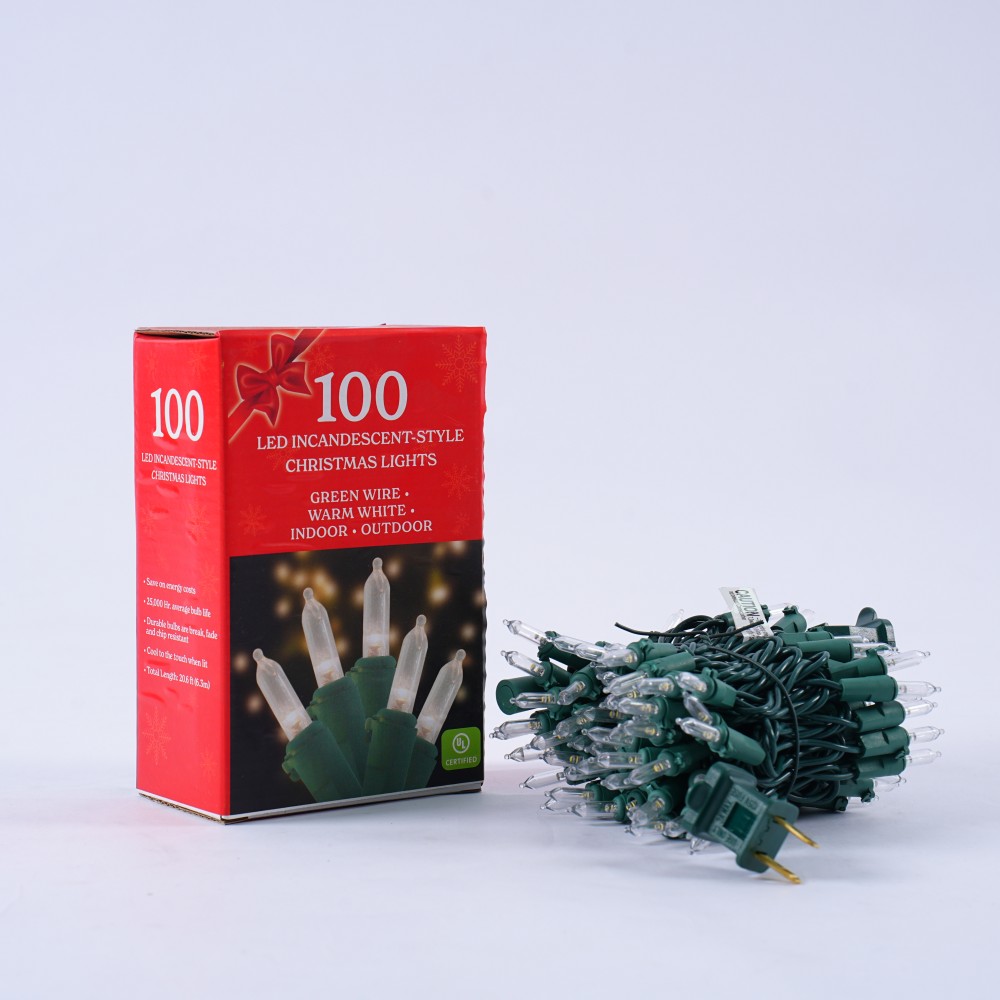
The 100 Mini-Style LED Light Set is designed for customers who need balanced coverage without moving immediately to a large commercial installation. With 100 LED bulbs arranged along a total length of approximately 27 feet, the set provides medium-scale illumination for trees, railings, window frames, shelves, entrances, displays, and other decorative structures. Its 7.2-watt power rating supports bright visual impact while helping users manage energy consumption during extended operating periods.
Manufactured by Taizhou Mingde Decorative Lighting Co., Ltd., the product is positioned as an adaptable LED light set for indoor and outdoor use. The manufacturer has operated in the festive lighting industry for decades and maintains production capabilities that include component manufacturing, assembly, testing, and shipment preparation. This integrated approach supports consistent product quality and gives buyers access to a broad selection of lighting formats, colors, wires, and configurations.
This article examines the product’s design, lighting performance, construction, application value, customization potential, and manufacturing advantages. It also compares the 100-light configuration with the related 300-light version and explains why the product may be a practical option for wholesalers, retailers, commercial decorators, and project buyers.
100 Mini-Style LED Light Set
Product Overview and Core Specifications
The 100 Mini-Style LED Light Set is a string-style decorative light intended for medium lighting needs. The standard model identified in the product information is MDSL100-IN. It uses a combination of PP, PVC, copper, LED, and PS materials, bringing together flexible wiring, protective insulation, light-emitting components, and durable bulb structures.
| Specification | MDSL100-IN | MDSL300-IN |
| Product name | 100 Mini-Style LED Light Set | LED 300CT Incandescent-Style Light Set |
| Category | LED Light Set | LED Light Set |
| Materials | PP, PVC, copper, LED, PS | PP, PVC, copper, LED, PS |
| Approximate total length | 27 feet | 80 feet |
| Light count | 100 LEDs | 300 LEDs |
| Power | 7.2 watts | 21.6 watts |
| Wire options | Green or white wire | Green or white wire |
| Light color options | White, multicolor, and additional selectable colors | White, multicolor, and additional selectable colors |
| Application | Indoor and outdoor use | Indoor and outdoor use |
| Certifications and compliance references | UL, NOM, CE, REACH, BSCI | UL, NOM, CE, REACH, BSCI |
| Minimum order quantity | 3,000 units | 3,000 units |
The 100-light version is suitable for buyers seeking a compact decorative format. It provides enough coverage for a small to medium tree, a window border, a retail display, a railing, or a localized holiday installation. Compared with a longer 300-light set, the 100-light product is easier to handle, faster to position, and more convenient for designs that require several separate decorative zones rather than one continuous lighting run.
The product information also describes support for series extension. This feature allows users or professional installers to develop longer arrangements when the project requires more coverage. Extension capability can reduce the need to purchase a single oversized string for every application and can make planning more flexible. However, the final number of connectable sets should always follow the applicable product instructions, electrical specifications, and safety requirements.
Balanced Illumination for Medium Decorative Projects
A central advantage of the 100 Mini-Style LED Light Set is its balance between coverage and manageability. A 100-light set is more substantial than a very short accent string, yet it remains less cumbersome than a long commercial strand. This makes it appropriate for projects where the goal is visible decorative brightness without excessive cable volume.
The evenly spaced LEDs distribute light across the length of the wire. Rather than concentrating illumination in one location, the set creates a repeated sequence of light points that can outline an object or add visual texture to a surface. When wrapped around branches, the individual bulbs create a layered appearance. When placed along a window or railing, they form a clean illuminated line. When used in a display, they can add depth behind products or highlight the edges of a structure.
The product information characterizes the light as soft and suitable for medium lighting needs. This is valuable in settings where decorative atmosphere is more important than intense task illumination. The set can contribute warmth, celebration, and visual interest without functioning as a replacement for a dedicated architectural or work light.
Mini-style LEDs are also useful because their compact form can blend into a decorative arrangement. During daylight hours, the wire and small bulbs can remain relatively unobtrusive, especially when the wire color is selected to match the surrounding material. At night, the illuminated points become the primary visual feature.
Flexible Installation and Broad Application Potential
The flexible main cable is designed to make installation easier across irregular shapes and changing layouts. Users can wrap the string around tree branches, arrange it along window frames, guide it over railings, or position it around shop displays. This flexibility gives the product an advantage over rigid light bars or fixed-format decorative fixtures, which usually work best on straight or predetermined surfaces.
For residential use, the set can be applied to Christmas trees, mantelpieces, stair railings, balconies, bedroom accents, entryways, and seasonal table arrangements. The 27-foot length is practical for decorating a defined area without leaving a large amount of excess cable to manage.
For commercial environments, the light set can support retail windows, reception areas, restaurants, cafés, hotel lobbies, shopping centers, seasonal kiosks, and event venues. Businesses can use multiple sets to create coordinated zones, selecting the same color for a polished appearance or combining colors to create a more energetic presentation.
For outdoor decoration, the product may be used on trees, fences, porches, garden structures, storefront exteriors, and temporary event installations, subject to the relevant installation and weather-safety instructions. Outdoor use requires careful attention to power connections, moisture exposure, mounting methods, and local electrical regulations. The manufacturer identifies the light set as suitable for indoor and outdoor use, but safe installation practices remain essential for every application.
| Application area | Recommended decorative use | Primary benefit |
| Residential interiors | Trees, shelves, windows, stair rails, mantels | Soft accent lighting with easy placement |
| Retail stores | Window displays, counters, product backgrounds | Improves visual attention and seasonal atmosphere |
| Hospitality spaces | Hotel lobbies, restaurants, cafés, reception areas | Creates a welcoming and festive environment |
| Outdoor areas | Garden structures, railings, fences, trees, entrances | Flexible coverage for decorative exterior installations |
| Events | Wedding décor, holiday events, exhibitions, temporary displays | Portable and adaptable decorative illumination |
LED Efficiency and Practical Operating Value
LED technology is one of the main reasons modern decorative light sets can deliver strong visual results with relatively modest power requirements. The 100-light model is rated at 7.2 watts. This rating allows buyers to estimate operating demand more easily when planning seasonal displays or purchasing multiple sets for a larger project.
For example, a single 7.2-watt set can be operated for extended periods with a lower electrical load than many older incandescent-style decorative strings. When a retailer installs several sets across a display, the total power requirement can still be calculated by multiplying the number of units by the rated wattage, while also considering the specifications of the power supply and any extension arrangement.
LED bulbs generally offer a long service life compared with traditional incandescent decorative bulbs, and they convert a greater proportion of electrical energy into light rather than heat. This can be beneficial for displays positioned near ornaments, fabrics, packaging, greenery, or other decorative materials. Even so, users should avoid covering the lights, blocking ventilation around power components, or placing the product near materials that are not suitable for electrical decoration.
The product’s energy profile can be particularly valuable for commercial users who operate displays for many hours each day. Lower power consumption may help reduce operating costs, especially during long holiday seasons or in locations with numerous decorative zones. Buyers should evaluate the actual savings according to local electricity rates, operating schedules, installation quantities, and the performance of the complete lighting system.
Color, Wire, and Visual Design Options
The standard product information lists green and white wire options, white light, multicolor LED bulbs, and additional colors that can be selected. This range allows the same basic product platform to serve different visual themes and sales channels.
Green wire is often appropriate for Christmas trees, wreaths, branches, and outdoor greenery because it can visually recede into the background. White wire may be better suited to light-colored interiors, winter displays, white artificial trees, wedding décor, or modern retail settings. Choosing a wire color that complements the installation surface can make the finished display look more intentional and professionally coordinated.
White LEDs can provide a clean and versatile appearance. Depending on the selected shade and surrounding materials, white light can appear modern, elegant, wintry, or understated. Multicolor LEDs can create a more playful and energetic atmosphere, making them suitable for family-oriented retail settings, holiday events, entertainment areas, and festive home decoration.
The product information also refers to flashing modes. Different operating effects can change the character of a display, from a steady and refined appearance to a more animated effect. For commercial users, selectable modes can help adapt the same inventory to multiple seasons or campaigns. A steady mode may be appropriate for a luxury window display, while a flashing or changing effect may be better suited to a lively holiday promotion.
Color and mode selection should be made with the intended audience and environment in mind. Excessively animated lighting may distract from merchandise, while a single steady color may not provide enough energy for an entertainment-oriented installation. The flexibility of the product platform allows buyers to make these decisions according to their market requirements.
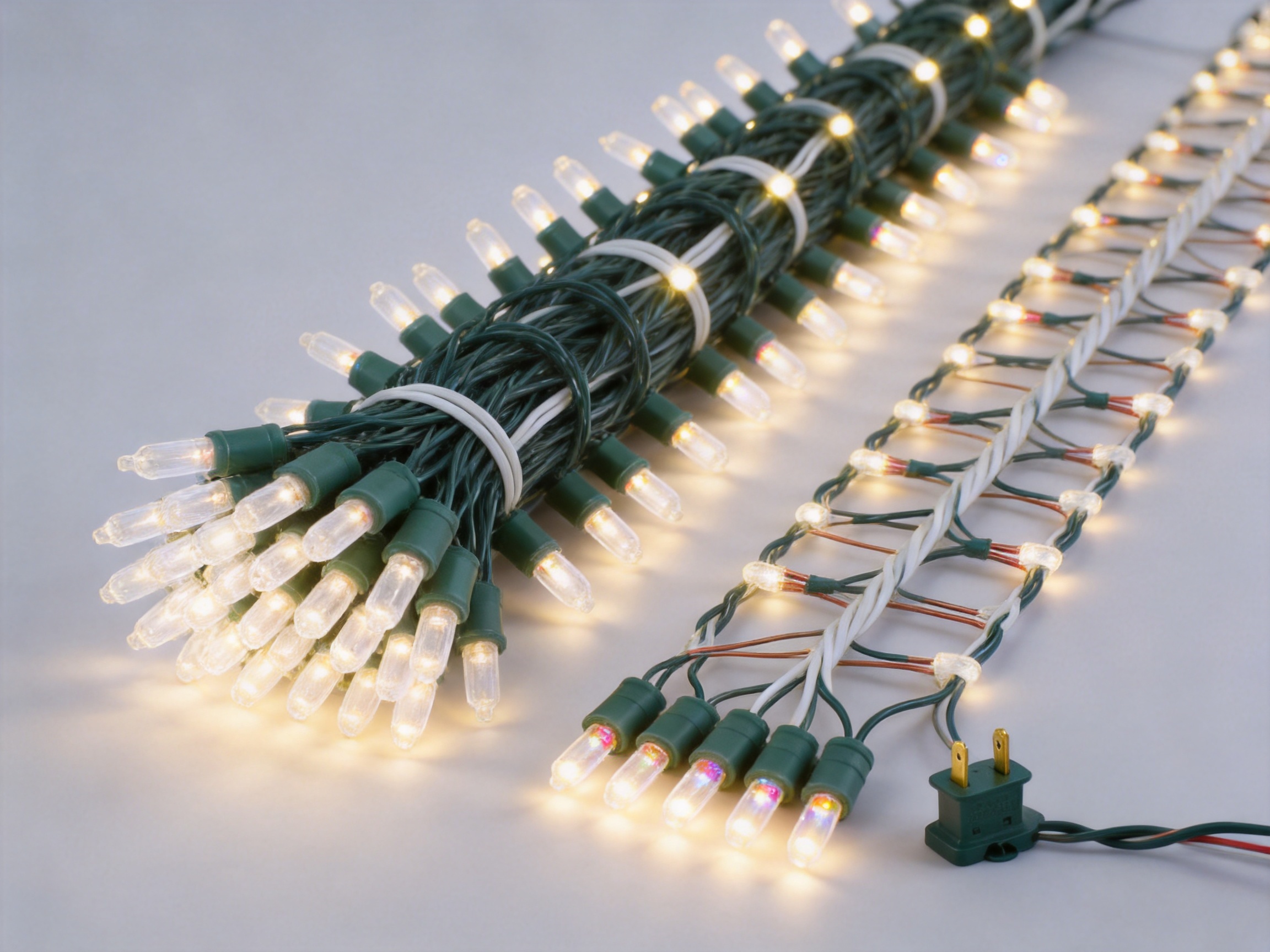
Construction Materials and Product Durability
The listed materials include PP, PVC, copper, LED, and PS. Each material contributes to a different part of the product’s construction. Copper is commonly used for electrical conductors because of its conductivity and flexibility. PVC can provide insulation and protective covering for wires, while PP and PS may be incorporated into housing, components, or structural parts of the light set.
This combination supports the requirements of a flexible decorative string. The cable must bend repeatedly during installation and storage, while the bulb assemblies must remain securely positioned along the wire. The materials also need to support production efficiency, visual consistency, and reliable electrical assembly.
Product durability depends not only on the selected materials but also on the quality of component preparation, wire processing, soldering or connection methods, insulation, bulb attachment, testing, packing, and handling. A manufacturer with control over multiple production stages can identify defects earlier and maintain closer coordination between component specifications and final assembly requirements.
For buyers, durability has a direct effect on the total cost of ownership. A light set that remains functional throughout a complete seasonal period can reduce replacement labor, display interruptions, and emergency purchasing. Wholesalers and retailers also benefit when product quality is consistent across large batches, because fewer returns and complaints can protect customer relationships.
Advantages Compared with Basic Decorative Light Strings
Many decorative light strings compete primarily on low purchase price. However, a low initial price does not always represent the best value for professional buyers. The 100 Mini-Style LED Light Set offers several practical advantages that can distinguish it from basic or less adaptable alternatives.
1. A useful medium-length format
Very short strings may not cover a complete display, while very long strings can be difficult to organize in small spaces. The approximate 27-foot length gives the 100-light model a practical middle position. It can cover a defined decorative feature without requiring the buyer to manage the excess cable associated with a much longer strand.
2. LED operation with a 7.2-watt rating
The product combines a visible 100-light arrangement with a relatively modest rated power of 7.2 watts. This can be advantageous for retailers, event planners, and property operators who need multiple illuminated zones while keeping electrical planning manageable.
3. Flexible placement
Unlike rigid lighting fixtures, the flexible cable can follow curved surfaces and irregular forms. This expands the number of possible applications and reduces the need for custom structural supports.
4. Multiple appearance options
Green or white wire, white light, multicolor options, and additional selectable colors enable buyers to adapt the product to different seasonal themes and customer preferences. A single product family can therefore support several sales programs.
5. Indoor and outdoor positioning
A product identified for both indoor and outdoor use can help distributors simplify their assortment. Instead of purchasing entirely separate strings for every environment, buyers may use one compatible platform for a wider range of projects, provided that installation conditions and safety requirements are respected.
6. Potential for series extension
Support for series extension can make the product more scalable. A user can begin with a small arrangement and add compatible sets for a larger display. This is particularly useful for commercial installations whose final size may vary between locations.
7. Documented certification and compliance references
The listed certification and compliance references include UL, NOM, CE, REACH, and BSCI. These references can provide important support during supplier evaluation, market entry planning, and procurement review. Buyers should confirm the exact certification scope, applicable model, market, voltage, and current documentation before placing an order.
Comparison with the 300-Light Configuration
The related MDSL300-IN model contains 300 LED lights and extends approximately 80 feet, with a rated power of 21.6 watts. It is intended for larger installations that require more continuous coverage. The 100-light model and the 300-light model share a similar material platform, color flexibility, indoor and outdoor positioning, and listed compliance references, but they serve different project scales.
| Evaluation factor | 100-light model | 300-light model |
| Best suited for | Small to medium decorative zones | Large trees, long outlines, and broad displays |
| Approximate length | 27 feet | 80 feet |
| Light density and coverage | Moderate coverage with 100 light points | Extended coverage with 300 light points |
| Rated power | 7.2 watts | 21.6 watts |
| Handling | Easier to install, remove, and store | More suitable for large continuous installations |
| Display planning | Useful for separate decorative zones | Useful for long or expansive areas |
| Order quantity reference | MOQ of 3,000 units | MOQ of 3,000 units |
The choice between the two models should be based on the physical dimensions of the display, desired brightness distribution, installation time, and electrical planning. The 100-light version may be more efficient for multiple small displays because each set can be assigned to a separate area. The 300-light version may be more convenient when a long, uninterrupted run is required.
For wholesalers, offering both formats can create a more complete product range. The shorter model can serve homes, small retailers, and localized decorations, while the longer model can meet the needs of shopping centers, event venues, and large commercial façades.
Manufacturing Experience and Integrated Production Strength
Taizhou Mingde Decorative Lighting Co., Ltd. reports an annual production capacity of 10 million strings of festive lights. This scale is significant for buyers who require stable supply, repeat orders, and consistent product specifications. Large production capacity can also support more predictable scheduling during the highly seasonal holiday lighting market.
The company was founded in 1968 and was formerly associated with Zhejiang Festival Lighting General Factory. Its long operating history indicates extensive experience in festive lighting products and export-oriented manufacturing. Over several decades, the company has developed product knowledge covering linear lights, icicle lights, net lights, circular lights, spiral trees, LED string lights, copper wire lights, and cord lights.
A broad product portfolio can strengthen manufacturing expertise because different lighting formats require different approaches to wiring, component arrangement, waterproofing, structural support, packaging, and quality inspection. Experience across these categories may help the company respond to varied customer specifications and project requirements.
The company describes its operation as an integrated and standardized lighting enterprise. Its production process covers component manufacturing through final assembly and shipment. This type of vertical coordination can offer several advantages:
Component consistency
When a manufacturer manages or closely coordinates component production, it can maintain better control over dimensions, material specifications, electrical compatibility, and appearance. Consistency at the component level helps reduce variation during final assembly.
Process coordination
Integrated production allows engineering, purchasing, assembly, inspection, and packaging teams to work from aligned specifications. If an issue appears during production, it may be easier to trace the problem to a particular material batch, machine setting, or process step.
Production scalability
A high-capacity production base is valuable for large-volume procurement. Buyers can plan seasonal purchasing programs with greater confidence when the supplier has dedicated equipment, trained personnel, and established production workflows.
Quality control from assembly to shipment
The company states that quality control extends from component manufacturing through final assembly and shipment. This broad coverage is important for light sets because final product performance depends on many linked stages, including conductor preparation, insulation, LED placement, electrical connections, mode functions, packaging, and shipping protection.
Quality Systems, Certification, and Export Readiness
The company reports that it was among the first domestic festive lighting companies to obtain U.S. UL certification and established an ISO 9001 quality system in 1997. These milestones indicate a long-term focus on formal quality management and international market requirements.
The product information lists UL, NOM, CE, REACH, and BSCI among its certificate or compliance references. These standards and programs address different aspects of product safety, market access, chemical compliance, or social responsibility. They should not be treated as interchangeable, and the exact documentation should be reviewed for the intended purchasing market.
For importers, certification review is a key part of supplier qualification. Buyers should request current certificates, test reports, technical files, product labels, packaging information, and applicable voltage details. They should also verify that the documentation applies specifically to the ordered model and configuration rather than to an unrelated product family.
The company’s established export presence in the United States, Central America, and South America may also be relevant to international buyers. Experience serving multiple markets can support better communication regarding packaging, labeling, shipping schedules, documentation, and regional requirements. Nevertheless, every importer remains responsible for confirming the regulations that apply in its own destination market.
Suitability for Wholesalers and Private-Label Buyers
The minimum order quantity for the listed models is 3,000 units. This quantity is generally oriented toward wholesalers, distributors, chain retailers, seasonal buying groups, and project-based procurement rather than individual consumers seeking a single set.
For wholesalers, the 100-light model provides an opportunity to stock a versatile product with several possible customer segments. It can be presented as a home holiday light, a retail display accessory, an event decoration product, or a general-purpose decorative light set. Color and wire options may allow distributors to create different stock-keeping units for different sales channels.
For private-label buyers, product customization discussions may include packaging, labeling, wire color, LED color, operating modes, plug configuration, carton design, and documentation. The available options should be confirmed with the manufacturer before production. A buyer should also establish sample approval procedures, inspection standards, carton quantities, lead times, and replacement policies.
Because seasonal lighting demand is often concentrated around a limited selling period, procurement timing is especially important. Buyers should account for product development, sample confirmation, production, inspection, shipping, customs clearance, warehouse receiving, and retail distribution. Early planning can reduce the risk of missed seasonal sales.

Manufacturing Process Considerations
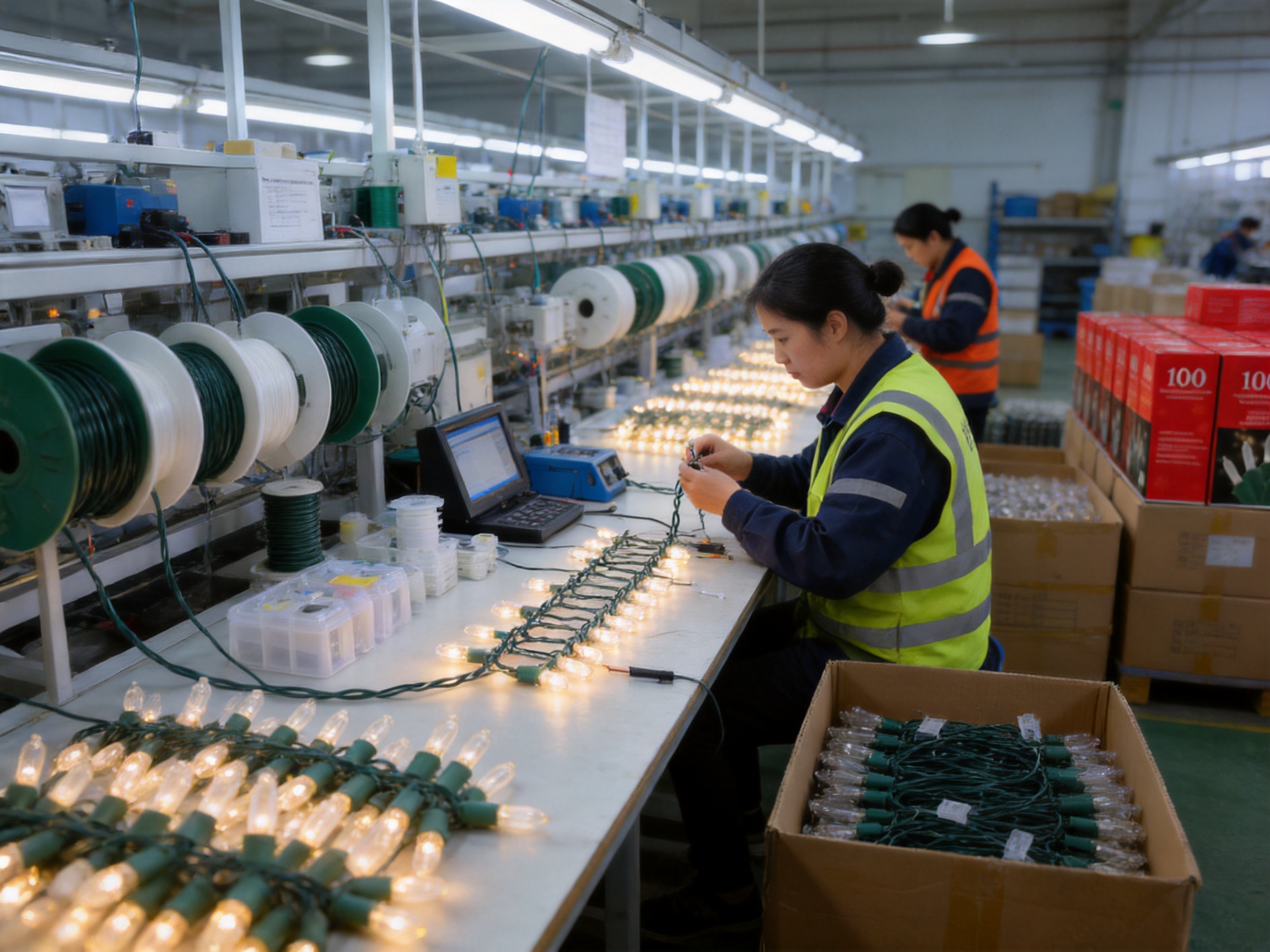
Although specific factory machine details are not provided, the stated integrated manufacturing structure supports a logical production sequence for this type of LED light set. A controlled process typically begins with incoming material inspection. Copper wire, PVC or other insulation materials, LED components, plastic parts, packaging materials, and electrical accessories must conform to approved specifications before entering production.
The next stage involves wire preparation. Conductors may be cut, arranged, stripped, tinned, or otherwise processed according to the design. Correct wire preparation is essential because inconsistent stripping or connection work can affect electrical continuity, insulation reliability, and final appearance.
LED assembly follows the electrical design and spacing requirements. The 100-light model requires consistent placement across the approximately 27-foot string so that the visual distribution remains uniform. Components must be connected with attention to polarity, electrical resistance, mechanical stability, and the intended operating mode.
Plastic components and protective parts are then integrated with the wire and LED assemblies. PP, PVC, and PS components must be fitted accurately to reduce looseness, visual defects, and exposure of electrical connections. Depending on the exact product design, additional processes may include sealing, forming, encapsulation, or protective finishing.
Electrical and functional testing is a critical stage. Finished strings may be checked for continuity, illumination, color consistency, mode performance, power consumption, and abnormal heating. Visual inspection can identify damaged bulbs, uneven spacing, incorrect wire colors, incomplete assembly, and cosmetic defects.
Final packing protects the product during storage and transportation. The packing process may include folding or winding the string in a way that reduces tangling, placing products into inner boxes, adding labels and instructions, and arranging cartons for export shipment. Proper packing is particularly important for seasonal products because inventory may remain in storage for months before sale.
An integrated manufacturer can coordinate these stages more closely than a trading structure that sources every component from unrelated suppliers. This does not eliminate the need for buyer inspection, but it can improve traceability and production communication.
How the Product Supports Professional Display Design
Professional decorators often need lighting that can be adjusted during installation. Architectural surfaces are rarely identical, and the final design may change after the installer sees the location in person. A flexible string format allows the installer to respond to tree density, branch shape, window dimensions, railing length, and merchandise arrangement.
The 100-light configuration can be used as a design module. Several modules may be allocated to different zones, such as a storefront entrance, two windows, a central tree, and a counter display. This modular approach can simplify budgeting because the number of required sets can be estimated by area or feature rather than by one oversized continuous product.
For visual merchandising, light placement can guide attention. A string placed around the perimeter of a display can frame the merchandise. A string arranged behind translucent materials can create a glowing background. A string wrapped around a decorative branch can add depth and make a display more dimensional. These applications allow the product to support design goals without requiring complex lighting infrastructure.
In hospitality settings, a steady white or warm-looking color may support an elegant atmosphere, while multicolor options can create a festive mood during holidays or special events. Since the manufacturer offers multiple color selections, buyers can align the lighting with interior themes, corporate colors, seasonal campaigns, or regional preferences.
Installation and Safety Guidance
Before installation, users should inspect the complete light set, cable, plug, controller, and visible connections for damage. Damaged products should not be connected to power. The installation surface should be stable, and the string should be positioned so that it is not exposed to sharp edges, excessive pulling, crushing, or repeated movement.
When the product is used outdoors, power connections should be protected from water and installed in accordance with local electrical requirements. Outdoor placement should consider rain, snow, standing water, wind, temperature, and the condition of the supporting structure. The product should not be submerged unless the specific model documentation expressly permits such use.
Users should avoid connecting more sets than the approved series-extension limit. The total electrical load must remain within the capacity of the power source, connectors, cables, and protection devices. Extension cords and adapters should be suitable for the environment and intended load.
During installation on trees or railings, the string should be secured without excessive tension. Clips or supports should be compatible with the cable and should not pierce or crush the insulation. The light set should be disconnected before repositioning, cleaning, or removing it.
For commercial installations, a written layout plan can improve safety and efficiency. The plan should identify power points, cable routes, connection locations, access paths, weather protection, and removal procedures. Trained personnel should handle large or elevated installations.
Purchasing and Quality Evaluation Checklist
Before placing a bulk order, buyers should confirm the product configuration in writing. Important details include the model number, light count, total length, rated power, wire color, LED color, flashing or steady modes, plug and voltage specification, extension capability, packaging, labels, and applicable certificates.
Samples should be evaluated under realistic conditions. A buyer can inspect the spacing of the LEDs, flexibility of the cable, appearance of the plastic components, brightness consistency, color uniformity, connection quality, packaging durability, and ease of installation. If the product is intended for outdoor use, the buyer should request the relevant technical information and test documentation.
Bulk production should be compared with the approved sample. Buyers may establish acceptable quality limits for missing lights, incorrect colors, damaged insulation, loose components, packaging errors, and functional failures. A pre-shipment inspection can help identify problems before the goods leave the factory.
Storage requirements should also be discussed. Decorative light sets are often purchased in advance of the selling season, so cartons should be stored in a clean, dry area away from excessive heat, moisture, crushing, and direct exposure to sunlight. Proper inventory rotation can help ensure that older stock is sold or distributed before newer stock.
Environmental and Commercial Considerations
LED lighting can support energy-conscious decoration because it provides decorative illumination with a relatively low rated power. The 100-light model’s 7.2-watt rating is useful for buyers who are planning numerous lighted displays and wish to estimate energy demand before installation.
The product information includes REACH among its compliance references. This is relevant to buyers concerned with chemical substance requirements in applicable markets. As with all regulatory information, the precise scope and validity of the documentation should be verified for the ordered model and destination.
Longer product service can also reduce the frequency of replacement and the material consumed by disposable seasonal decorations. Responsible use includes avoiding premature disposal, storing the product carefully between seasons, and following local rules for the handling or recycling of electrical products and packaging.
Commercial buyers may use sustainability information as part of their procurement evaluation. However, environmental claims should be based on verified documentation, product life-cycle information, packaging data, and the actual operating conditions of the installation.
Company Background and Industry Position
Taizhou Mingde Decorative Lighting Co., Ltd. identifies itself as one of China’s major export bases for festive lighting. Its history began in 1968, and its product range has expanded across several categories, including linear lights, icicle lights, net lights, circular lights, spiral trees, LED string lights, copper wire lights, and cord lights.
This category breadth is relevant to buyers seeking a coordinated lighting program. A distributor may need several product types for the same holiday campaign, while a commercial decorator may require different formats for trees, façades, windows, pathways, and interior displays. A supplier with multiple product families can potentially simplify sourcing and communication.
The company’s stated mission is to provide nature-friendly home ambient lighting and build a reputable enterprise. Its stated vision is to create a long-lasting brand that brings warmth to households. These statements align with the practical role of decorative lighting: the product is not intended only to illuminate a space, but also to influence mood, visual identity, and seasonal experience.
Advanced manufacturing strength in this category depends on more than production volume. It requires consistent access to components, reliable assembly processes, trained production teams, testing capability, quality records, export documentation, and the ability to manage seasonal demand. The company’s reported capacity, quality-system history, product diversity, and integrated operation provide a foundation for serving these needs.
Recommended Buyer Profiles
The 100 Mini-Style LED Light Set is particularly suitable for several buyer groups.
Importers and wholesalers
Importers can use the product as a general-purpose SKU for holiday and decorative lighting programs. Its medium length and multiple appearance options make it suitable for different retail channels.
Retail chains
Retail chains may use the light set for both resale and in-store decoration. Green and white wire options can support different packaging designs and seasonal themes.
Event and wedding suppliers
Event suppliers can use the product for temporary installations where flexibility, light weight, and quick placement are important. White or multicolor versions can be matched to different event concepts.
Hospitality businesses
Hotels, restaurants, cafés, and entertainment venues can use the set to refresh entrances, dining areas, reception counters, patios, and seasonal displays.
Professional decorators
Decorators can combine multiple 100-light sets to create modular arrangements across trees, windows, railings, and display structures. The product can complement larger lighting formats when a project requires detailed accent illumination.
Q&A
What is the main purpose of the 100 Mini-Style LED Light Set?
It is designed for decorative lighting in residential, commercial, retail, hospitality, event, and selected outdoor applications. It provides medium-scale illumination through 100 evenly distributed LED bulbs.
How long is the light set?
The listed total length is approximately 27 feet. The actual usable coverage may depend on the installation pattern, spacing around objects, lead-wire arrangement, and the amount of cable used for connections.
How much power does the 100-light model use?
The product information lists a rated power of 7.2 watts. Buyers should confirm the complete electrical specification, including voltage, plug type, controller details, and applicable regional configuration before ordering.
Can the light set be used outdoors?
The product is identified for indoor and outdoor use. Outdoor installation must follow the product instructions and local electrical safety requirements. Connections should be protected from water, and the product should not be submerged unless the specific documentation allows it.
What wire colors are available?
The listed options include green wire and white wire. Green wire can blend with trees and greenery, while white wire may be more suitable for light-colored interiors, winter displays, and white artificial trees.
Are different LED colors available?
Yes. The listed color choices include white and multicolor LEDs, with additional colors available for selection. Exact color combinations and minimum quantities should be confirmed with the manufacturer.
Does the product offer flashing modes?
The product information indicates that multiple flashing modes are available. Buyers should confirm the exact mode options, controller type, and whether the selected configuration operates in steady, flashing, or changing patterns.
Can several light sets be connected together?
The product information describes support for series extension. The permitted number of connected sets and the correct connection method must be confirmed in the official product instructions and technical documentation.
How does the 100-light model compare with the 300-light model?
The 100-light model is approximately 27 feet long and rated at 7.2 watts, making it suitable for smaller or modular decorative areas. The 300-light model is approximately 80 feet long and rated at 21.6 watts, making it better suited to large trees, long outlines, and expansive displays.
What materials are used?
The listed materials are PP, PVC, copper, LED, and PS. These materials support the cable, insulation, light-emitting components, and plastic structural parts of the light set.
What is the minimum order quantity?
The listed minimum order quantity is 3,000 units for both the 100-light and 300-light models.
Which certifications or compliance references are listed?
The product information lists UL, NOM, CE, REACH, and BSCI. Buyers should request current documentation and verify that it applies to the exact model, configuration, destination market, and intended use.
What type of buyer is best suited to this product?
The product is most suitable for wholesalers, importers, retailers, chain stores, professional decorators, event suppliers, hospitality businesses, and other organizations purchasing decorative lighting in commercial quantities.
What should buyers confirm before ordering?
Buyers should confirm model number, light count, length, wattage, voltage, plug, wire color, LED color, operating modes, extension limits, packaging, labeling, certification documents, production schedule, inspection requirements, and shipping terms.
Conclusion
The 100 Mini-Style LED Light Set offers a practical combination of medium-length coverage, 100 LED light points, flexible installation, multiple color choices, indoor and outdoor positioning, and a 7.2-watt power rating. It is well suited to buyers who need more visual presence than a small accent string but do not require the extensive coverage of an 80-foot, 300-light configuration.
Its advantages over basic decorative strings include a manageable 27-foot format, flexible cable placement, selectable wire and LED colors, potential series extension, LED efficiency, and a product platform supported by listed certification and compliance references. These features make it adaptable to homes, retail displays, hospitality environments, events, and seasonal commercial projects.
The manufacturing background of Taizhou Mingde Decorative Lighting Co., Ltd. further strengthens the product’s commercial appeal. The company reports decades of industry experience, an annual capacity of 10 million festive light strings, an ISO 9001 quality system established in 1997, experience with international certification, and integrated control from component manufacturing through final assembly and shipment.
For bulk buyers, the best purchasing decision will combine product selection with careful technical verification. Confirming the exact electrical configuration, certification scope, outdoor-use requirements, extension limits, packaging, and inspection criteria can help ensure that the product performs as expected in the destination market. With appropriate planning and installation, the 100 Mini-Style LED Light Set can serve as a dependable and flexible foundation for attractive decorative lighting programs.
References
1. Product specification information for the 100 Mini-Style LED Light Set, model MDSL100-IN.
2. Product specification information for the LED 300CT Incandescent-Style Light Set, model MDSL300-IN.
3. Manufacturer-provided company profile and production capability information for Taizhou Mingde Decorative Lighting Co., Ltd.
4. Manufacturer-provided information concerning UL, NOM, CE, REACH, BSCI, and ISO 9001 quality-system experience.
5. General principles of LED decorative-lighting installation, electrical loading, outdoor use, and product inspection.
Product: 100 Mini-Style LED Light Set

Don't Miss New Releases & Subscriber Exclusives
Sign up for our newsletter to stay in the holidy spirit all year.
Further Questions? Contact Us
-
Useful Links
Home Products About Us Production Services News Contact Us -
Classification
Mini String Light LED Light Set Garland Light Light-up Spiral Trees LED Curtain Lights Battery Light LED Copper Wire Light Decorative Light -
Contact Info
zd@zflgf.com.cn+86-576-82467401
+86-13968612122 ( Ms. Zhang )
+86-13505747679 ( Mr. Tan )
+86-15062835074 ( Mr. Cheng )No.270 Zhenxi Road, Xinqiao Town, Luqiao District, Taizhou City, Zhejiang Province, China -


Holiday Lights Supplier