

 中文简体
中文简体
28ft Candy Cane Ground Stake Light Set with 50 LEDs: A Practical Guide to Commercial-Grade Holiday Landscaping
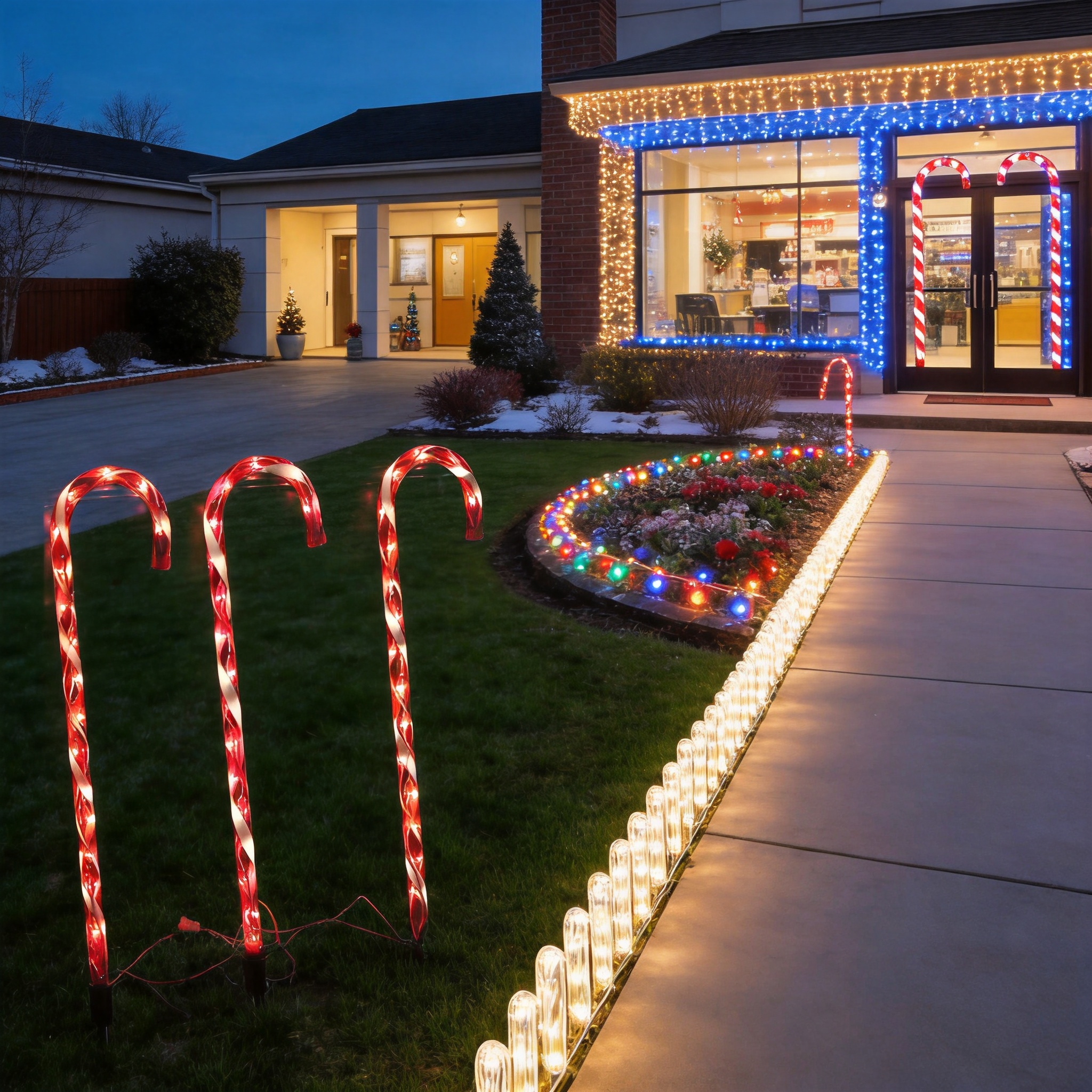
Outdoor holiday lighting can transform an ordinary lawn, garden, walkway, patio, or commercial frontage into a welcoming seasonal display. Among the many available formats, candy cane ground stake lights offer a particularly effective combination of visual recognition, simple installation, and organized decoration. Their familiar shape immediately communicates a festive theme, while their stake-based design allows them to be installed directly into soil, lawns, flower beds, and landscaped areas.
The 28ft Candy Cane Ground Stake Light Set with 50 LEDs is designed for buyers who need more than a small decorative string. It combines multiple candy cane forms, energy-efficient LED technology, outdoor placement capability, and a long arrangement length suitable for residential and commercial displays. Its appearance is suitable for holiday landscapes, entrance paths, garden borders, retail properties, hospitality venues, community areas, and seasonal public decorations.
This article examines the product’s structure, specifications, application advantages, installation considerations, purchasing value, and quality characteristics. It also explains how the manufacturing capabilities of Taizhou Mingde Decorative Lighting Co., Ltd. support consistent production, export readiness, and broad customization potential for buyers seeking reliable seasonal lighting in volume.
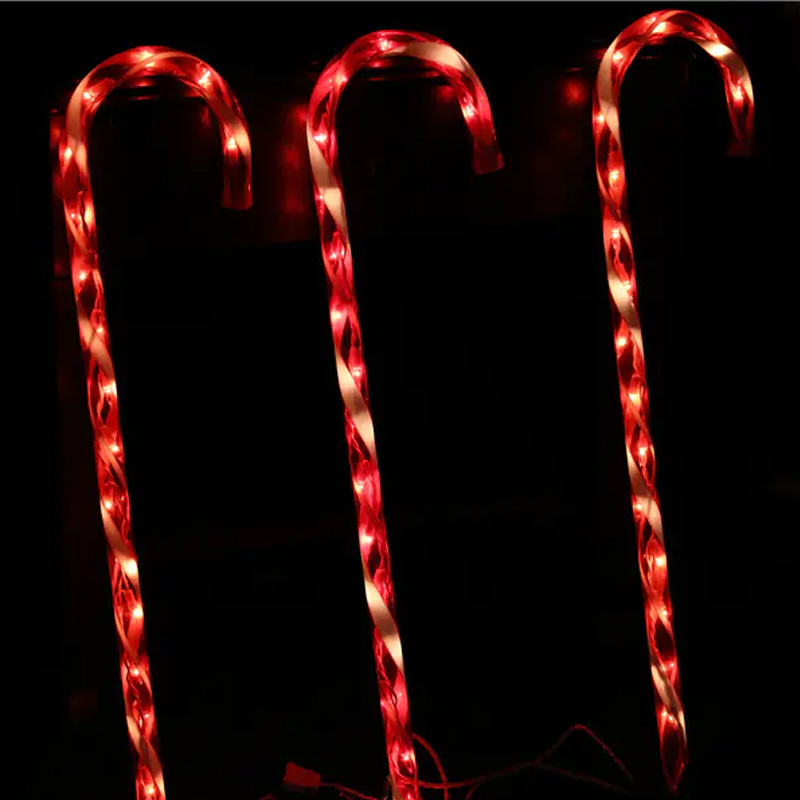
28ft Candy Cane Ground Stake Light Set W/50l
1. Product Overview
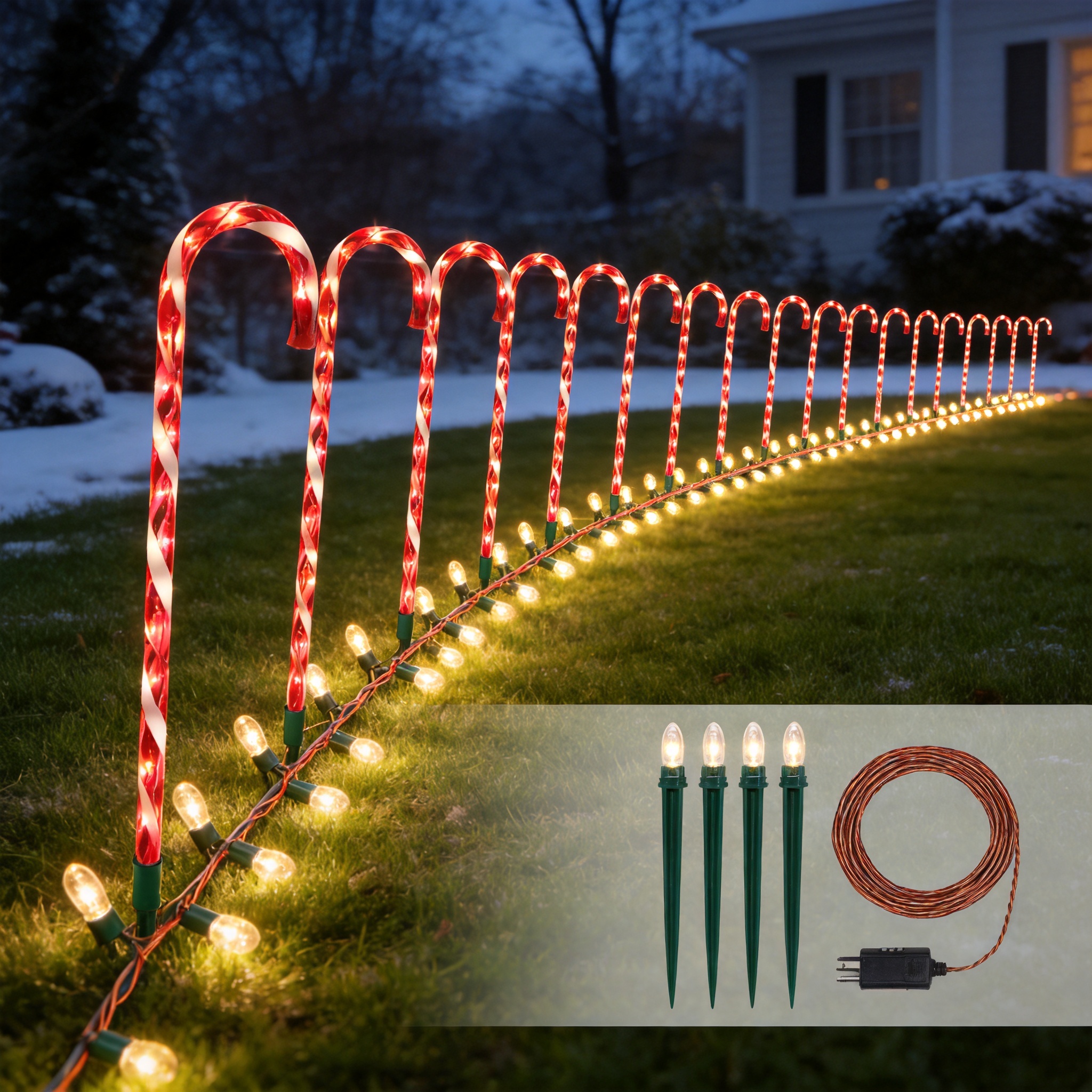
The 28ft Candy Cane Ground Stake Light Set with 50 LEDs is a decorative outdoor lighting product built around a classic candy cane silhouette. Rather than using a loose string that must be wrapped around trees or attached to railings, the set is designed as a ground decoration. Each candy cane form can be positioned along a path, planted in a lawn, or arranged in a flower bed to create a clear and orderly visual pattern.
The product belongs to the garland light category, although its physical appearance is different from a conventional flexible garland. It functions as a linked landscape lighting set in which repeated illuminated shapes create a continuous festive arrangement. This makes it useful for buyers who want the visual impact of a lighting line without relying on complicated mounting hardware.
The product information identifies the model as MDG050-CA. It uses PP, PVC, and copper as its principal materials. The wire may be supplied in green or white, while the bulbs are available in clear, multicolor, or blue configurations. The stated electrical power is 20.4W, and the product is intended for indoor and outdoor use. Certification information includes UL, NOM, CE, REACH, and BSCI-related compliance credentials.
The product name identifies a 28-foot set with 50 lights. The supplied specification table also lists a total length of five feet. Because these two measurements may refer to different portions of the construction, buyers should confirm whether the five-foot figure represents an individual section, a lit decorative portion, a spacing dimension, or a packaging configuration before placing a large order. This confirmation is especially important when preparing a precise landscape plan. The principal product concept remains a long, 50-LED candy cane ground decoration intended for repeated outdoor placement.
Core Product Specifications
| Specification | Product Information |
|---|---|
| Model | MDG050-CA |
| Product name | 28ft Candy Cane Ground Stake Light Set with 50 LEDs |
| Category | Garland Light |
| Main materials | PP, PVC, and copper |
| Wire color options | Green or white |
| Bulb color options | Clear, multicolor, or blue |
| Advertised arrangement length | 28 feet |
| Additional listed length | 5 feet, subject to configuration confirmation |
| Light quantity | 50 LEDs |
| Power | 20.4W |
| Usage | Indoor and outdoor applications |
| Minimum order quantity | 2,000 units |
| Certifications and compliance references | UL, NOM, CE, REACH, and BSCI |
2. Why Candy Cane Ground Stake Lights Are Effective
Holiday lighting succeeds when it is visually understandable, easy to install, and appropriate for the surrounding environment. Candy cane ground stake lights perform well in all three areas. Their shape is instantly recognizable, their placement method is straightforward, and their repeated forms create rhythm across a large space.
Immediate Seasonal Recognition
A candy cane is one of the most familiar symbols associated with Christmas and winter celebrations. A display does not require extensive signage or additional ornaments to communicate its theme. Even when viewed from a distance, the repeated curved shapes provide a clear seasonal message.
This visual recognition is valuable for businesses, shopping centers, hotels, restaurants, public venues, and community organizations. A recognizable decorative form can attract attention more effectively than an unstructured line of bulbs. It can also help establish a coordinated identity across multiple properties or display zones.
Organized Ground-Level Decoration
Ground stake lights create a controlled arrangement close to eye level for pedestrians and above the surface of lawns and planting areas. By placing the candy cane forms at regular intervals, users can create a clean border along paths, entrances, driveways, or garden edges.
Compared with loose string lights, stake-mounted designs are less dependent on nearby trees, fences, walls, or railings. This is especially useful in open landscapes where there are few convenient attachment points. The product can be used to define the edge of a lawn, outline a walkway, or create a visual corridor leading toward a building entrance.
Suitable for Large-Scale Layouts
The supplied product information describes long spacing and an arrangement length of 28 feet. This makes the set more appropriate for extensive decoration than a short indoor light string. Several sets can be installed in parallel lines, around a perimeter, or along separate sections of a property.
Commercial buyers can use repeated sets to decorate multiple entrances or create a consistent look across a large site. Residential users can combine the set with wreaths, tree lights, window lights, and roofline decorations. The product is therefore suitable for both focused displays and broader holiday lighting plans.
3. Advantages Over Conventional Holiday Light Strings
Many holiday light products provide illumination, but not all products offer the same installation efficiency or visual structure. The candy cane ground stake format has several advantages compared with ordinary loose string lights, net lights, and individually placed lawn ornaments.
Advantage One: Faster Placement
A conventional string light may need to be clipped, tied, wrapped, or supported at multiple points. Installation can become time-consuming when the target area has no existing structures. Ground stake lights simplify the process by allowing each decorative form to be inserted into soil or another suitable ground surface.
For seasonal commercial installations, faster placement can reduce labor hours. Maintenance teams can create a planned row without constructing a separate support system. At the end of the season, the set can be removed and stored for future use, provided it is cleaned and packed properly.
Advantage Two: Stronger Visual Definition
Loose bulbs often produce a general glow but may not communicate a specific design. The candy cane shape creates a stronger visual identity. When multiple units are arranged at regular intervals, the display appears intentional rather than improvised.
This is useful in locations where decoration must be visible from a road, parking area, sidewalk, or building entrance. Clear shapes are easier to recognize in low-light conditions than small points of light distributed without a pattern.
Advantage Three: Reduced Dependence on Trees and Structures
Tree-mounted and roofline lighting can be attractive, but those methods require ladders, hooks, clips, or other installation accessories. They may also be impractical for properties with limited trees or restrictions on attaching fixtures to buildings.
A ground stake system can be installed in open areas without modifying the building envelope. This expands the number of locations that can receive holiday lighting, including grass strips, garden beds, landscaped medians, and temporary event zones.
Advantage Four: Energy-Efficient LED Performance
The set uses 50 LED light sources and has a stated power rating of 20.4W. LED technology is generally valued for its lower energy consumption, long service life, rapid illumination, and strong brightness compared with traditional incandescent lamps. These characteristics are particularly important when lights are operated for several hours each evening over an extended holiday season.
Lower operating power can help reduce electricity use across a multi-set installation. It can also make the product more suitable for commercial sites that need to control seasonal operating costs. LED illumination is additionally beneficial where users want bright, visible decoration without installing a high-wattage lighting system.
Advantage Five: Flexible Color Selection
The product is listed with clear, multicolor, or blue bulb options. Clear bulbs provide a traditional and versatile appearance. Multicolor bulbs create a more playful and family-oriented atmosphere, while blue bulbs can support cool-toned winter themes or coordinated commercial color schemes.
The green or white wire options also allow buyers to select a visual finish that works with the installation environment. Green wire can blend into lawns, shrubs, and garden beds. White wire may be preferred for snow-themed displays, light-colored surfaces, indoor applications, or designs where the cable is intended to remain visible.
4. Materials and Construction
The product uses polypropylene, polyvinyl chloride, and copper. Each material serves a different functional purpose in the overall structure.
Polypropylene Components
Polypropylene, commonly abbreviated as PP, is a lightweight thermoplastic often used in decorative housings, structural parts, and outdoor consumer products. In this application, PP can support the candy cane form and stake-related components while keeping the product relatively easy to handle during installation and removal.
Its low weight is beneficial for shipping, storage, and seasonal deployment. A lighter product can be moved by one person in many residential or commercial settings. It also reduces the burden on packaging and transportation systems when buyers order in volume.
PVC Insulation and Protective Elements
PVC is commonly used for cable insulation and flexible protective components. For an outdoor decorative light, cable protection is important because wiring may be exposed to cool temperatures, humidity, handling, and contact with soil or landscaping materials.
Properly applied insulation helps separate conductive elements from the surrounding environment. Buyers should still follow installation instructions and avoid placing connectors in standing water. Outdoor lighting should be used with appropriate power protection, and all connections should be inspected before energizing the display.
Copper Conductors
Copper is used for electrical conduction because it offers strong conductivity and is widely established in lighting and electrical products. Reliable conductor quality supports stable current delivery to the LED units and helps reduce unnecessary electrical resistance.
In a multi-light decorative set, conductor consistency is important because irregular connections can affect brightness, reliability, and service life. A professional production process should therefore include checks on wire preparation, soldering or terminal connection, insulation, polarity, and final illumination.
5. Outdoor Application Benefits
The product information identifies the set as suitable for indoor and outdoor use. Its ground stake format makes outdoor landscaping the primary application, although some components may also be used in indoor seasonal displays where a ground-based arrangement is desired.
Lawns and Flower Beds
Lawns and flower beds are natural locations for candy cane ground stake lights. The stakes can be arranged in a straight line, a gentle curve, or a geometric pattern. In flower beds, the light set can create a glowing border without covering the plants or obstructing the central planting area.
Installation should be performed when the soil is workable. Users should avoid forcing the stake into frozen, rocky, or compacted ground because excessive pressure can damage the stake, housing, or internal connection. Preparing the soil first can make installation easier and help preserve the product.
Walkways and Driveways
Placed along both sides of a walkway, the lights can create a welcoming route toward a front door, event entrance, store, or reception area. Along driveways, they can help define the edge of a display while adding a festive appearance.
Careful placement is important in pedestrian and vehicle areas. The lights should not obstruct walking paths, interfere with snow removal, or create a hazard for vehicles. The distance from the pavement, road edge, and turning area should be determined before installation.
Commercial Landscaping
Retail stores, shopping centers, hotels, restaurants, office buildings, amusement venues, and public facilities can use the sets to create consistent seasonal branding. A row of matching candy cane forms can decorate an entrance plaza, parking approach, outdoor dining zone, or landscape perimeter.
The product is especially useful for companies that need a repeatable decorative element across several sites. Uniform models, colors, spacing, and installation methods make it easier to establish a recognizable seasonal appearance while simplifying purchasing and replacement planning.
Temporary Events and Seasonal Displays
Because the lights are designed for seasonal placement, they can support winter markets, holiday fairs, community celebrations, school events, religious gatherings, and temporary commercial promotions. Their recognizable shape can contribute to a themed environment without requiring permanent construction.
Event organizers should plan power distribution, cable routing, pedestrian safety, weather exposure, and daily inspection schedules. Temporary displays often experience frequent handling, so careful setup and removal are essential for preserving product life.
6. Manufacturing Strengths Behind the Product
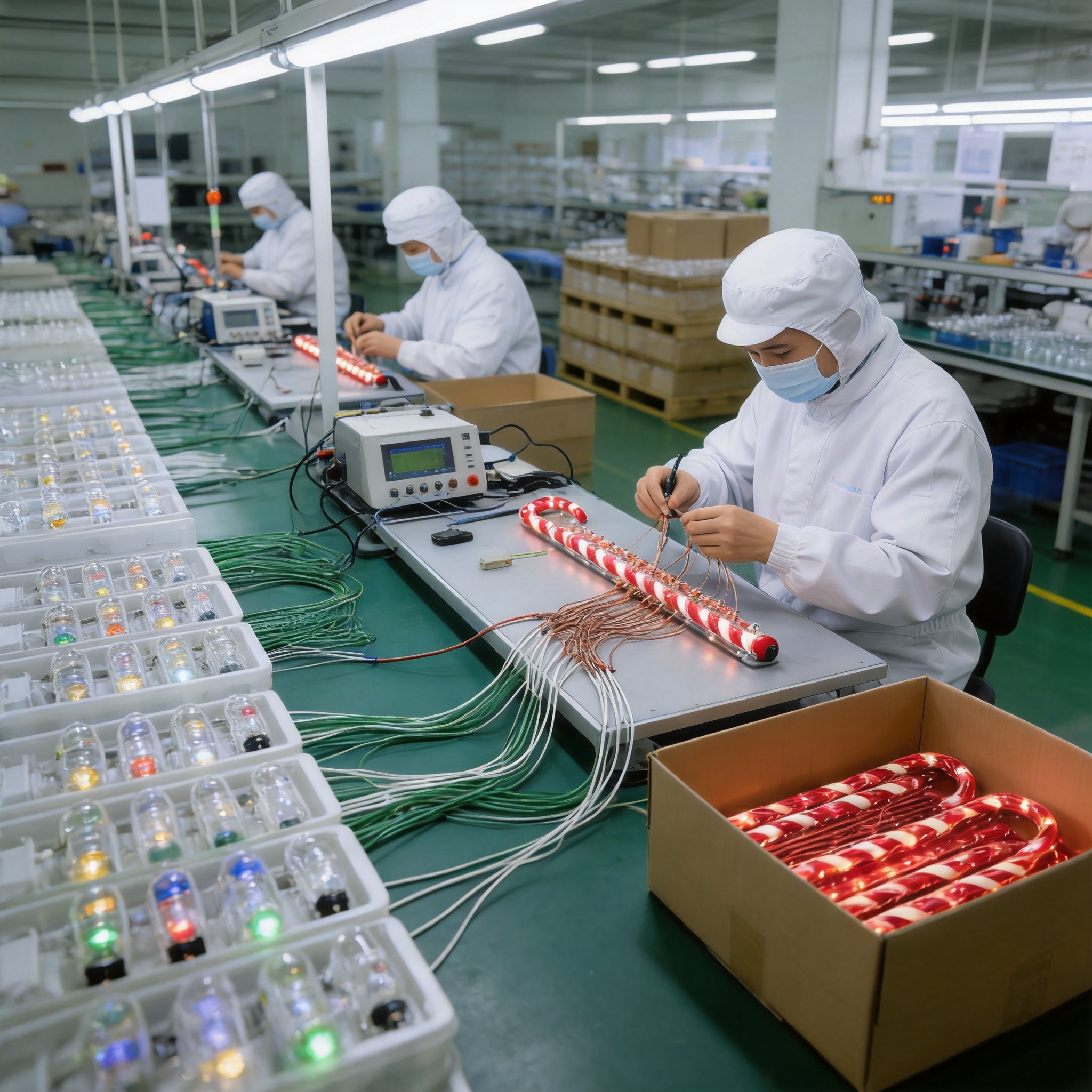
The performance of a decorative light depends not only on its visible design but also on the manufacturing system used to produce it. Taizhou Mingde Decorative Lighting Co., Ltd. reports an annual production capacity of 10 million strings of festive lights. This scale indicates the ability to support substantial seasonal demand and repeat purchasing programs.
The company was established in 1968 and has long-term experience in the Christmas lighting industry. It was formerly connected with Zhejiang Festival Lighting General Factory and became one of the early domestic companies in the sector to obtain United States UL certification. The company also established an ISO 9001 quality system in 1997.
Integrated Production Capability
The company describes itself as an integrated and standardized lighting enterprise. Its manufacturing scope covers component production, assembly, quality control, and shipment preparation. An integrated approach can reduce dependence on disconnected suppliers and improve communication between design, production, inspection, and logistics teams.
For buyers, this is valuable because decorative lighting requires coordination between several details. The shape of the housing must match the wire route. The bulb arrangement must match the electrical design. The stake must support the unit without damaging the cable. Packaging must protect the product while keeping the set easy to unpack and install.
Broad Product Experience
The company’s product range includes linear lights, icicle lights, net lights, circular lights, spiral trees, LED string lights, copper wire lights, and cord lights. This breadth suggests experience with multiple lighting formats, materials, electrical structures, and decorative applications.
Experience across several product categories can strengthen the development of a specialized item such as the candy cane ground stake set. Lessons from string lights can support cable reliability. Experience with spiral trees and outdoor structures can contribute to frame stability. Knowledge of copper wire products can support compact electrical arrangements.
Quality Control from Components to Shipment
The company states that quality control covers component manufacturing through final assembly and shipment. This full-process approach is important because defects can arise at any stage. A visually attractive finished product may still fail if the wire insulation is inconsistent, the connection is weak, the bulb is improperly seated, or the packaging allows damage during transportation.
Effective quality control may include incoming material checks, dimensional inspection, electrical testing, light-up testing, waterproofing-related checks where applicable, visual inspection, aging tests, and final packaging review. Buyers should request the specific inspection procedures and test records relevant to their order, especially when the product will be installed outdoors or sold through regulated markets.
7. Certification and Market Readiness
The listed certifications and compliance references include UL, NOM, CE, REACH, and BSCI. These designations address different aspects of product acceptance, market access, chemical compliance, safety expectations, and social responsibility. The exact scope of each certificate should be confirmed according to the target market, product configuration, voltage, plug type, and production batch.
UL Considerations
UL certification or recognition is particularly important for products intended for the United States and certain North American purchasing channels. Buyers should verify that the relevant certification applies to the complete product, including the light set, controller if included, power cord, plug, and any associated accessories.
CE and European Market Considerations
CE marking is associated with applicable European Union product requirements. For lighting products, documentation may involve electrical safety, electromagnetic compatibility, material restrictions, and other applicable directives or regulations. Importers remain responsible for confirming that the product documentation matches the intended market and configuration.
REACH and Material Responsibility
REACH relates to chemical substance registration, evaluation, authorization, and restriction requirements in the European market. Because decorative lights contain plastics, cable insulation, metal conductors, soldered parts, and packaging materials, chemical compliance documentation can be important for responsible importers and distributors.
BSCI and Responsible Production
BSCI is associated with social compliance and responsible supply-chain practices. For commercial buyers, responsible manufacturing is increasingly part of supplier evaluation. Production capacity, product quality, labor practices, documentation, and environmental responsibility all influence the long-term value of a supplier relationship.
8. Installation Planning and Best Practices
Proper installation helps the light set achieve its intended appearance and can reduce preventable damage. Before installation, users should inspect the entire set, confirm that the cable and bulbs are intact, check connectors and plugs, and test the lights in a safe location.
Prepare the Layout First
Measure the intended installation area before placing the stakes. For a 28-foot arrangement, determine whether the set will run in a straight line, follow a curve, or form a border around a display. Mark the approximate positions of each candy cane so the spacing remains visually consistent.
Buyers working with several sets should draw a simple site plan. The plan can show the number of sets, electrical outlet locations, cable routes, entrances, paths, landscape obstacles, and areas requiring additional protection. Good planning reduces the need to reposition the product after installation.
Use Suitable Ground Conditions
Insert stakes into soft soil, prepared flower beds, or suitable lawn areas. Do not strike the decorative housing or apply force directly to the cable. If the ground is hard, loosen it with an appropriate garden tool before inserting the stake.
Do not install the set in locations that flood regularly or remain covered by standing water. Although the product is intended for outdoor use, outdoor-rated does not mean that every component can be submerged. Connectors and power supplies should be elevated or protected as required by the installation instructions.
Protect Cables and Connections
Route cables away from sharp edges, lawn equipment, snowplows, vehicle tires, and pedestrian traffic. Where a cable crosses a walkway, use an appropriate cable cover or select another route. Avoid burying connectors unless the product instructions specifically permit it.
Outdoor electrical connections should be connected to a suitable protected power source. Ground-fault protection may be required or strongly recommended depending on local electrical codes and the installation environment. Commercial installations should be handled by qualified personnel when the layout is extensive or involves permanent electrical infrastructure.
Inspect During Operation
Seasonal displays should be inspected periodically. Look for loose stakes, damaged insulation, broken housings, water accumulation, flickering lights, exposed conductors, and changes in brightness. Disconnect the set before handling damaged sections.
At the end of the season, clean away dirt and moisture, allow the product to dry completely, and store it in a cool, dry place. Avoid tightly bending the cable or placing heavy objects on the decorative forms. Proper storage can help preserve the appearance and reduce the likelihood of damage during the next installation cycle.
9. Color and Design Strategies
The available color combinations allow the product to serve different decorative goals. Clear bulbs are suitable for classic holiday themes and can be combined with warm white, gold, red, or green decorations. Multicolor bulbs are appropriate for family-oriented displays, public events, and locations where a lively appearance is preferred. Blue bulbs support cool winter themes and can coordinate with silver, white, or icy visual elements.
Classic Traditional Display
For a traditional appearance, use clear bulbs with green wire in lawn and garden environments. Combine the candy cane set with red bows, evergreen garlands, wreaths, and warm-colored facade lighting. The green wire can visually recede into landscaping during the daytime while the illuminated forms become prominent at night.
Snow and Winter Display
White wire and blue bulbs can create a cooler winter presentation. This combination is suitable for snow-themed storefronts, winter festivals, hotel entrances, and modern residential designs. White decorative elements, silver ornaments, and cool white building lights can reinforce the theme.
Family and Community Display
Multicolor bulbs can add energy to community spaces, school grounds, amusement venues, and family attractions. They can be combined with colorful ornaments, illuminated gift boxes, character figures, and other playful decorations. The candy cane shape remains recognizable while the colors make the display more engaging for children and families.
10. Commercial Purchasing Value
The listed minimum order quantity is 2,000 units, which places the product primarily in the wholesale, project, retail, and commercial procurement category. A high minimum order can be advantageous for buyers who need consistent products across a broad distribution network or multiple installation locations.
Bulk purchasing can simplify product management by reducing the number of models and spare-part types used in a seasonal program. A distributor can select one or more color configurations and develop packaging, catalog, and marketing materials around a stable product specification.
Benefits for Importers and Distributors
Importers can use the product as a recognizable seasonal item in garden centers, home-improvement stores, holiday shops, online marketplaces, and commercial decoration channels. Its shape makes it relatively easy to demonstrate in product photography and in-store displays.
Because the product is available in multiple bulb colors and wire colors, distributors may be able to serve different customer segments without introducing a completely different product platform. Before ordering, distributors should confirm carton dimensions, unit weight, packaging method, plug configuration, voltage, replacement policy, and testing documentation.
Benefits for Landscape Contractors
Landscape contractors and holiday installation companies can use candy cane stake lights as a repeatable design component. The product can be offered as part of entrance packages, pathway packages, retail frontage packages, or full-property seasonal lighting plans.
A repeatable product makes labor estimation easier. Contractors can calculate the approximate number of units needed for a given path, order replacement stock, and train installation crews on a consistent placement method. The 50-LED configuration and advertised 28-foot arrangement can also support project-based planning, subject to confirmation of the exact layout measurements.
Benefits for Retail and Hospitality Properties
Retail and hospitality businesses often need decoration that is highly visible but not excessively complicated to install. Candy cane lights can make entrances and outdoor customer areas more inviting. A coordinated display may encourage holiday shopping, improve the appearance of a hotel or restaurant, and create a more memorable arrival experience.
For businesses operating several branches, standardized seasonal decorations can create a consistent visual identity. The same light configuration can be installed at each location, while different bulb colors can be selected for different property styles or marketing campaigns.
11. Comparing the Product with Alternative Formats
| Lighting Format | Primary Strength | Typical Limitation | Why Choose the Candy Cane Stake Set |
|---|---|---|---|
| Loose string lights | Flexible wrapping and broad use | May require clips, trees, railings, or structures | Provides a defined ground-based shape and simpler placement |
| Net lights | Fast coverage of shrubs and bushes | Limited to surfaces with suitable dimensions | Creates repeated recognizable forms rather than a flat grid |
| Icicle lights | Effective on rooflines and eaves | Often requires elevated installation | Works at ground level without ladders or roof attachments |
| Inflatable decorations | Large visual presence | Needs continuous air supply and anchoring | Uses compact illuminated forms with no inflation system |
| Individual lawn ornaments | Highly varied designs | Can require separate power and placement for each piece | Offers a coordinated multi-unit arrangement from one product set |
| Traditional incandescent lights | Familiar warm appearance | Higher operating power and more heat | Uses energy-efficient LED illumination with a stated 20.4W rating |
No single lighting format is ideal for every location. Loose strings remain useful for trees and architectural features, net lights are effective on shrubs, and icicle lights suit rooflines. The candy cane ground stake set is strongest where buyers want a recognizable, repeatable, low-level outdoor design that can be installed across open ground.
12. Manufacturing Process Considerations
Although the exact factory sequence for this model should be confirmed with the manufacturer, a professional decorative-lighting production process typically involves several coordinated stages. These stages help convert raw PP, PVC, copper, LED components, connectors, and packaging materials into a finished seasonal product.
Component Preparation
Plastic components are commonly formed through controlled molding processes. The candy cane body, base, stake, connectors, or protective covers must be produced with consistent dimensions. Uniform molding supports visual consistency and helps ensure that parts fit together properly during assembly.
Wire and copper conductors are cut, stripped, prepared, and routed according to the product design. At this stage, accurate length control is important because a cable that is too short may create assembly tension, while excessive loose cable can affect packaging and installation appearance.
Electrical Assembly
LEDs, conductors, sockets, terminals, and protective components are assembled according to the approved electrical design. Connections must be secure and insulated. Polarity, current flow, and spacing should be checked during production to reduce the possibility of non-illuminating sections or uneven brightness.
For a 50-LED set, the assembly line must maintain consistent spacing and reliable connection throughout the entire arrangement. A single weak connection can affect part of the set or create a future service issue. This is why process controls and final testing are essential.
Mechanical Assembly
The decorative forms and stakes are fitted to the wiring and housings. The structure should remain stable when placed into soil while also being light enough for practical handling. The cable must be routed in a way that avoids unnecessary bending and reduces stress at entry points.
Testing and Inspection
Finished products can be inspected for appearance, dimensions, light output, connection integrity, cable condition, and packaging accuracy. Electrical testing may include continuity checks, insulation checks, power verification, and a full light-up test.
Quality systems based on ISO 9001 principles encourage documented procedures, traceability, corrective actions, and continuous improvement. For large-volume buyers, these systems can provide greater confidence that production is repeatable rather than dependent only on individual worker judgment.
13. Supplier Capability and Export Experience
A decorative-lighting supplier serving international customers must manage more than production. Export packaging, documentation, market requirements, shipping schedules, product labeling, and communication all influence the success of an order.
Taizhou Mingde Decorative Lighting Co., Ltd. reports serving markets including the United States and Central and South America. This international orientation is relevant for importers because seasonal goods are highly time-sensitive. A shipment that arrives after the holiday selling season may lose much of its commercial value, even if the product itself meets quality expectations.
The company’s long operating history and high annual capacity can support repeat programs, though every buyer should still conduct normal supplier verification. A prudent procurement process may include sample approval, written specifications, pre-production confirmation, production inspection, carton inspection, and review of export documents.
Communication Before Purchase
Buyers should clarify the following points before confirming an order:
1. The exact meaning of the advertised 28-foot length and the separately listed five-foot measurement.
2. The number and shape of candy cane units included in each set.
3. The bulb color, wire color, voltage, frequency, plug type, and power supply configuration.
4. Whether the product includes controllers, connectors, extension leads, stakes, spare bulbs, or replacement parts.
5. The exact outdoor-use rating and any restrictions related to rain, snow, moisture, or standing water.
6. Packaging dimensions, carton quantity, gross weight, and pallet configuration.
7. The certification documents that apply to the exact ordered configuration.
8. Production lead time, inspection arrangements, shipping terms, and warranty provisions.
9. Private-label packaging, color combinations, or other customization options.
10. Recommended storage, installation, and maintenance procedures.
14. Sustainability and Operating Efficiency
Environmental responsibility in holiday lighting involves product energy use, service life, material selection, packaging, transportation, and end-of-life handling. LED technology supports operating efficiency because the stated product power is 20.4W for the 50-light set. When operated for a planned number of hours, the energy consumption can be estimated and compared with higher-wattage alternatives.
Reusable seasonal lighting can also reduce the need to purchase disposable decorations each year. A durable product that can be removed, stored, and reinstalled supports a longer service cycle. Proper handling is therefore part of sustainability: avoid unnecessary bending, protect the cable, store the set dry, and replace damaged components when possible rather than discarding an entire installation.
The use of PP and PVC should be considered as part of the buyer’s material-responsibility program. Importers may request material declarations, chemical compliance documentation, packaging information, and recycling guidance. REACH-related compliance references can be useful for buyers serving markets with strict chemical-substance requirements.
Transportation efficiency also matters. Lightweight plastic construction can help reduce handling demands, while appropriate carton design can protect the candy cane shapes during shipment. Buyers should balance compact packaging with sufficient protection against crushing, abrasion, and moisture.
15. Maintenance and Storage
Routine maintenance is simple but important. Before each use, examine the wire for cuts, exposed conductors, severe bending, or crushed areas. Check that the candy cane bodies, stakes, and bases are intact. Confirm that the plugs and connectors are dry and free from visible damage.
During operation, replace or isolate any unit that shows abnormal flickering, overheating, smoke, unusual odor, or exposed wiring. Do not attempt electrical repairs while the set is connected to power. Repairs should be performed only by qualified personnel using compatible components.
After removal, wipe away soil and surface dirt with a suitable dry or slightly damp cloth, then allow the product to dry completely. Do not pack wet lighting. Coil cables loosely rather than wrapping them tightly around the candy cane forms. Store the set in a rigid container or protective carton where it will not be crushed by heavier decorations.
Labels identifying the color configuration, installation zone, and number of sets can help commercial operators manage large inventories. A simple storage record can also identify damaged units that require inspection before the next holiday season.
16. Display Planning for Different Buyers
Residential Users
Homeowners can place the candy cane lights along a front walkway, around a garden, near a mailbox, or beside a driveway. A small number of sets can create a focused entrance display, while additional lighting can be added to trees, windows, porch railings, or rooflines.
Residential users should prioritize safe cable routing and avoid placing stakes where children or pets may trip over wires. The lights should be positioned far enough from snow-clearing equipment, lawnmowers, and vehicle paths to reduce accidental impact.
Retail Stores
Retailers can use the set around storefront windows, sign areas, entrance paths, and parking-lot landscaping. Clear bulbs may support premium or traditional merchandise, while multicolor bulbs can create a family-friendly atmosphere. Repetition across several entrances can help unify a large retail property.
Hotels and Restaurants
Hotels and restaurants can install candy cane lights near driveways, reception entrances, outdoor dining areas, and landscape features. The lights can strengthen the sense of arrival and support seasonal photographs or promotional events. Blue or clear bulbs may suit modern properties, while multicolor options may work well for family restaurants and entertainment venues.
Municipal and Community Projects
Municipal parks, community centers, schools, and public event organizers can use the sets for temporary holiday corridors or themed display zones. Because the candy cane form is familiar to visitors of different ages, it can contribute to a welcoming public environment without requiring extensive explanation.
17. How the Product Supports Competitive Differentiation
In a crowded holiday-lighting market, buyers need products that can be distinguished from generic strings. This product offers several features that support differentiation: a recognizable candy cane silhouette, a ground stake installation format, a 50-LED configuration, multiple color choices, outdoor landscaping suitability, and a long advertised arrangement.
These features give distributors several possible selling points. The product can be marketed as a pathway light, a lawn ornament, a commercial landscape decoration, or a coordinated holiday garland. Its applications are broad enough for different customer groups, but its shape is specific enough to stand out in a catalog or display.
Compared with unstructured lighting, the product offers stronger visual storytelling. Compared with large illuminated figures, it can be easier to place in repeated rows and may require less floor area per decorative element. Compared with roof-mounted products, it can be installed at ground level with fewer elevated-access requirements.
For professional buyers, the greatest competitive benefit may be repeatability. A reliable factory source can help maintain consistent shape, brightness, color, packaging, and documentation across multiple orders. Consistency is important to retailers and installation companies because customers expect replacement units to match the original display.
18. Recommended Evaluation Checklist
Before approving a sample or mass order, buyers should evaluate the product in conditions similar to the final application. Test the illumination in darkness and at a distance. Check whether the candy cane forms remain visually distinct when arranged according to the planned spacing.
Inspect the stake strength by placing the unit into suitable soil without excessive force. Examine the point where the stake connects with the decorative body. Check whether the cable remains flexible and whether connectors are protected from expected weather conditions.
Confirm the stated power rating using the correct electrical equipment and compare it with the documentation. Verify that the selected bulb colors are consistent across the set. Review carton packaging by inspecting sample cartons after handling or simulated transportation.
For commercial use, request production samples from the same material and process intended for mass production. A hand-finished sample may not accurately represent an automated or high-volume production run. Written approval should identify the model, color, wire, light quantity, length, power, plug, packaging, and certification requirements.
19. Q&A
Q1: What type of product is the 28ft Candy Cane Ground Stake Light Set?
It is a decorative LED ground stake light set categorized as a garland light. It uses repeated candy cane-shaped illuminated forms designed to be inserted into lawns, flower beds, landscaped areas, and other suitable ground surfaces.
Q2: How many lights are included?
The product information identifies the set as having 50 LEDs. Buyers should confirm whether the 50 LEDs are distributed across the complete advertised arrangement and how they are allocated among the individual candy cane forms.
Q3: Is the product suitable for outdoor use?
Yes. The supplied information identifies the product as suitable for indoor and outdoor use. However, buyers must follow the manufacturer’s installation instructions, protect electrical connections, avoid standing water, and use a suitable protected power source.
Q4: What colors are available?
The listed wire options are green or white. The listed bulb options are clear, multicolor, or blue. The final available combinations should be confirmed when requesting a quotation or placing an order.
Q5: What materials are used?
The principal materials are PP, PVC, and copper. PP may be used for molded structural parts, PVC for insulation and protective elements, and copper for electrical conductors.
Q6: How much power does the light set use?
The stated power is 20.4W. Buyers should verify the operating voltage, frequency, plug type, and power-supply configuration for the destination market.
Q7: What does the 28-foot measurement describe?
The product name and description identify a 28-foot arrangement. The specification table also lists a total length of five feet, so buyers should request clarification about the relationship between these measurements. The five-foot figure may refer to a section or another configuration detail, but it should be confirmed before final layout planning.
Q8: What is the minimum order quantity?
The listed minimum order quantity is 2,000 units. This makes the item suitable for wholesalers, distributors, large retail programs, landscape contractors, and commercial or municipal projects.
Q9: Can the lights be used along a walkway?
Yes, they can be arranged along a walkway if the installation maintains safe pedestrian clearance. Cables should be routed away from foot traffic, and any unavoidable crossings should be protected with suitable cable covers.
Q10: What certifications are associated with the product?
The supplied product information references UL, NOM, CE, REACH, and BSCI. Buyers should verify the scope and validity of the documents for the exact model, electrical configuration, and destination market.
Q11: What makes the product different from ordinary string lights?
Its primary difference is the candy cane ground stake structure. Instead of requiring attachment to trees, railings, or building surfaces, it creates a repeated, recognizable ground-level display. It also offers a more organized appearance than a loose string of bulbs.
Q12: Is the product suitable for commercial landscaping?
Yes. The product is designed for patios, gardens, commercial landscaping, entrances, paths, and large seasonal displays. Its recognizable form and repeated arrangement make it suitable for retail, hospitality, public, and event applications.
Q13: How should the product be stored?
After the season, clean and dry the product before storage. Coil the cable loosely, avoid crushing the candy cane forms, and keep the set in a dry, protected container. Inspect it again before the next installation.
Q14: Can buyers request customized configurations?
The provided information confirms color options but does not specify all customization services. Buyers should ask the manufacturer about private-label packaging, bulb color combinations, wire colors, plug types, voltage, carton design, and other project-specific requirements.
Q15: Who is the most suitable buyer for this product?
The product is particularly suitable for importers, wholesalers, retailers, landscape contractors, holiday installation companies, hospitality businesses, property managers, public venues, and organizations planning large seasonal displays.
20. Final Assessment
The 28ft Candy Cane Ground Stake Light Set with 50 LEDs is a practical solution for buyers seeking a recognizable, organized, and scalable holiday landscape decoration. Its candy cane design offers stronger thematic communication than a generic light string, while its stake-based installation reduces dependence on trees, walls, railings, and roof structures.
The combination of PP, PVC, and copper supports a lightweight yet functional construction. LED technology provides bright illumination with a stated power of 20.4W, and clear, multicolor, or blue bulb options allow the product to serve traditional, playful, modern, and winter-themed displays. The advertised long arrangement is suitable for paths, lawns, gardens, commercial landscaping, and public seasonal projects.
The manufacturing background of Taizhou Mingde Decorative Lighting Co., Ltd. adds value for volume buyers. Its reported annual capacity of 10 million strings, operating history since 1968, experience with international markets, broad lighting portfolio, ISO 9001 quality-system background, and process-wide quality-control approach indicate a supplier equipped to support substantial seasonal programs.
As with any electrical outdoor product, successful use depends on confirming the exact specification, following safe installation practices, protecting connections, and maintaining the lights correctly. Buyers should clarify the relationship between the stated 28-foot product name and the separately listed five-foot measurement, verify market-specific certifications, approve samples, and document all production requirements before mass ordering.
For distributors and project buyers, the product’s greatest strengths are its recognizable design, efficient LED operation, simple ground placement, flexible color choices, and suitability for repeated commercial arrangements. When combined with disciplined manufacturing and reliable quality management, these characteristics make the candy cane ground stake light set a strong candidate for holiday landscaping and seasonal decoration programs.
References
1. Product specification sheet for model MDG050-CA, 28ft Candy Cane Ground Stake Light Set with 50 LEDs.
2. Manufacturer-provided company information concerning production capacity, product categories, quality systems, certifications, and export markets.
3. General principles of LED lighting efficiency, outdoor decorative-light installation, and seasonal electrical safety.
4. ISO 9001 quality-management principles for manufacturing and process control.
5. General guidance concerning UL, CE, NOM, REACH, and BSCI-related product and supply-chain requirements.
Product: 28ft Candy Cane Ground Stake Light Set W/50l

Don't Miss New Releases & Subscriber Exclusives
Sign up for our newsletter to stay in the holidy spirit all year.
Further Questions? Contact Us
-
Useful Links
Home Products About Us Production Services News Contact Us -
Classification
Mini String Light LED Light Set Garland Light Light-up Spiral Trees LED Curtain Lights Battery Light LED Copper Wire Light Decorative Light -
Contact Info
zd@zflgf.com.cn+86-576-82467401
+86-13968612122 ( Ms. Zhang )
+86-13505747679 ( Mr. Tan )
+86-15062835074 ( Mr. Cheng )No.270 Zhenxi Road, Xinqiao Town, Luqiao District, Taizhou City, Zhejiang Province, China -


Holiday Lights Supplier