

 中文简体
300 Icicle Garland Light Set: A Commercial-Grade Solution for Large-Scale Holiday Displays
Holiday lighting has evolved from a seasonal decorative accessory into an important visual communication tool for homes, retail properties, hospitality venues, public spaces, event organizers, and commercial landscapes. A well-designed lighting installation can define an entrance, emphasize architectural features, create a welcoming atmosphere, and transform an ordinary outdoor environment into a memorable destination. For larger projects, however, decorative lights must offer more than attractive illumination. They must provide coverage, visual consistency, installation flexibility, durability, energy efficiency, and dependable production support.
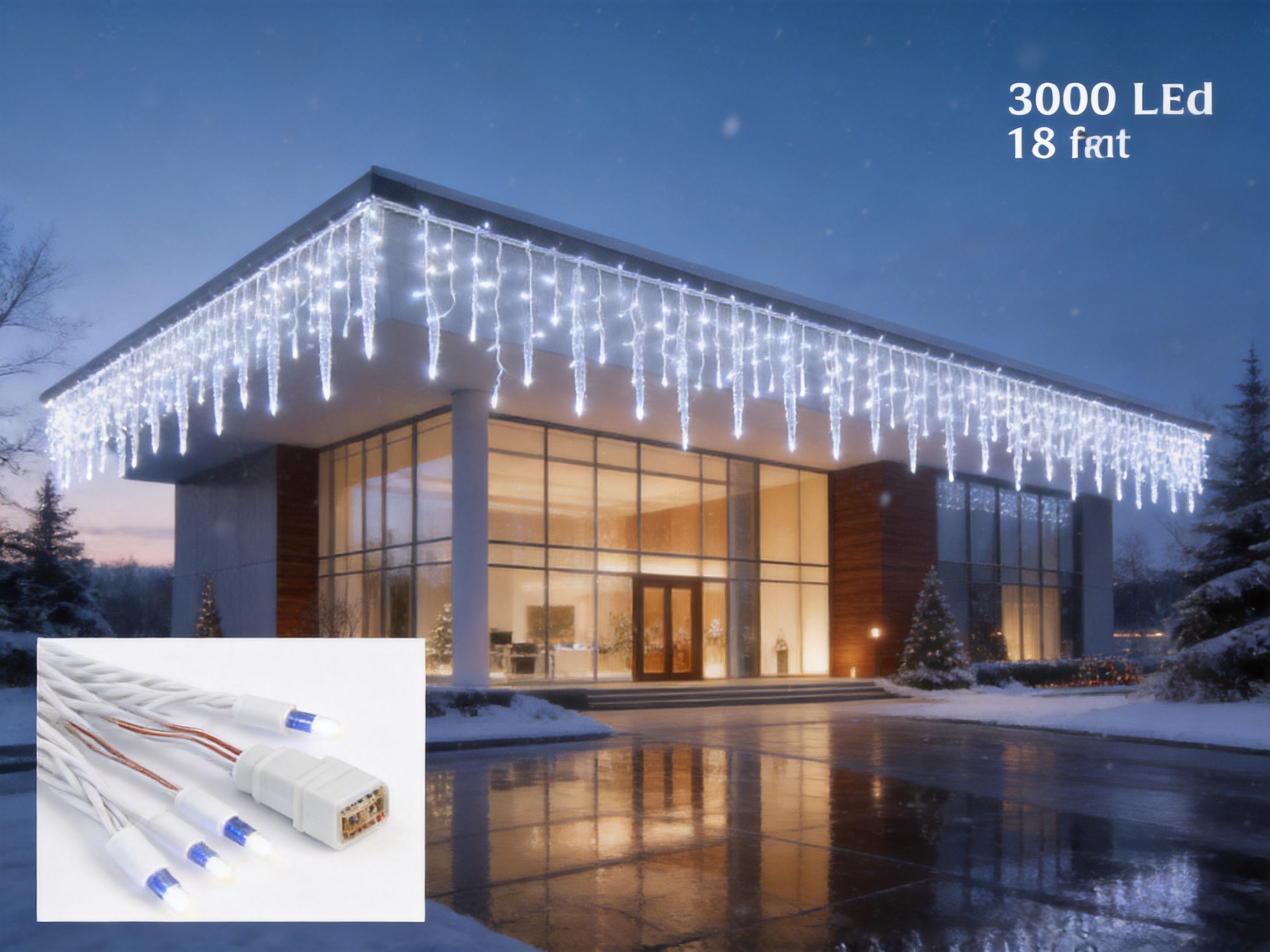
The 300 Icicle Garland Light Set is designed to address these requirements. Identified by model MDI300, this garland light combines 300 LED light points with a prominent vertical icicle arrangement. Its 18-foot total length is suitable for decorating substantial areas, while its support for series extension helps installers create longer continuous lighting effects. The product is available with green or white wire and clear, multicolor, or blue bulbs, allowing buyers to coordinate the display with different architectural styles, holiday themes, and commercial branding requirements.
Manufactured by Taizhou Mingde Decorative Lighting Co., Ltd., the product is supported by an integrated manufacturing operation, long-term industry experience, international certifications, and a substantial annual production capacity. These characteristics make the MDI300 more suitable for wholesale, professional, and project-based applications than many basic consumer lighting strings designed only for occasional household use.
This article examines the construction, appearance, application value, manufacturing strengths, quality considerations, and purchasing advantages of the 300 Icicle Garland Light Set. It also explains why a densely arranged LED icicle product can be a practical alternative to scattered string lights when the objective is to achieve a strong visual effect across large trees, building edges, plazas, commercial landscaping, and public holiday events.

300 Icicle Garland Light Set
Product Overview and Core Specification
The MDI300 is a 300-light icicle garland set intended for indoor and outdoor decorative use. The product combines a horizontal main cable with multiple vertical hanging sections. When installed along a roofline, tree branch, railing, storefront, fence, or event structure, the hanging sections create the recognizable icicle appearance associated with winter and Christmas displays.
Unlike a simple straight string light, an icicle garland provides depth and movement. Its vertical drops break up a flat line and create a layered lighting effect. This makes the product particularly effective when viewed from a distance, where the repeated vertical pattern can form a continuous illuminated border. The arrangement also helps cover a larger visual surface without requiring every light to be individually positioned.
| Specification | Product Detail |
| Model | MDI300 |
| Product name | 300 Icicle Light Set |
| Product category | Garland Light |
| Light source | 300 LED light points |
| Materials | Polypropylene, polyvinyl chloride, and copper |
| Wire colors | Green or white |
| Bulb colors | Clear, multicolor, or blue |
| Total length | 18 feet |
| Application | Indoor and outdoor decorative lighting |
| Power rating | 72 watts |
| Minimum order quantity | 3,000 sets |
| Listed certifications | UL, NOM, CE, REACH, and BSCI |
The listed 18-foot length gives buyers a clear starting point for project calculations. In practical installation, the exact coverage achieved will depend on spacing, the arrangement of the drops, the shape of the mounting surface, and whether multiple sets are connected or installed side by side. The product information indicates that the light set can cover spaces of approximately six meters or more, making it appropriate for larger holiday trees, display zones, and commercial decoration projects.
The 72-watt rating provides a useful basis for electrical planning. Project managers can calculate the approximate power demand by multiplying the number of sets by the stated wattage and then allowing suitable capacity for the control system, extension components, and other display elements. Electrical installation should always follow the requirements of the destination market and should be completed with appropriate protection for indoor or outdoor conditions.
Why the Icicle Format Creates a Stronger Visual Effect
The principal advantage of the MDI300 is its icicle structure. Many conventional string lights consist of bulbs arranged along a single horizontal cable. They are useful for outlining objects, but they may appear visually thin when used across a broad wall, tree canopy, or commercial façade. The icicle configuration adds vertical dimension, allowing the lights to occupy more of the visible space.
The hanging sections produce a repeated rhythm that can be seen from a considerable distance. This is valuable for shopping centers, hotels, restaurants, entertainment venues, municipal areas, and event entrances that need to attract attention after dark. Instead of creating only a line of points, the product forms a curtain-like edge of light while retaining the installation simplicity of a garland string.
The high number of light points also contributes to a denser appearance. A sparse decorative string may leave large dark gaps between illuminated sections, particularly when installed along a long roofline or large tree. The MDI300 is intended for situations where the buyer wants a more substantial and continuous visual effect. Its 300 LED arrangement is especially suitable for projects that need to look complete and coordinated rather than improvised.
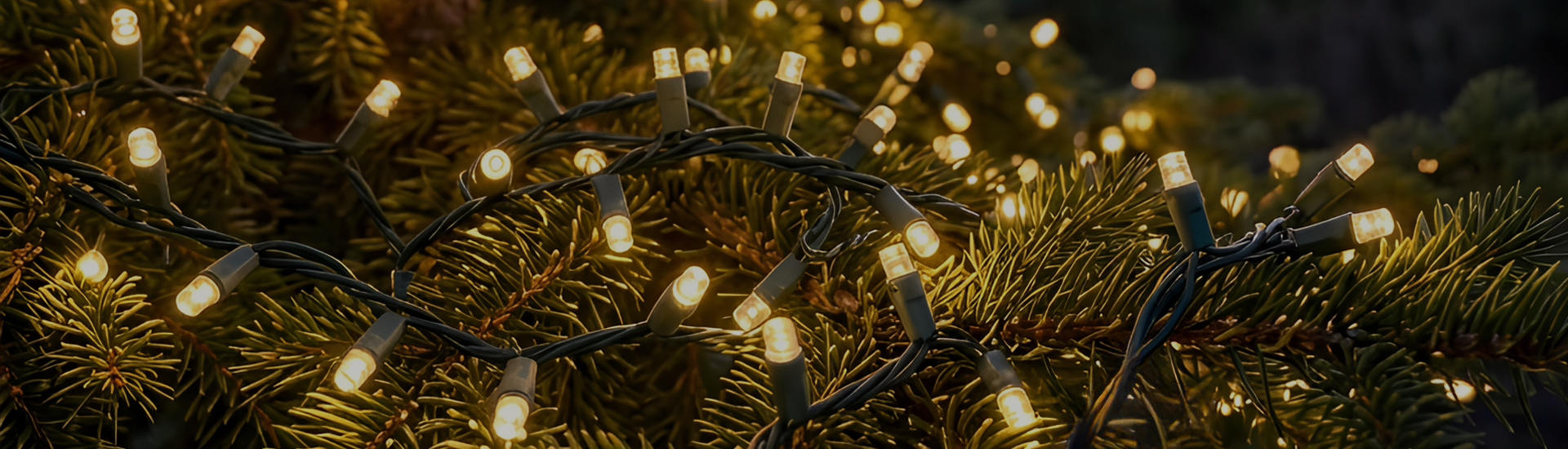
Clear bulbs can produce a clean and classic appearance, especially when combined with a white wire on light-colored architectural surfaces. Blue bulbs can support winter scenes, cool-toned commercial themes, and contemporary exterior designs. Multicolor bulbs can create a festive and family-friendly atmosphere for public spaces, retail areas, amusement venues, and community celebrations. Green wire can blend into trees, shrubs, wreaths, and other natural backgrounds, while white wire may be preferred for façades, indoor displays, snow-themed installations, or light-colored structures.
These options give distributors and project buyers the opportunity to purchase one basic product platform for multiple markets. Rather than relying on a completely different manufacturing design for every application, buyers can select the wire and bulb combination that best fits the intended display.
Advantages for Large Holiday and Commercial Installations
Broad Coverage from a Compact Product Format
The MDI300 is designed for scale. Its 18-foot length and 300-light arrangement help reduce the number of short decorative strings required for a large project. Fewer individual sections can simplify planning, reduce the number of visible connection points, and support a more uniform appearance across the installation.
For large Christmas trees, the product can be arranged around the outer branches to create illuminated vertical lines that emphasize the tree’s height and fullness. Along a roofline, it can provide a repeated downward pattern that visually softens the edge of the building. On a fence or railing, it can establish a continuous festive boundary. In public squares, several sets can be coordinated to outline trees, kiosks, stages, walkways, and temporary structures.
Strong Visibility at Night
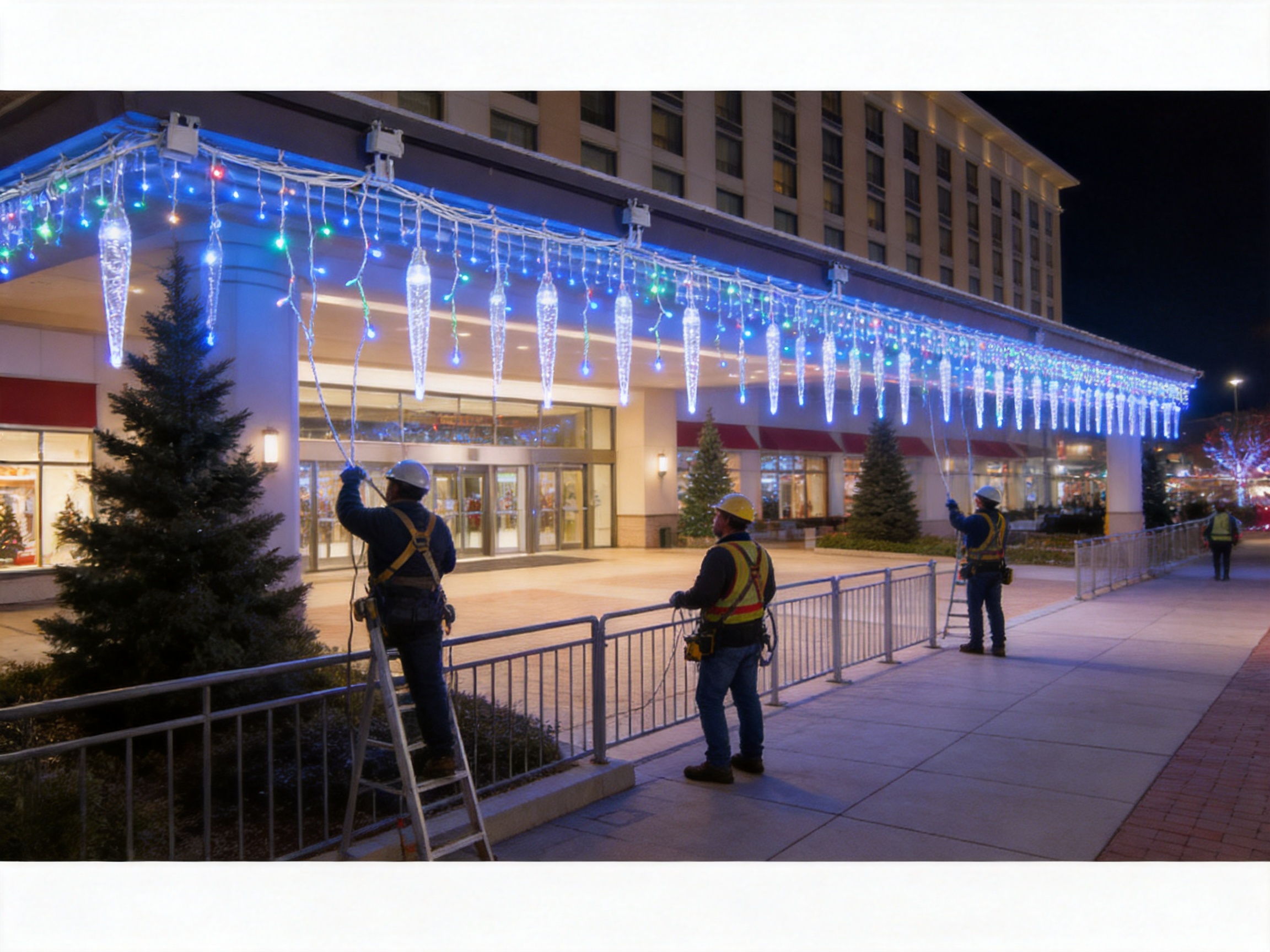
Commercial decoration often needs to remain visible from roads, parking areas, pedestrian paths, and surrounding buildings. The dense LED arrangement and vertical drops help the display maintain visual presence at a distance. This can be particularly important for businesses that use lighting to communicate seasonal opening periods, invite visitors into a venue, or enhance the nighttime identity of a property.
Compared with a basic straight light string, the icicle shape creates more illuminated surface area without requiring a full net light or rigid lighting panel. It occupies a useful middle position between simple outline lighting and more complex architectural systems.
Flexible Color Coordination
Product customization does not always require a change to the entire design. The availability of clear, multicolor, and blue bulbs allows buyers to match the MDI300 with different display concepts. Clear lighting can support elegant hotel décor and refined retail windows. Multicolor lighting can add energy to public celebrations and family-oriented venues. Blue lighting can be used for winter themes, cool visual palettes, and contemporary façades.
The choice between green and white wire also affects the finished appearance. Green wire is generally useful where the garland will be installed on trees, wreaths, hedges, or darker natural backgrounds. White wire can create a cleaner contrast on indoor walls, windows, white architectural surfaces, and snow-inspired displays.
Indoor and Outdoor Application Potential
The product is specified for indoor and outdoor use, providing a broad range of commercial applications. Indoor uses may include shopping mall decorations, department store windows, hotel lobbies, exhibition areas, reception zones, restaurants, themed attractions, and holiday markets. Outdoor uses may include rooflines, trees, fences, plaza structures, entrances, garden areas, public landscaping, and event installations.
Outdoor use requires more careful planning than indoor use. Installers should consider weather exposure, drainage, mounting points, wind load, electrical protection, and local safety requirements. The product’s specified materials and certification profile support professional evaluation, but installation conditions and destination-market regulations should always be reviewed before deployment.
Support for Extended Lighting Layouts
The product information indicates support for series extension. This feature is valuable when a display must continue across a long façade, a row of trees, a large fence, or a commercial walkway. Series extension can help create a unified lighting line and reduce the need for numerous separate power access points.
Extension planning should be based on the approved electrical configuration, maximum connection quantity, local regulations, and the instructions supplied for the specific order. Professional buyers can use these details to create a consistent layout before installation, ensuring that the total electrical load and physical cable arrangement remain within safe operating limits.
Materials and Construction Considerations
The MDI300 uses polypropylene, polyvinyl chloride, and copper. Each material contributes to a different part of the product’s performance and manufacturability.
Polypropylene is a practical polymer commonly used in decorative lighting components because it can be formed into consistent shapes and offers useful resistance to ordinary handling. It can support the production of covers, holders, connectors, or related structural components depending on the design. Consistent molding is important because repeated light sets must maintain a uniform appearance across thousands of units.
Polyvinyl chloride is widely used in wire insulation and protective cable components. Its role is important in maintaining electrical separation, supporting flexibility during installation, and protecting conductors from routine abrasion. The exact performance of any finished product depends on the formulation, thickness, manufacturing controls, and applicable regional standards.
Copper is used for the conductive wiring. Copper offers strong electrical conductivity and is well suited to the production of flexible decorative light cables. The quality of the conductor, the consistency of the connections, and the integrity of the insulation all contribute to reliable operation.
In a commercial lighting project, construction quality matters because products may be handled repeatedly during installation, removal, storage, and redeployment. A light set that is difficult to handle or inconsistent in its cable construction can increase labor time and create avoidable maintenance issues. A standardized combination of molded components, insulated wiring, and LED assemblies helps support efficient installation at scale.
Buyers should also evaluate packaging, carton protection, connector arrangements, labeling, spare-part policy, and installation documentation. These supporting elements are often overlooked, but they can have a significant impact on the total cost of ownership for distributors and professional installers.
LED Efficiency and Operational Value
LEDs are widely used in seasonal lighting because they can provide bright decorative illumination with lower energy demand than many traditional incandescent alternatives. They also generate less heat during normal operation and can support longer service life when properly manufactured and operated within their rated conditions.
For a commercial display, energy efficiency can influence both operating cost and installation design. A lower-energy light source may reduce the load placed on power distribution equipment and make it easier to plan larger displays. Over a full holiday season, the cumulative energy difference can become meaningful, particularly for shopping centers, hotels, municipalities, and venues that operate their lights for many hours each evening.
The MDI300 is listed at 72 watts. This rating should be used in project calculations and compared with the expected operating schedule. Buyers should distinguish between the power rating of one set and the total demand of a complete installation. If multiple sets are used together, the total load will rise accordingly, and the project should include properly rated cables, protective devices, timers, controllers, and connection hardware.
Energy efficiency does not mean that buyers should ignore safety or quality. LED performance depends on the quality of the diodes, resistors, circuit design, wiring, connections, thermal conditions, and production controls. Consistent assembly is therefore essential. A professional manufacturer must control the process from component preparation through final inspection so that brightness, color, polarity, connection strength, and electrical behavior remain within acceptable limits.
Manufacturing Strengths and Production Capability
Taizhou Mingde Decorative Lighting Co., Ltd. has an annual production capacity of 10 million strings of festive lights. This capacity is significant for distributors and project purchasers because large orders require more than a good product concept. They require stable sourcing, repeatable assembly, production scheduling, quality control, packaging coordination, and export experience.
The company was founded in 1968 and was formerly associated with Zhejiang Festival Lighting General Factory. Its long operating history gives it extensive exposure to the seasonal lighting sector, including the changing requirements of export markets, certification systems, product trends, and commercial installation practices.
Large production capacity can provide several advantages over smaller or less specialized suppliers. First, it may support more reliable order planning during peak seasonal periods. Holiday lighting is subject to strong seasonal demand, and buyers often need to place orders well before the selling season. An established production base can help coordinate raw materials, assembly lines, inspection processes, and shipment schedules.
Second, an integrated operation can improve communication between engineering, component production, assembly, quality assurance, and packaging teams. This is especially important when a customer requires a specific wire color, bulb color, carton configuration, label, or order quantity. The company describes itself as an integrated and standardized lighting enterprise, with quality control extending from component manufacturing through final assembly and shipment.
Third, scale can help support consistency. Commercial buyers often need thousands of units that look and perform alike. Variations in bulb brightness, wire color, drop length, connector configuration, or packaging can create problems during installation and resale. Standardized processes are intended to reduce such variation and make the finished display more cohesive.
Quality System and Process Control
The company established an ISO 9001 quality system in 1997. An ISO 9001-based approach emphasizes documented processes, defined responsibilities, corrective action, continual improvement, and customer-focused quality management. Certification alone does not replace product inspection, but a formal quality system can provide a structured framework for managing production and addressing nonconformities.
Decorative lighting production involves multiple linked processes. Materials must be received and checked. Wires must be cut, stripped, connected, and insulated. LED components must be assembled in the correct orientation. Molded parts must maintain accurate dimensions. Finished strings must be tested, packed, labeled, and prepared for shipment. A process failure at any stage can affect the performance or appearance of the final product.
The company’s stated quality-control coverage from component manufacturing through final assembly and shipment is therefore relevant to commercial buyers. It suggests that quality is not treated only as a final visual inspection. Instead, control is applied across the production chain, where problems can be identified earlier and corrected before they affect a complete shipment.
Certification and Market Readiness
The MDI300 is listed with UL, NOM, CE, REACH, and BSCI certifications or compliance credentials. These designations relate to different areas of market access, safety, environmental requirements, and social responsibility. Buyers should request current documentation applicable to the exact model, electrical version, destination market, and order configuration before placing an order.
UL is particularly relevant to products intended for markets that require or recognize Underwriters Laboratories standards. NOM is associated with Mexican market requirements. CE marking relates to applicable European Union conformity requirements. REACH concerns chemical substance controls in the European market, while BSCI is associated with social compliance and responsible supply-chain practices.
The availability of multiple certification credentials can simplify supplier evaluation for importers serving different regions. It may also reduce the need to begin compliance discussions from the beginning for every market. Nevertheless, buyers should verify certificate validity, scope, testing laboratory information, model numbers, voltage configuration, and any country-specific requirements.
Competitive Advantages in Wholesale Purchasing
The MDI300 offers several advantages when compared with generic, low-density, or household-focused alternatives.
Its first advantage is product density. A 300-light configuration creates a more substantial visual result than a short or sparsely populated string. For commercial displays, the cost of labor and access equipment can exceed the cost of the lighting itself. Using a product that produces stronger coverage per installed section may help improve labor efficiency and reduce the number of pieces needed for a visually complete installation.
Its second advantage is the distinctive icicle structure. Straight strings can outline an edge, but they do not provide the same vertical movement. The MDI300 is better suited to displays where depth, repeated drops, and a curtain-like visual effect are important.
Its third advantage is application flexibility. The product can be used indoors or outdoors and is available with multiple wire and bulb-color combinations. This makes it useful for seasonal retail programs, municipal installations, hospitality projects, themed events, and residential developments.
Its fourth advantage is suitability for larger procurement programs. The minimum order quantity of 3,000 sets indicates that the product is positioned for wholesale and project purchasing rather than one-off consumer orders. Buyers seeking private-label programs, regional distribution, chain-store rollouts, or large event decoration can discuss order planning directly with the manufacturer.
Its fifth advantage is manufacturing support. A supplier with decades of industry experience and a stated annual capacity of 10 million strings may be better positioned to support repeat orders, seasonal production planning, and consistent quality than a trading source with limited control over production.
Its sixth advantage is the combination of visual impact and operational practicality. The MDI300 is not simply a decorative novelty. It combines LED technology, a recognizable icicle format, a defined length, multiple color options, series-extension capability, and a certification profile intended to support professional market use.
| Evaluation Area | Potential Value of the MDI300 |
| Visual coverage | 300 LED points and vertical icicle drops create a dense, layered appearance. |
| Installation planning | The stated 18-foot length supports project quantity calculations. |
| Design flexibility | Green or white wire and clear, multicolor, or blue bulbs serve different themes. |
| Application range | Suitable for indoor and outdoor decorative projects. |
| Large-area deployment | Series-extension support can help continue lighting effects across broad spaces. |
| Energy planning | The 72-watt rating provides a basis for calculating electrical demand. |
| Supply capability | High annual production capacity supports wholesale and project procurement. |
| Quality framework | ISO 9001 history and process coverage support structured manufacturing management. |
| Market access | Listed UL, NOM, CE, REACH, and BSCI credentials assist regional evaluation. |
Applications Across Different Display Environments
Retail and Shopping Centers
Retail properties use holiday lighting to encourage seasonal visits and improve the customer experience. The MDI300 can be installed around entrances, storefronts, atriums, escalator zones, display windows, and exterior landscaping. Multicolor versions may be appropriate for lively family-oriented campaigns, while clear or blue versions may suit premium retail environments.
Because the product creates a repeated vertical effect, it can make a plain storefront edge more visually active. A coordinated installation across multiple stores can also create a consistent shopping-center identity, especially when the same wire and bulb configuration is used throughout the property.
Hotels, Restaurants, and Hospitality Venues
Hotels and restaurants often use decorative lighting to create warmth, communicate seasonal hospitality, and enhance photographs taken by guests. The MDI300 can be applied to entrance canopies, trees, patios, terraces, fences, balconies, windows, and reception areas. Clear light can provide a refined appearance, while blue or multicolor options can support themed promotions and special events.
For hospitality operators, appearance consistency is important. A commercial-grade product that can be purchased in larger quantities helps maintain the same visual language across multiple buildings or locations.
Public Plazas and Municipal Areas
Public spaces often require broad coverage and strong visibility. Icicle garlands can be installed on trees, railings, kiosks, stage structures, pedestrian corridors, and temporary event facilities. The dense arrangement helps establish a festive atmosphere without requiring every branch or structural element to be wrapped separately.
Municipal and public projects may also require documentation, product traceability, delivery coordination, and compliance review. The supplier’s manufacturing history and certification portfolio can be useful during the procurement process, subject to verification by the purchasing authority.
Christmas Trees and Landscape Features
The vertical drops of the MDI300 complement the natural shape of large Christmas trees. Installed around the perimeter or distributed through the branches, the garland can emphasize the tree’s height and create a fuller nighttime silhouette. It can also be used on shrubs, hedges, garden arches, and landscape borders.
Green wire may blend more easily into vegetation during the day, allowing the illuminated bulbs to become the main visible feature after dark. Where the installation is intended to remain visibly decorative during daylight hours, white wire may offer a brighter and more deliberate appearance.
Events, Festivals, and Temporary Installations
Event organizers can use icicle garlands for holiday markets, winter festivals, promotional stages, entrance portals, photo areas, and branded activation zones. The product’s recognizable shape helps visitors immediately associate the installation with winter or holiday themes.
Temporary installations place additional emphasis on handling and storage. After removal, the strings should be organized, protected from crushing, and stored in a dry, suitable environment. Proper storage can help preserve the wires, bulbs, connectors, and packaging for future seasons.
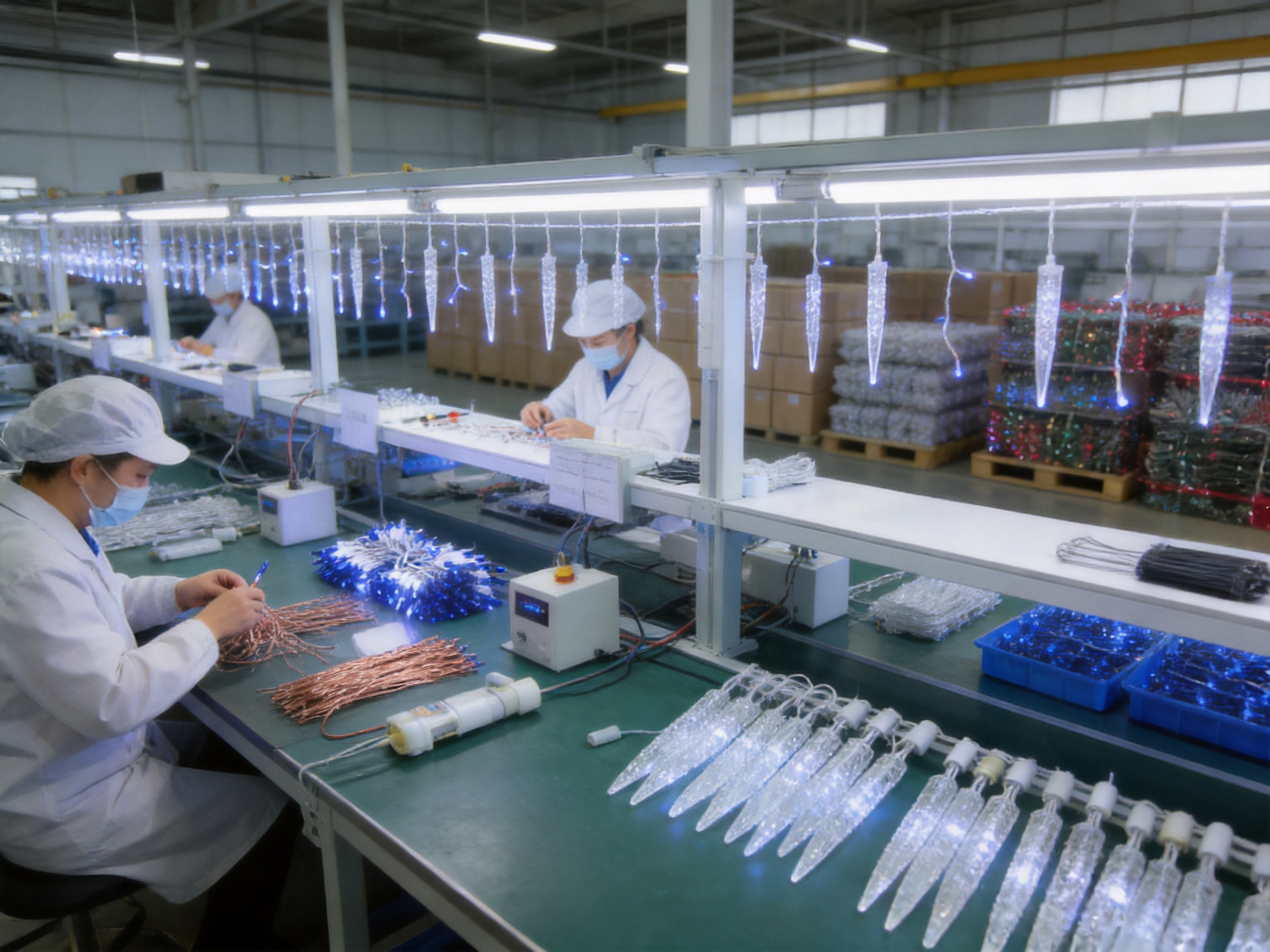
Manufacturing Process from Components to Finished Shipment
A reliable decorative light set is the result of many coordinated manufacturing steps. Although exact factory procedures may vary by order and configuration, an integrated lighting manufacturer generally manages the following production stages.
Material Preparation
Production begins with the receipt and inspection of polymer materials, copper wire, LED components, insulation materials, connectors, packaging supplies, and related parts. Material identification and batch control help maintain consistency across production orders. For large commercial programs, stable material preparation is important because a change in wire color or component appearance can affect the finished display.
Wire Processing
Copper conductors are prepared according to the required cable design. Processing may include cutting, stripping, terminal preparation, and the application of insulation or protective coverings. Wire color selection is managed according to the order, with green and white versions available for the MDI300.
Wire processing must balance electrical performance and mechanical flexibility. The finished garland needs to carry power while remaining manageable during installation. Inconsistent stripping, weak connections, or damaged insulation can create reliability and safety problems, which is why process control at this stage is important.
LED and Component Assembly
LED bulbs and associated components are assembled into the cable at defined intervals. The spacing and drop arrangement determine the final icicle appearance. Accurate assembly helps ensure that the hanging sections maintain a regular rhythm and that the product looks consistent when multiple sets are installed together.
Different bulb colors can be incorporated according to the selected configuration. Clear, blue, and multicolor options allow the same product family to serve different customer requirements while maintaining a common basic structure.
Molding and Protective Component Production
Polypropylene and polyvinyl chloride components may be formed or applied to create bulb covers, holders, insulation sections, connectors, and other protective parts. Dimensional consistency is important because parts must fit securely and maintain a uniform appearance across a large production run.
Well-controlled molding and insulation processes also support the physical durability of the finished string. Decorative lights are frequently bent, coiled, unpacked, mounted, removed, and repacked, so components must be able to withstand ordinary handling associated with seasonal use.
Electrical and Appearance Testing
Before shipment, finished light sets should undergo appropriate electrical and visual checks. Testing may include illumination, continuity, connection integrity, polarity, wire condition, bulb placement, color consistency, and overall appearance. The exact tests depend on the product design, certification requirements, and destination market.
Visual inspection is particularly important for an icicle product. Inspectors can verify that hanging sections are present, the light distribution is consistent, and the final set matches the approved sample. This helps prevent defects from becoming visible only after the product has been installed at a customer site.
Final Assembly, Packaging, and Shipment
After testing, products are organized, labeled, packed, and prepared for export. Packaging must protect the garlands from tangling, crushing, moisture, and unnecessary abrasion during transport. Carton markings and order documentation should correspond with the selected model, color, quantity, and destination requirements.
The company’s stated quality-control coverage through final assembly and shipment is valuable because export performance depends on more than factory assembly. Accurate packing and documentation help ensure that the correct configuration reaches the distributor or project site in usable condition.
Purchasing Guidance for Distributors and Project Buyers
Before ordering the MDI300, buyers should define the intended application, destination market, electrical requirements, bulb color, wire color, quantity, packaging needs, and delivery schedule. Because the minimum order quantity is 3,000 sets, a purchasing plan should account for storage, distribution, and seasonal sales timing.
Buyers should request a current technical specification sheet and confirm the exact voltage, plug, connector, controller, and extension configuration. The supplied information identifies the product as an indoor and outdoor light set, but practical installation requirements can vary by country and project environment.
It is also advisable to request samples before approving a large order. Samples allow the buyer to evaluate brightness, wire color, bulb color, spacing, drop length, connector design, packaging, and overall appearance. For a commercial installation, the sample can be tested on the intended mounting surface and viewed during both daylight and nighttime conditions.
Order documents should clearly identify the model, selected colors, quantity, packaging method, inspection requirements, certification documents, shipping marks, and delivery terms. Clear documentation reduces the risk of receiving a different configuration from the one used for project approval.
Project planners should calculate the number of sets required by measuring the installation area and allowing for corners, transitions, mounting gaps, and spare stock. It is often wise to purchase a reasonable number of additional units for replacement, maintenance, or future expansion, particularly when the display will operate for several seasons.
Installation and Maintenance Considerations
Before installation, inspect every light set for visible damage, exposed conductors, broken bulbs, damaged insulation, or compromised connectors. Do not install a product that appears damaged. Confirm that the power supply and protective equipment match the requirements for the specific order and destination.
Mounting should be performed with suitable clips, hooks, ties, or support hardware. The cable should not be pulled excessively, and the weight of the garland should not be transferred to electrical connections. When installed on trees, façades, or temporary structures, the mounting system should account for wind, movement, and the weight of accumulated moisture where applicable.
Outdoor installations should be positioned to minimize standing water and should use appropriate weather-protection practices. Indoor and outdoor environments differ significantly, and the installation must follow the applicable electrical code. Qualified personnel should handle power distribution, connection limits, timers, controls, and protective devices.
During operation, maintenance teams should periodically check for dark sections, loose mounting points, damaged cables, and changes in appearance. Promptly replacing damaged units can help preserve the uniformity of a large display and reduce the chance that a minor issue will affect other components.
After the season, disconnect the lighting before removal. Avoid pulling on the wire or dragging the garland across rough surfaces. Coil or organize the product carefully, use protective packaging, and store it in a clean, dry area away from sharp objects, excessive heat, and crushing pressure. Good seasonal handling can improve reuse potential and protect the buyer’s investment.
Environmental and Social Responsibility
Modern buyers increasingly assess decorative lighting suppliers according to environmental, social, and operational criteria. REACH and BSCI are included among the listed credentials for the product and manufacturer, providing relevant points for compliance and supply-chain review.
LED technology can help reduce energy consumption during operation when compared with less efficient traditional light sources. Durable materials and reusable seasonal products can also support more sustainable purchasing when the lights are properly maintained and used across multiple years.
Environmental responsibility should be considered across the entire product lifecycle. Buyers can reduce waste by selecting appropriate quantities, using durable packaging, maintaining products rather than discarding them prematurely, and following local rules for electrical and electronic waste at the end of service life.
Social responsibility is also relevant to large-scale procurement. BSCI-related supply-chain information can support a buyer’s review of workplace conditions and responsible sourcing practices. Commercial customers may request updated audit documents or related evidence as part of their supplier approval procedures.
Why Manufacturer Experience Matters
Seasonal lighting is a specialized industry. Production schedules are influenced by holiday calendars, international shipping cycles, regional certification requirements, and short retail selling windows. A supplier with experience dating back to 1968 is familiar with the importance of advance planning and consistent seasonal execution.
Taizhou Mingde Decorative Lighting Co., Ltd. describes its mission as delivering nature-friendly home ambient lighting and building a reputable enterprise. Its vision is to create a long-lasting brand that brings warmth to households. While the MDI300 is suitable for commercial-scale projects, these values reflect the broader purpose of decorative lighting: creating atmosphere, comfort, celebration, and visual connection.
The company’s product range includes linear lights, icicle lights, net lights, circular lights, spiral trees, LED string lights, copper wire lights, and cord lights. This broader product capability can be useful for buyers seeking a coordinated lighting program rather than a single isolated item. A distributor or project contractor may be able to source multiple decorative formats from one experienced manufacturing partner.
The company also reports serving markets in the United States and Central and South America. Experience with export destinations can support communication about certification, packaging, documentation, and logistics. Buyers should still confirm the exact requirements for their own market, but a supplier accustomed to international business may reduce the amount of basic market preparation required.
Q&A: Frequently Asked Questions
What is the 300 Icicle Garland Light Set?
It is an MDI300 garland light set containing 300 LED light points arranged in a vertical icicle pattern. It is designed for decorative indoor and outdoor applications, including holiday trees, rooflines, façades, plazas, landscapes, retail properties, and event venues.
How long is one light set?
The listed total length is 18 feet. The practical area covered depends on the installation layout, spacing, surface shape, and whether multiple sets are connected or installed together.
What bulb colors are available?
The listed options are clear, multicolor, and blue bulbs. Buyers should confirm the selected color configuration when requesting a quotation or placing an order.
What wire colors are available?
The product is available with green or white wire. Green wire may blend with trees and vegetation, while white wire may suit indoor displays, light-colored structures, and snow-themed designs.
Can the product be used outdoors?
The product information specifies indoor and outdoor use. Outdoor installation must still follow the applicable electrical regulations and should include suitable mounting, power protection, weather considerations, and professional installation practices.
Does the product support series extension?
The product information indicates support for series extension. The permitted connection quantity and exact electrical limits should be confirmed in the technical documentation for the selected configuration before installation.
What is the power rating?
The stated power rating is 72 watts per set. Buyers should use this figure when calculating the total electrical demand of a project and should allow for all connected equipment and local safety requirements.
What materials are used?
The listed materials are polypropylene, polyvinyl chloride, and copper. These materials support the molded components, insulation, and conductive wiring used in the light set.
What is the minimum order quantity?
The stated minimum order quantity is 3,000 sets. This makes the product especially suitable for wholesalers, importers, chain retailers, large commercial projects, and seasonal distribution programs.
Which certifications are listed?
The listed credentials are UL, NOM, CE, REACH, and BSCI. Buyers should request current documents and verify that they apply to the exact model, electrical configuration, and destination market.
Who manufactures the product?
The product is manufactured by Taizhou Mingde Decorative Lighting Co., Ltd., a Chinese decorative lighting enterprise founded in 1968 with a stated annual capacity of 10 million strings of festive lights.
How does the product compare with a basic straight string light?
The MDI300 provides a vertical icicle effect and a denser 300-light arrangement. A straight string light may be useful for simple outlining, but the icicle format can create greater visual depth and stronger coverage across façades, trees, fences, and commercial displays.
What should be confirmed before placing a bulk order?
Buyers should confirm the voltage, plug and connector configuration, wire color, bulb color, packaging, certification documents, extension limits, inspection method, delivery schedule, labeling, and destination-market requirements. Ordering a sample before mass production is also recommended.
Conclusion
The 300 Icicle Garland Light Set is a practical choice for buyers who need dense, visually prominent, and scalable holiday illumination. Its 300 LED points, vertical icicle structure, 18-foot length, multiple color options, indoor and outdoor application range, and series-extension capability make it suitable for both decorative and commercial environments.
Its value extends beyond the visible product design. The MDI300 is supported by a manufacturer with a long history in festive lighting, an annual production capacity of 10 million strings, an ISO 9001 quality-system background, international market experience, and a stated process-control structure covering components, assembly, inspection, and shipment. These strengths are important for distributors and project buyers who require consistent products, dependable supply, and documentation for large seasonal programs.
Compared with basic low-density strings, the MDI300 can create stronger coverage and a more dimensional visual effect with fewer separate installation sections. Clear, blue, and multicolor bulbs provide design flexibility, while green and white wires allow the finished display to coordinate with natural or architectural backgrounds.
For retail centers, hotels, restaurants, public plazas, event organizers, landscape contractors, municipalities, and wholesale importers, the product offers a balanced combination of decorative impact and commercial practicality. With suitable planning, approved electrical installation, careful maintenance, and proper seasonal storage, the 300 Icicle Garland Light Set can become a dependable foundation for large-scale holiday lighting programs.
References
1. Product specification sheet for the MDI300 300 Icicle Light Set, including listed materials, dimensions, power rating, colors, certifications, and minimum order quantity.
2. Manufacturer information for Taizhou Mingde Decorative Lighting Co., Ltd., including company history, production capacity, product range, quality-system background, and export markets.
3. ISO 9001 quality management system principles relating to documented processes, corrective action, continual improvement, and customer-focused production control.
4. General LED lighting engineering principles concerning energy use, electrical planning, illumination consistency, and decorative lighting applications.
5. General product-safety and conformity guidance concerning UL, NOM, CE, REACH, and social-compliance evaluation for international lighting procurement.
Product: 300 Icicle Garland Light Set


Don't Miss New Releases & Subscriber Exclusives
Sign up for our newsletter to stay in the holidy spirit all year.
Further Questions? Contact Us
-
Useful Links
Home Products About Us Production Services News Contact Us -
Classification
Mini String Light LED Light Set Garland Light Light-up Spiral Trees LED Curtain Lights Battery Light LED Copper Wire Light Decorative Light -
Contact Info
zd@zflgf.com.cn+86-576-82467401
+86-13968612122 ( Ms. Zhang )
+86-13505747679 ( Mr. Tan )
+86-15062835074 ( Mr. Cheng )No.270 Zhenxi Road, Xinqiao Town, Luqiao District, Taizhou City, Zhejiang Province, China -


Holiday Lights Supplier