

 中文简体
300 Icicle Garland Light Set: A Commercial-Grade Solution for Large-Scale Holiday Displays
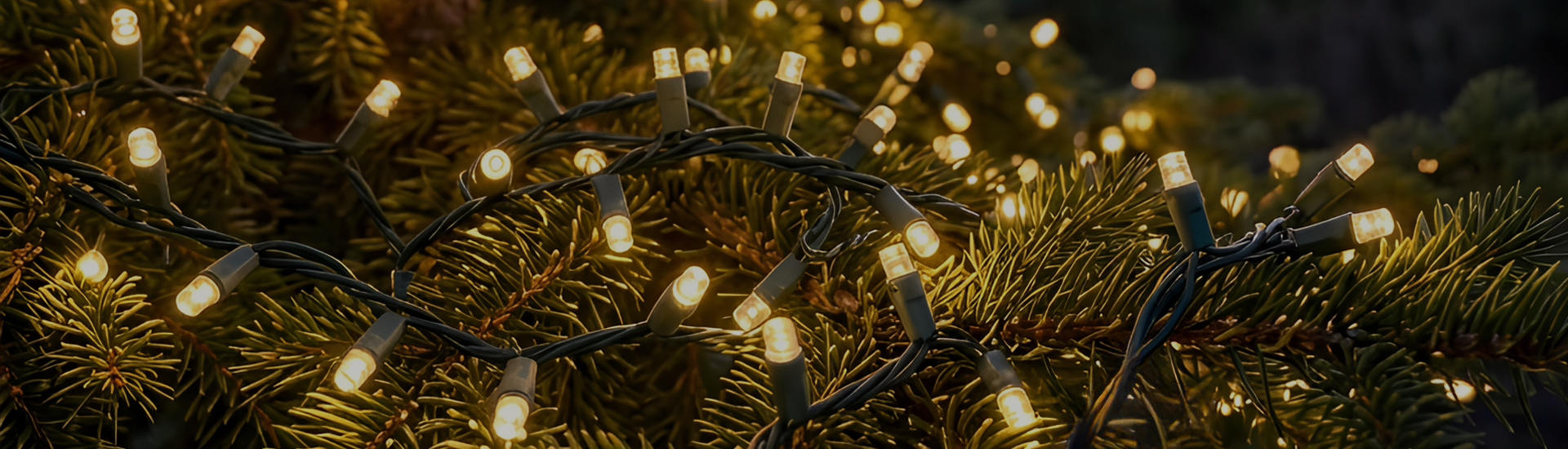
Large holiday lighting projects require more than attractive illumination. They need dependable coverage, a convincing decorative effect, efficient energy use, suitable safety certifications, and a product that can be integrated into residential, commercial, and public installations. The 300 Icicle Garland Light Set is designed to address these requirements with a dense arrangement of LED bulbs, a pronounced hanging icicle profile, durable wiring, and support for indoor and outdoor decorative applications.
With a total length of approximately 18 feet, this icicle light set is suitable for covering large trees, building edges, retail displays, plazas, event venues, streetscapes, and landscaped areas. Its high bulb count creates a fuller and more continuous appearance than many basic decorative light strings, while its vertical drops add depth and movement to otherwise flat surfaces. For professional buyers, retailers, event planners, landscapers, and holiday decoration contractors, the product offers a practical balance between visual impact, installation flexibility, and large-volume supply capability.
The product is manufactured by Taizhou Mingde Decorative Lighting Co., Ltd., an established Chinese festive-lighting producer with roots extending back to 1968. The company has developed extensive experience in the production of linear lights, icicle lights, net lights, circular lights, spiral trees, LED string lights, copper wire lights, and cord lights. Its reported annual production capacity of 10 million strings allows it to support substantial wholesale and commercial orders while maintaining a product range suited to different decorative environments.

300 Icicle Garland Light Set
Understanding the 300 Icicle Garland Light Set
The 300 Icicle Garland Light Set is a decorative LED lighting product intended to create a hanging, snow-like visual effect. Rather than placing every bulb on one continuous horizontal line, the product uses vertical drops of varying or repeated lengths to simulate icicles. When installed along a roofline, balcony, tree branch, fence, wall, stage edge, or commercial façade, the lights create a layered outline that is more dimensional than an ordinary string light.
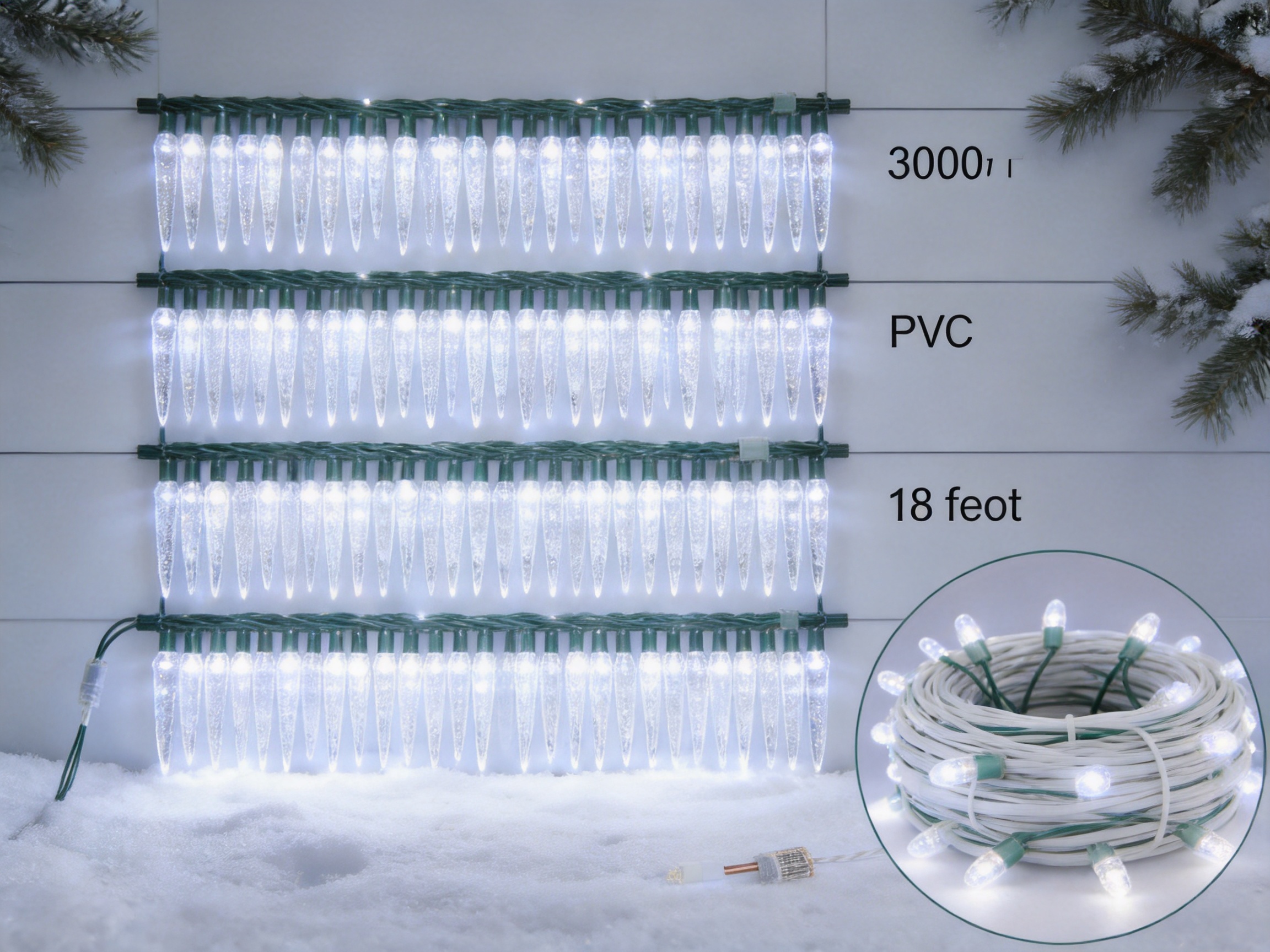
The model identified for this product is MDI300. It contains 300 LED bulbs and has a total stated length of 18 feet. This configuration is intended for large-area illumination and can cover spaces of approximately six meters or more, depending on installation arrangement, spacing, the shape of the surface, and the amount of overlap required. The dense bulb configuration helps reduce visible gaps and supports a rich, highly illuminated appearance.
The light set is constructed from PP, PVC, and copper. Polypropylene, commonly known as PP, may be used in suitable molded components and protective parts. PVC is widely used for insulation and flexible cable coverings because it helps protect conductors from everyday handling and environmental exposure. Copper is used as the conductive material in the wiring because of its established electrical conductivity and suitability for decorative lighting assemblies.
The product is available with green or white wire and clear, multicolor, or blue bulbs. These combinations allow buyers to coordinate the light set with different design themes. Green wire can blend naturally with trees, garlands, wreaths, and foliage, while white wire may be preferable for buildings, snowy visual themes, winter installations, and light-colored backgrounds. Clear bulbs offer a classic and versatile appearance, multicolor bulbs provide a festive and energetic effect, and blue bulbs create a cool-toned winter atmosphere.
| Product Attribute | Specification | Practical Benefit |
| Model | MDI300 | Clear product identification for purchasing and project planning |
| Product type | 300 Icicle Light Set | Creates a layered vertical icicle effect |
| Material | PP, PVC, and copper | Combines molded components, insulated wiring, and conductive cores |
| Bulb quantity | 300 LED bulbs | Dense illumination for fuller decorative coverage |
| Total length | 18 feet | Suitable for large trees, façades, displays, and landscaping |
| Wire options | Green or white | Supports visual coordination with different backgrounds |
| Bulb options | Clear, multicolor, or blue | Allows different seasonal and commercial design styles |
| Application | Indoor and outdoor use | Suitable for homes, businesses, events, and public spaces |
| Rated power | 72 watts | Provides a clear basis for electrical planning |
| Certificates | UL, NOM, CE, REACH, and BSCI | Supports market access, compliance review, and responsible sourcing |
| Minimum order quantity | 3,000 units | Designed for wholesale and commercial procurement |
Why an Icicle Design Creates Greater Visual Impact
One of the most important advantages of this product is its three-dimensional appearance. A conventional straight light string generally creates a single horizontal or gently curved line. That format is useful for outlining objects, but it may appear visually limited when used across a large wall or roofline. Icicle lights add downward strands, creating a rhythm of vertical light columns that can make an installation appear taller, fuller, and more dynamic.
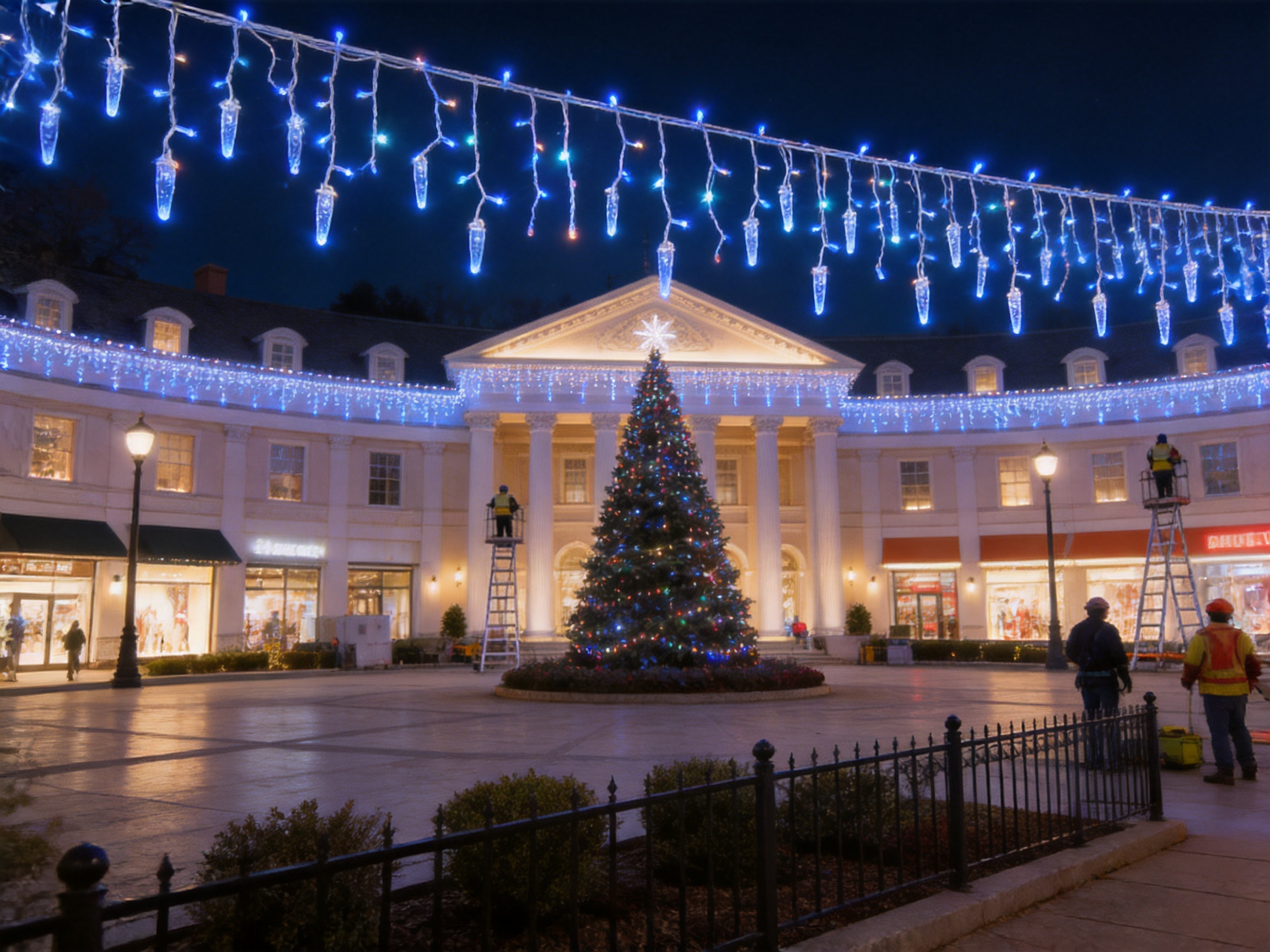
The hanging structure is especially effective on roof edges and building façades. When the lights are placed along a horizontal line, the vertical drops naturally emphasize the architecture below the roofline. On a large Christmas tree, the strands can follow branches and extend through different layers of foliage. Along a fence or commercial display, they can create a luminous boundary that is visible from a distance.
The effect is also useful for public and commercial environments because it communicates a clear seasonal message without requiring complicated decorative structures. A retail store can use the product around entrances and windows. A shopping center can combine it with wreaths, garlands, spiral trees, and net lights. A hospitality venue can install it along balconies, event spaces, and landscaped walkways. A municipality or public-space operator can use it to add a festive atmosphere to plazas and streetscapes.
The dense arrangement of 300 LEDs is another major visual benefit. Sparse lighting can leave dark sections that interrupt the intended design, particularly when the decoration is viewed from a distance. A higher bulb count helps maintain a more continuous impression of light. It also provides flexibility during installation because the user can adapt the set to irregular surfaces without making the entire display appear empty.
Compared with some low-density seasonal strings, the 300 Icicle Garland Light Set is positioned as a solution for projects where decorative richness matters. Its purpose is not simply to provide a few points of light. It is intended to form a recognizable visual feature that contributes to the overall identity of a building, tree, event, or public setting.
LED Efficiency and the 72-Watt Power Specification
LED technology is widely used in modern decorative lighting because it can provide strong visual output with lower energy consumption than many traditional incandescent alternatives. The stated power rating of this model is 72 watts. This rating gives installers, facility managers, and purchasing teams a basis for estimating electrical demand, selecting suitable outlets, and planning the number of sets that can be used on a circuit.
Energy efficiency is particularly relevant for large holiday displays. A single small indoor decoration may not consume much electricity, but a project involving dozens or hundreds of light sets can create a significant total load. LED-based products can help reduce operating costs and may produce less heat than older lighting technologies. Lower heat generation can also be beneficial when lights are positioned near decorative materials, displays, foliage, or building surfaces, provided that the installation follows appropriate safety practices.
The power rating should always be considered together with the local electrical system, installation environment, connector specifications, and any applicable regulations. Professional installers should verify circuit capacity, outdoor protection requirements, extension arrangements, and the instructions supplied with the final product configuration. The 72-watt figure is therefore both a purchasing specification and an important planning reference.
LEDs can also support longer operating periods during seasonal events. Retail displays, hotels, public plazas, and commercial landscapes may operate lighting for many hours each evening. A design that combines a full decorative effect with a clearly defined power requirement can make the project easier to budget and manage.
Materials, Wiring, and Product Construction
The product uses PP, PVC, and copper, a material combination commonly associated with decorative light assemblies that require both flexibility and electrical protection. Each material contributes to a different part of the product’s intended performance.
Polypropylene can be used for molded components that require a lightweight structure and resistance to routine handling. In a seasonal product, molded parts need to be practical for assembly, packaging, storage, and installation. They should also be compatible with the product’s overall appearance and production process.
PVC is commonly used as an insulating and protective material around wires. Flexible insulation allows the light set to be packed, transported, unfolded, and arranged across different surfaces. It also helps separate electrical conductors from direct contact with the surrounding environment. The durability of the finished cable depends on the formulation, thickness, processing controls, and inspection standards applied during production.
Copper serves as the conductive core of the wiring. Its electrical conductivity makes it suitable for distributing power throughout a multi-bulb decorative assembly. In a 300-light product, consistency in conductor quality and connection workmanship is important because the circuit must supply numerous bulbs while remaining suitable for repeated handling during installation and removal.
The main wiring is described as durable, an important feature for products that may be installed outdoors, moved between seasons, or incorporated into recurring commercial displays. Outdoor use can expose decorations to temperature changes, moisture, wind, dust, and repeated mechanical movement. No decorative light should be treated as indestructible, but robust materials and controlled assembly can reduce the likelihood of premature damage during normal use.
Green and white wire options also have a functional design role. Green cable can visually disappear into evergreen branches, wreaths, and landscaping. White cable can blend with light-colored architectural surfaces or reinforce a snow-themed arrangement. Choosing the appropriate wire color can reduce the visual distraction caused by exposed cable and help the bulbs become the primary focus of the installation.
Indoor and Outdoor Applications
The 300 Icicle Garland Light Set is identified for indoor and outdoor use, giving buyers flexibility across different project types. Indoor applications may include shopping centers, department stores, hotels, restaurants, exhibition areas, event halls, residential interiors, stairways, window displays, and seasonal photo backdrops.
In retail environments, icicle lights can be used around display windows or storefront entrances to attract attention and reinforce a holiday campaign. Clear bulbs can support an elegant presentation, while multicolor bulbs may be more appropriate for family-oriented promotions or entertainment venues. Blue bulbs can be used for winter-themed displays, technology-oriented campaigns, and cool-toned interior concepts.
Hotels and restaurants can use the product to create a welcoming seasonal atmosphere around reception areas, terraces, banquet spaces, and exterior entrances. Because the product is visually dense, it can help make a relatively simple architectural surface appear more festive without requiring a large number of separate decorative elements.
Outdoor applications may include building façades, rooflines, trees, fences, balconies, garden structures, plazas, public walkways, and commercial landscaping. Large Christmas trees can benefit from the vertical icicle profile because the strands can be arranged to follow the tree’s natural shape. Along a fence or wall, multiple sets can be positioned side by side to create a continuous luminous border.
Event planners can also use the product for temporary installations. Weddings, winter festivals, corporate celebrations, public ceremonies, and seasonal markets may require lighting that can be installed quickly and removed after the event. The recognizable icicle pattern provides a decorative result without requiring complex programming or specialized structural equipment.
Although the product is suitable for outdoor decorative use, installation teams should still protect connections from water exposure where required, avoid placing cables where they may be crushed or cut, and follow local electrical regulations. Outdoor suitability does not eliminate the need for proper installation practices, inspection, and maintenance.
Coverage for Large Trees and Commercial Spaces
The product information states that this light set is suitable for lighting large areas and can cover spaces of approximately six meters or more. The actual coverage depends on whether the set is installed in a straight line, wrapped around a structure, arranged in a curve, or combined with other products. A straight roofline installation will use the available length differently from a tree installation, where the light set may need to follow branches and contours.
For a large tree, installers can begin at the upper section and work downward, distributing the vertical drops so that the light remains balanced from multiple viewing angles. For a roofline or fence, the light set can be attached along a secure horizontal support and extended in a continuous arrangement. If the area is longer than one set, additional sets may be planned according to the product’s connection and extension specifications.
The ability to support series extension can be valuable for large-scale projects. It allows installers to create a continuous lighting effect across broader areas rather than treating every section as an isolated decoration. Before connecting multiple sets, the installer should confirm the permitted number of connected units, total electrical load, connector compatibility, and local safety requirements.
For commercial buyers, consistent product appearance is important when multiple units are installed together. Using the same model, wire color, bulb color, and purchasing batch can help achieve a more uniform result. The 300-bulb format also offers a repeatable planning unit: project managers can estimate how many sets may be required based on the length and shape of the installation area.
Advantages Compared with Basic Decorative Light Strings
The product’s main advantage over a basic light string is its decorative structure. A simple straight string may be suitable for small trees, indoor shelves, or narrow outlines, but it may not provide enough visual presence for a large façade or public installation. The icicle configuration adds height and texture, helping the display appear more substantial.
A second advantage is the high bulb count. Three hundred LEDs provide a fuller lighting pattern than many smaller sets. This can be valuable for buyers who want fewer visible gaps and stronger long-distance recognition. A dense arrangement may also simplify project design because each unit contributes a significant amount of illumination and decorative coverage.
A third advantage is the range of available visual combinations. Green or white wire, together with clear, multicolor, or blue bulbs, gives buyers several ways to coordinate the product with a seasonal theme. Competitors that provide only one cable color or one bulb color may offer less flexibility for professional decorators working across multiple client projects.
A fourth advantage is the balance between consumer-friendly LED technology and commercial-scale capacity. The product is intended for large-area applications and has a 72-watt rating, while its construction and supply profile are suitable for wholesale orders. This makes it different from very small household light strings that may be attractive for limited spaces but inefficient for large installations.
A fifth advantage is the stated support for series extension. Large installations often require more than one light set. A product that can be incorporated into an extended arrangement may reduce visual breaks and help installers create a consistent border or curtain effect. Proper electrical planning remains essential, but the extension capability can improve project flexibility.
Finally, the product is supported by a manufacturer with a long history in festive lighting and a broad production portfolio. Buyers seeking multiple product categories may be able to source icicle lights, linear lights, net lights, spiral trees, copper wire lights, and other decorative products from one experienced supplier. Consolidated sourcing can simplify communication, product matching, quality coordination, and shipment planning.
Manufacturing Experience and Production Capacity
Taizhou Mingde Decorative Lighting Co., Ltd. reports an annual production capacity of 10 million strings of festive lights. This capacity is significant for wholesalers, importers, retail chains, and project contractors that need dependable volume during seasonal purchasing cycles. Large production capability can support higher order quantities, recurring supply programs, and more predictable planning for major holiday campaigns.
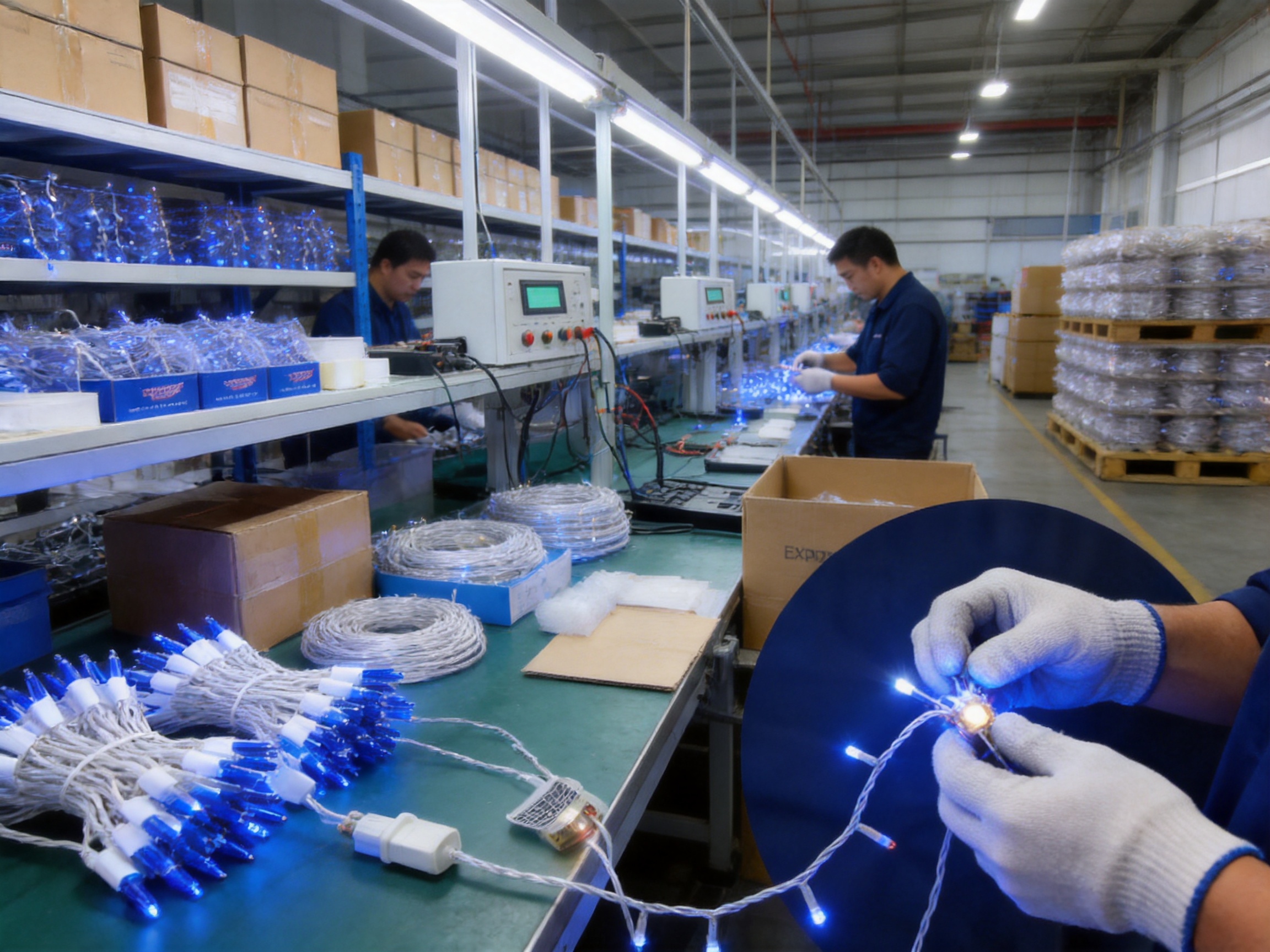
The company was founded in 1968 and was formerly part of Zhejiang Festival Lighting General Factory. Its long involvement in the festive-lighting sector provides accumulated experience in product development, component coordination, assembly, packaging, and export requirements. Decorative lighting may appear simple from the outside, but reliable production requires control over many small details, including bulb placement, wire preparation, connection quality, insulation, soldering or terminal work, testing, and final packing.
The company states that it was among the first domestic companies in the industry to obtain United States UL certification. It also established an ISO 9001 quality system in 1997. These credentials indicate an emphasis on structured quality management and market-specific compliance. Certification alone does not replace product-level verification, but it can give buyers a useful starting point when reviewing supplier capability.
The reported manufacturing approach covers component production through final assembly and shipment. An integrated process can improve coordination between different stages of production. When the same organization manages more of the product journey, it may be easier to monitor material specifications, identify production deviations, coordinate corrective action, and maintain consistent documentation.
Advanced production equipment also supports repeatability. For a 300-bulb icicle set, repeatability matters because the visual pattern should remain consistent from one unit to the next. Buyers often need many sets installed together, and significant variation in wire length, bulb spacing, connector position, or color appearance could reduce the quality of the final display. Controlled machinery and organized workstations can help minimize such variation.
Quality Control from Components to Shipment
Quality control for decorative LED lighting should begin before final assembly. Incoming materials such as copper conductors, PVC insulation, PP components, LED bulbs, connectors, and packaging materials should be checked against specified requirements. Material consistency can affect both appearance and electrical performance.
During assembly, production teams must maintain accurate bulb placement and secure electrical connections. A dense 300-bulb product contains many individual connection points and components, so assembly discipline is essential. Wiring should be routed correctly, insulation should remain intact, and molded parts should be properly fitted. These details influence durability, safety, and the finished visual effect.
Testing can include electrical continuity checks, power verification, illumination inspection, polarity checks where applicable, and visual examination of cable coverings and connectors. Products intended for export may also require documentation and testing aligned with the regulations of the destination market. The listed UL, NOM, CE, REACH, and BSCI credentials provide important information for buyers conducting supplier evaluations.
Final inspection should review the complete assembled light set rather than only individual components. Inspectors may check whether all bulbs illuminate, whether the icicle drops are correctly arranged, whether the cable is free from obvious damage, whether labels are accurate, and whether packaging protects the product during transportation. Careful packing is particularly important because light sets can become tangled, bent, or stressed if they are packed without sufficient organization.
Shipment control is another part of product quality. Correct quantities, carton markings, product variants, certificates, and shipping documents must be coordinated before goods leave the factory. This is especially important for orders containing several wire colors or bulb colors. A well-managed factory process should connect production records with inspection and shipment records so that buyers receive the correct configuration.
Certificates and Market Considerations
The product information lists UL, NOM, CE, REACH, and BSCI. These designations address different aspects of market access, safety, chemical management, and social compliance. Buyers should evaluate the exact scope and validity of each certificate or audit document for the product, factory, and destination market rather than assuming that one certificate covers every requirement.
UL is particularly relevant to buyers serving the United States and certain other markets that recognize or request UL-related compliance. NOM is associated with Mexican standards and may be relevant for products entering Mexico. CE marking is associated with conformity requirements for products placed on the European market, while REACH relates to chemical substances and supply-chain obligations in the European Union.
BSCI is generally connected with social compliance and responsible sourcing audits. For retailers and importers, social compliance information can be an important part of supplier qualification. It may support internal procurement policies, customer expectations, and responsible supply-chain management.
Because regulations vary by country and product configuration, importers should confirm the applicable requirements with local authorities, testing laboratories, compliance consultants, or their own regulatory departments. The listed certifications are valuable indicators, but the final responsibility for market placement and installation remains with the relevant importer, distributor, installer, or user.
Wholesale Supply and Minimum Order Quantity
The stated minimum order quantity is 3,000 units. This requirement indicates that the product is aimed primarily at wholesalers, distributors, retail programs, commercial decorators, project contractors, and other buyers with substantial seasonal demand. A high MOQ may not suit an individual household buyer, but it can be advantageous for businesses seeking factory-direct pricing and consistent product supply.
Large-volume purchasing can help retailers prepare for peak holiday demand well in advance. It may also support private-label programs, regional distribution, chain-store rollouts, and recurring annual orders. Buyers can discuss packaging formats, wire-color combinations, bulb-color selections, labeling, carton quantities, and shipment schedules with the supplier during the quotation and production process.
For a project requiring many units, centralized procurement can reduce the risk of inconsistent color temperatures, different connector designs, or mismatched cable colors. It can also make quality inspection more efficient because a single supplier and product model can be evaluated before the goods are distributed to multiple locations.
Purchasers should consider lead times carefully because holiday lighting demand is seasonal. Production, inspection, inland transportation, export documentation, ocean or air freight, customs clearance, and final delivery all require time. Early forecasting is particularly important for orders that involve custom packaging, multiple bulb colors, or large quantities.
Design and Installation Recommendations
Before installation, the project area should be measured and photographed or mapped. The installer should identify the starting point, the end point, available power sources, attachment locations, connection routes, and areas that may be exposed to foot traffic or moving equipment. A simple plan can prevent unnecessary cable tension and reduce the need for improvised connections.
For rooflines and façades, suitable clips, hooks, or support systems should be selected according to the surface and local conditions. The cable should not be pulled tightly enough to place excessive stress on the conductors or connectors. The hanging sections should be distributed evenly where a uniform appearance is desired.
For trees and landscaping, the installer should avoid trapping the cable against sharp branches or placing it where it may be cut by pruning equipment. The light set should be arranged so that its weight is supported by appropriate attachment points rather than by delicate wire sections. Wind-exposed installations may require additional securing measures.
For indoor displays, the cable should be routed away from doors, walkways, heat sources, and areas where it may be pinched. Window displays should be installed so that the light set does not interfere with cleaning, ventilation, emergency exits, or normal store operations.
Where multiple sets are connected in series, the installer should follow the manufacturer’s instructions concerning the maximum number of units and total power load. Connections should be kept away from standing water and protected in accordance with the product’s intended use. Any damaged wire, cracked insulation, loose connection, or malfunctioning section should be removed from service until it has been properly assessed.
Maintenance, Storage, and Reuse
Proper maintenance can extend the useful life of seasonal lighting. At the end of each operating period, the lights should be switched off, disconnected safely, and inspected for visible damage. Bulbs, wires, connectors, and support points should be checked before the product is packed away.
Light sets should be stored dry and protected from crushing, sharp objects, excessive heat, and rodents. Avoid pulling the strands apart forcefully when removing them from a tree or roofline. Instead, release attachment points gradually and organize the cable into loose coils or a suitable storage arrangement. Excessive bending or knotting can place stress on the wire and increase the risk of damage during the next installation.
Before reuse, the product should be unfolded and tested in a controlled location. This allows the installer to identify problems before the set is placed at height or integrated into a large public display. Commercial operators may find it helpful to keep records of installation dates, storage conditions, inspection results, and replacement needs.
Seasonal lighting is often reused over several years. A clear maintenance process can reduce labor costs, improve safety, and help preserve a consistent appearance across annual events. Products with durable wiring and reliable assembly are more likely to support this type of repeated use when they are handled and stored correctly.
Use in Integrated Holiday Lighting Programs
The 300 Icicle Garland Light Set can serve as one component in a broader decorative lighting program. A complete display may combine icicle lights with net lights on shrubs, linear lights along railings, circular lights around trees, spiral trees in entrances, and copper wire lights for smaller decorative details.
Using coordinated products allows designers to create layers of scale. The icicle lights can define the upper edge of a building or large tree, while smaller copper wire lights can add detail to wreaths, planters, and ornaments. Net lights can fill shrubs or low landscape areas, creating a transition between vertical architectural lighting and ground-level decoration.
Color coordination is important in integrated programs. Clear icicle bulbs can act as a neutral foundation for colored accent lighting. Blue icicle bulbs can be combined with white or cool-toned linear lighting for a winter scene. Multicolor bulbs can become the central feature of a family-oriented display and may be paired with colorful spiral trees or illuminated ornaments.
The supplier’s broad product range may help buyers coordinate these elements through one manufacturing source. This can reduce the complexity of comparing specifications across unrelated suppliers. It may also make it easier to request matching wire colors, packaging styles, certification documents, and shipment schedules.
Commercial Value for Retailers and Project Buyers
For retailers, the product offers a recognizable category with strong seasonal appeal. Icicle lights are familiar to consumers and can be displayed in packaging, store demonstrations, catalogs, and online product listings. The 300-bulb configuration and 18-foot length provide clear selling points that can be communicated easily to customers.
For commercial decorators, the product’s visual density may reduce the number of separate light strands required to achieve a full appearance. This can simplify inventory planning and potentially reduce installation time, although the final result depends on the size and complexity of the project.
For property managers, the indoor and outdoor application range provides flexibility across multiple parts of a property. One product can be used around entrances, rooflines, trees, fences, and event areas, helping maintain a consistent seasonal identity throughout a site.
For distributors, the company’s production capacity and established export experience may support larger procurement programs. The listed certifications and long manufacturing history can also help distributors prepare documentation for their own customers. As with any imported product, buyers should conduct due diligence, confirm current certification records, and establish clear quality standards before placing a large order.
What Makes the Supplier Suitable for Large Orders
A supplier’s ability to produce a decorative light is only one part of commercial suitability. Large buyers also need communication, production planning, quality control, documentation, packaging, and shipping coordination. Taizhou Mingde Decorative Lighting Co., Ltd. presents itself as an integrated and standardized lighting enterprise with long-term experience in these areas.
The company’s production history since 1968 suggests familiarity with seasonal demand cycles and the operational requirements of festive lighting. Its reported annual capacity of 10 million strings indicates that it is structured to handle substantial production volumes. Its product range demonstrates experience across several forms of decorative lighting rather than a narrow focus on one product type.
The company also reports an ISO 9001 quality system established in 1997. A quality management system can help define procedures for purchasing, production, inspection, corrective action, and documentation. For buyers, this may provide a more organized framework for discussing quality expectations and resolving production issues.
Its export orientation is another relevant strength. The company serves markets including the United States and Central and South America, and it reports certifications or compliance credentials relevant to several regions. Export experience can help a supplier understand packaging requirements, document preparation, product labeling, and communication with overseas customers.
Purchasing Checklist for the 300 Icicle Garland Light Set
Before placing an order, buyers should confirm the exact model, bulb quantity, total length, wire color, bulb color, rated power, connector type, packaging method, and intended market. These details should appear clearly in the quotation, purchase order, product specification sheet, and inspection documentation.
Buyers should also ask whether the 18-foot measurement refers to the full assembled length, the illuminated portion, or another defined measurement. If the product will be used for a precise architectural layout, clarification of spacing and icicle-drop dimensions may be important.
For outdoor projects, purchasers should review the applicable ingress protection information, plug and connector requirements, operating conditions, and installation instructions. If these details are not included in the initial product information, they should be requested before production approval.
For series extension projects, the maximum permitted number of connected sets and the total allowable load should be confirmed. The 72-watt rating should be incorporated into the electrical plan, particularly when many units are installed on one circuit.
Buyers should also request current copies of relevant certificates, audit documents, test reports, and quality records. If the product will be sold under a private label, the parties should agree on artwork approval, carton markings, manuals, barcode requirements, and responsibility for regulatory labeling.
Frequently Asked Questions
What is the 300 Icicle Garland Light Set?
It is an LED decorative light set with 300 bulbs arranged in a hanging icicle pattern. The design creates a vertical, layered lighting effect for trees, façades, rooflines, fences, windows, event spaces, and commercial landscapes.
How long is the light set?
The stated total length is 18 feet. The actual usable coverage depends on how the product is installed and whether it is arranged straight, curved, wrapped around a structure, or combined with additional sets.
How many bulbs does the product contain?
The product contains 300 LED bulbs. This dense configuration is intended to provide fuller visual coverage and reduce the appearance of large dark gaps in a decorative installation.
Can it be used outdoors?
The product is identified for indoor and outdoor use. Outdoor installations should follow the manufacturer’s instructions and local electrical requirements. Connections should be protected appropriately, and the product should not be installed with damaged wiring or connectors.
What wire colors are available?
The listed wire options are green and white. Green wire may blend with foliage and evergreen decorations, while white wire may suit snowy themes, light architectural surfaces, and winter displays.
What bulb colors are available?
The listed bulb choices are clear, multicolor, and blue. Clear bulbs provide a classic appearance, multicolor bulbs create a lively festive effect, and blue bulbs support cool-toned winter or contemporary themes.
What is the rated power?
The stated power rating is 72 watts. This specification should be used when estimating energy consumption and planning circuit capacity for an installation.
Can several light sets be connected together?
The product information states that series extension is supported. Installers should confirm the maximum number of connected units, connector requirements, and total permissible electrical load before creating an extended installation.
What materials are used?
The listed materials are PP, PVC, and copper. These materials contribute to the molded components, insulated cable construction, and electrical conductivity of the light set.
What certificates are listed for the product?
The listed certificates and compliance credentials are UL, NOM, CE, REACH, and BSCI. Buyers should verify the current documentation and confirm that it applies to the exact product configuration and destination market.
What is the minimum order quantity?
The stated minimum order quantity is 3,000 units. This indicates that the product is primarily intended for wholesale, distribution, retail, and commercial project purchasing.
Who manufactures the product?
The product is manufactured by Taizhou Mingde Decorative Lighting Co., Ltd., a festive-lighting producer based in Taizhou, Zhejiang Province, China. The company reports a history dating back to 1968 and an annual production capacity of 10 million strings of festive lights.
Is the product suitable for a large Christmas tree?
Yes. The dense 300-bulb configuration and vertical icicle pattern are suitable for large Christmas trees, especially when the strands are distributed across multiple layers of branches. The number of sets required depends on the tree’s height, width, density, and desired brightness.
Can the lights be used for commercial landscaping?
Yes. The product is designed for large-area decorative use and can be applied to trees, fences, building edges, plazas, entrances, and other commercial landscaping features. Installation should be planned according to the site’s electrical and environmental conditions.
How should the light set be stored after the holiday season?
It should be disconnected safely, inspected for damage, allowed to remain dry, and stored in a protected location away from crushing, sharp objects, excessive heat, and rodents. The cable should be organized without excessive pulling, tight knots, or sharp bends.
Conclusion
The 300 Icicle Garland Light Set is designed for buyers who need more than a small decorative string. Its 300 LED bulbs, 18-foot total length, vertical icicle structure, color options, durable material combination, and support for indoor and outdoor use make it suitable for large Christmas trees, façades, rooflines, retail displays, public spaces, and commercial landscaping.
Its advantages over basic decorative light strings include a stronger three-dimensional effect, denser illumination, flexible color choices, commercial-scale coverage, and the ability to support series extension. The 72-watt rating provides a defined basis for electrical planning, while the listed UL, NOM, CE, REACH, and BSCI credentials support buyer evaluation for different markets.
The product is further supported by a manufacturer with a long history in festive lighting, substantial reported production capacity, an established ISO 9001 quality system, export experience, and an integrated manufacturing process covering components, assembly, quality control, and shipment. These strengths make the product relevant to wholesalers, distributors, retailers, event contractors, property managers, and professional holiday-lighting installers.
For the best results, buyers should confirm the exact configuration, certification scope, connector requirements, extension limits, packaging, and destination-market regulations before ordering. When correctly specified, installed, maintained, and stored, the 300 Icicle Garland Light Set can serve as a reliable foundation for bright, cohesive, and visually impressive seasonal lighting programs.
References
1. Product specification sheet for Model MDI300, 300 Icicle Light Set.
2. Manufacturer-provided material information for PP, PVC, and copper decorative light assemblies.
3. Manufacturer-provided company profile for Taizhou Mingde Decorative Lighting Co., Ltd.
4. General principles of LED decorative lighting design, installation, operation, and maintenance.
5. ISO 9001 quality management system principles for manufacturing organizations.
6. General compliance guidance concerning UL, NOM, CE, REACH, and BSCI documentation.
7. Commercial holiday-lighting planning practices for trees, façades, public spaces, and landscaped environments.
Product: 300 Icicle Garland Light Set


Don't Miss New Releases & Subscriber Exclusives
Sign up for our newsletter to stay in the holidy spirit all year.
Further Questions? Contact Us
-
Useful Links
Home Products About Us Production Services News Contact Us -
Classification
Mini String Light LED Light Set Garland Light Light-up Spiral Trees LED Curtain Lights Battery Light LED Copper Wire Light Decorative Light -
Contact Info
zd@zflgf.com.cn+86-576-82467401
+86-13968612122 ( Ms. Zhang )
+86-13505747679 ( Mr. Tan )
+86-15062835074 ( Mr. Cheng )No.270 Zhenxi Road, Xinqiao Town, Luqiao District, Taizhou City, Zhejiang Province, China -


Holiday Lights Supplier