

 中文简体
Silk-Wrapped Candy Cane LED Decorative Lights for Premium Holiday Displays
Holiday lighting has developed far beyond the traditional string of bulbs. Today, retailers, hospitality businesses, event planners, interior decorators, and homeowners are looking for decorative lighting that performs several functions at once: it must provide attractive illumination, create a memorable visual identity, fit different display environments, and remain practical to install and operate. The Silk-Wrapped Candy Cane LED Decorative Light responds to these needs by combining a sculptural metal frame, warm white LED illumination, decorative silk wrapping, reflective sequins, and flexible placement options in one distinctive seasonal product.
With a listed size of approximately 27 × 5 × 30 and an arrangement of 60 LED lights, this decorative light is designed to create a concentrated visual statement rather than simply blend into a long lighting strand. Its candy cane-inspired appearance connects naturally with Christmas and winter themes, while its three-dimensional wire construction allows it to function as a tabletop ornament, a hanging display, or part of a larger commercial installation. The silk-wrapped surface adds a softer and more luxurious appearance than exposed wire or ordinary plastic decorations.
This article examines the product’s design, illumination, material composition, installation advantages, commercial applications, quality considerations, and the manufacturing strengths behind its production. It also compares the product with common competing holiday light formats and provides practical answers for buyers evaluating decorative lighting for seasonal programs.
1. Product Overview and Design Concept
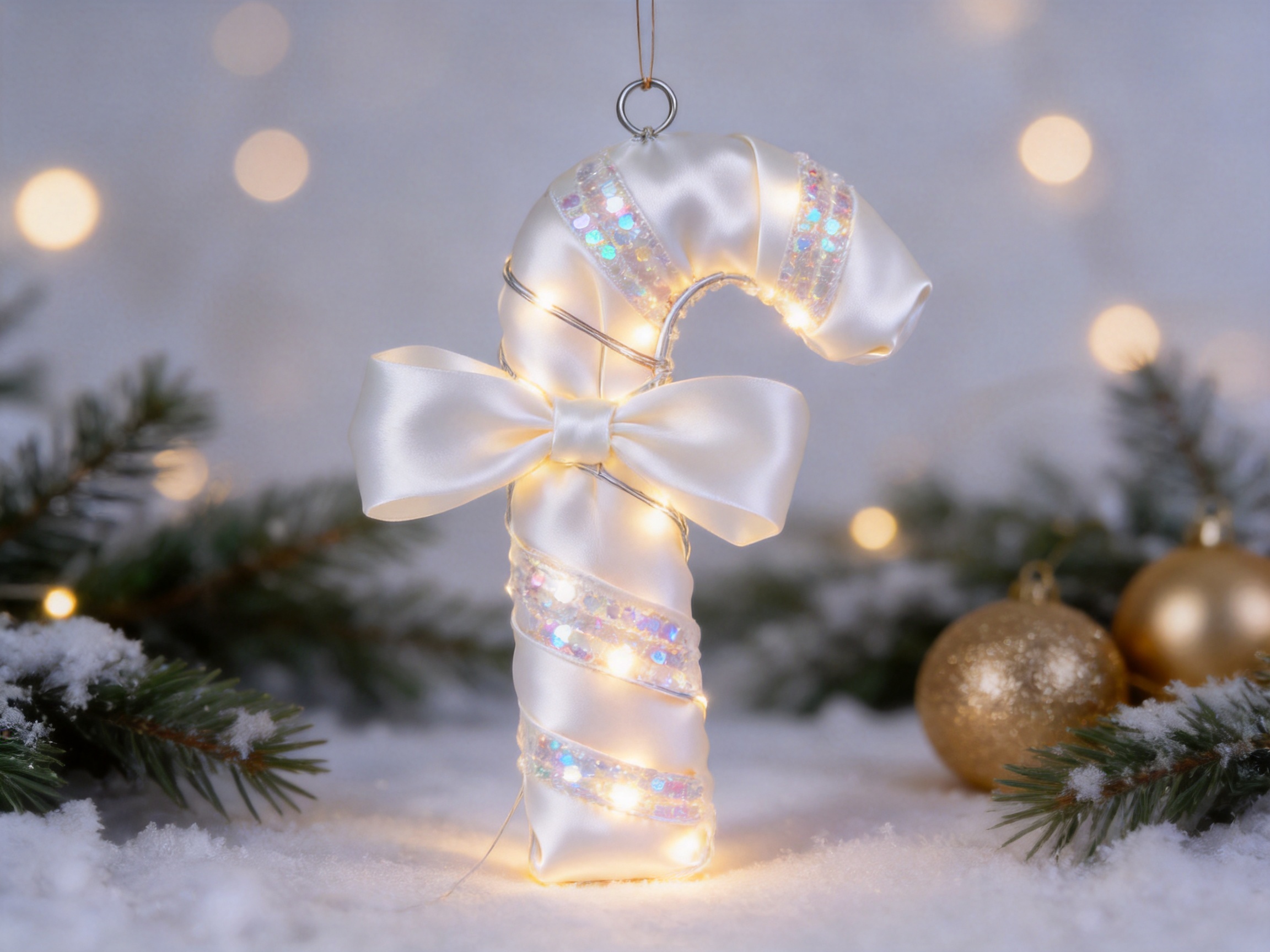
The Silk-Wrapped Candy Cane LED Decorative Light is a compact, shaped lighting decoration created for festive environments. Its design combines the recognizable visual language of a candy cane with the layered appearance of a small ornamental tree or seasonal silhouette. The structure is formed from metal wire, giving the product a defined outline and a stable three-dimensional profile. Silk material is wrapped around the frame, while iridescent sequins are applied to the surface to create additional sparkle when exposed to light.
This construction gives the product a stronger decorative identity than a standard string light. A string light is generally seen as a series of points connected by cable. By contrast, this product is a complete decorative object: its outline, surface, illumination, and reflective details are designed to work together as one visual composition. Even when the light is turned off, the wrapped frame and sequined finish can continue to contribute to a seasonal display.
The product is listed under the Decorative Light category and is suitable for Christmas, New Year celebrations, winter promotions, retail displays, parties, hospitality interiors, and festive home decoration. The top hanging ring allows the unit to be suspended from a hook, wall point, branch, display frame, or window fixture. It can also be positioned on a table, shelf, reception desk, entrance console, or merchandising platform, depending on the supporting arrangement.
| Product Feature | Specification or Benefit |
| Product type | Silk-wrapped candy cane LED decorative light |
| Approximate size | 27 × 5 × 30 |
| LED quantity | 60 LED lights |
| Materials | Iron, copper, PVC, LED components, and silk |
| Power specification | 3AA battery operation as listed in the product specification |
| Structural feature | Three-dimensional metal wire frame with top hanging ring |
| Decorative finish | Silk wrapping and iridescent sequins |
| Primary light color | Warm white |
| Minimum order quantity | 1,000 units |
| Typical uses | Christmas, New Year, retail, hospitality, events, and home decoration |
Because power configurations can vary according to production version, buyers should confirm the final operating method, battery compartment, controller, cable length, and packaging details before placing a purchase order. The supplied specification identifies 3AA battery power, while the descriptive material also mentions plug-in operation. This difference should be resolved during technical confirmation so that the delivered product matches the intended installation environment.
2. Why the Decorative Form Matters
Many seasonal lights rely on repetition. A long line of bulbs may be useful for outlining a roof, wrapping a tree, or decorating a railing, but it does not always provide a strong focal point. Shaped decorative lights address this limitation by giving the viewer an immediately recognizable object. A candy cane silhouette communicates the holiday theme without requiring additional signs or graphic elements.
The three-dimensional frame is particularly valuable in commercial displays. A flat printed decoration can appear effective from one direction but lose impact when viewed from the side. A dimensional wire structure can remain visible from several angles, making it suitable for storefront windows, hotel entrances, restaurant counters, shopping centers, and event venues. The product’s narrow profile also helps it fit into areas where a large freestanding decoration may be impractical.
The silk wrapping changes the visual character of the frame. Bare metal wire may look functional or industrial, while silk introduces texture and a softer surface. The wrapped material can help the light integrate with luxury-oriented displays, boutique interiors, gift shops, department store windows, and premium residential spaces. It is a useful option for buyers who want holiday lighting to appear decorative and refined rather than purely utilitarian.
The addition of iridescent sequins creates a second layer of visual movement. Warm white LEDs provide the primary illumination, while the sequins catch and redirect portions of the light. Depending on the viewing angle, they may produce shifting highlights and subtle rainbow-like reflections. This effect can make the decoration look more dynamic without requiring complicated lighting programs or color-changing electronics.
Compared with a simple fabric-wrapped ornament without lighting, this product has greater evening visibility. Compared with an exposed LED outline, it offers more surface texture and a more finished appearance. Compared with a large illuminated sculpture, it is more compact and easier to place in smaller display zones. These combined characteristics make it suitable for buyers who want a decorative centerpiece with manageable installation requirements.

Candy Cane LED Decorative Lights with Silk Wrapped
3. Illumination Performance and Visual Atmosphere
The product contains 60 LED lights arranged across its decorative structure. LEDs are widely used in seasonal lighting because they can provide consistent illumination with relatively low heat generation and efficient power consumption compared with many older lighting technologies. In this design, the LEDs are intended to illuminate the shaped frame and the silk-wrapped surface rather than produce a harsh spotlight.
The warm white light is an important part of the product’s appeal. Cool white light can create a crisp, icy, or contemporary mood, while warm white light generally produces a more welcoming and traditional atmosphere. For Christmas displays, warm white illumination works well with wood, textiles, metallic ornaments, greenery, red accents, gold decorations, and neutral interior finishes.
Even coverage is also important. A decorative silhouette can appear unfinished if the light sources are concentrated in only one area. The stated quantity of 60 LEDs supports a fuller distribution across the frame. When installed correctly, the light can define the outline while also highlighting the silk wrapping and reflective sequins. This allows the product to remain visually interesting both at a distance and during close viewing.
The product is not positioned as a high-output area lamp. Its purpose is decorative illumination and atmosphere creation. Buyers should therefore evaluate it according to the role it is expected to perform. It is well suited to accent lighting, visual merchandising, seasonal mood lighting, and decorative focal points. It should not be treated as a replacement for general room lighting, emergency lighting, or task lighting.
Battery operation offers an advantage in locations where electrical outlets are limited or where visible power cords would reduce the quality of the display. A battery-powered unit can be placed on a tabletop, inside a window, on a temporary event structure, or in a retail installation without planning the decoration around an outlet. It can also simplify short-term holiday setups and reduce the need for extension cords.
At the same time, commercial users should plan battery replacement or maintenance schedules when operating multiple units for extended periods. Runtime depends on battery quality, LED configuration, operating conditions, and whether the unit includes a timer or control function. Buyers should request confirmed runtime data and control specifications for their planned application.
4. Materials and Construction Advantages
4.1 Iron Wire Framework
Iron provides the structural foundation of the product. A wire frame allows the manufacturer to create curves, angles, layers, and shaped outlines while keeping the overall form relatively lightweight. The metal skeleton also supports the wrapped surface and helps the finished decoration retain its intended shape during display.
For a candy cane-inspired product, the frame must communicate the correct seasonal silhouette while accommodating the LED layout and decorative covering. A well-formed wire structure helps maintain symmetry and gives the product a more professional appearance. In commercial settings, consistent shape is particularly important because multiple units are often displayed together.
4.2 Copper Conductive Elements
Copper is included among the listed materials and is commonly used in lighting products for conductive wiring because of its electrical conductivity and flexibility. Copper conductors can be routed around shaped frames more easily than rigid wiring, helping manufacturers distribute LED components across curved or layered surfaces.
Flexible conductive paths are valuable in decorative products because the lighting circuit must follow the design rather than remain on a straight cable. Proper routing can reduce visual clutter, support a cleaner finish, and improve the consistency of illumination throughout the structure.
4.3 PVC Components
PVC may be used in insulating, protective, or component-supporting parts of the lighting assembly. In a seasonal decorative product, appropriate insulation helps separate conductive elements and supports safer handling during normal use. The exact PVC application, thickness, and performance rating should be confirmed in the technical documentation for the specific order.
4.4 Silk Wrapping
Silk is the most distinctive surface material in this design. It adds a textile layer that can soften the appearance of the metal frame and create a more ornamental finish. The wrapped surface also gives the product a tactile quality that is absent from many molded plastic decorations.
The silk finish can help differentiate the product in a crowded holiday lighting market. Many competing items use plain plastic tubing, bare wire, paper, or inexpensive fabric. A carefully applied silk covering can communicate greater attention to appearance and help the product fit premium or luxury-oriented merchandising programs.
4.5 Iridescent Sequins
The sequins provide reflected highlights that respond to movement and changing viewing angles. They can catch the warm white LED output and create small flashes of color across the surface. This is especially useful in storefronts and event settings, where visitors move around the display and observe it from different positions.
Reflective decoration also helps the product remain noticeable when the LEDs are not operating at full brightness. During daytime window displays, the sequins can contribute to the visual appeal of the item, making the product more versatile than a decoration that depends entirely on illumination.
5. Advantages Compared with Common Competitor Products
The holiday lighting market includes many product types, including string lights, curtain lights, net lights, rope lights, plastic figurines, wire sculptures, and fabric ornaments. Each has a useful role, but the Silk-Wrapped Candy Cane LED Decorative Light offers a combination of features that is not always available in a single competing product.
5.1 Compared with Ordinary LED String Lights
Ordinary LED string lights are flexible and economical, but they generally require a separate surface or object for support. They may be wrapped around a tree, attached along a wall, or arranged around a window. Their final appearance depends heavily on installation technique.
The candy cane decorative light arrives as a shaped object with its own visual identity. It does not require the buyer to form the decoration manually. This can reduce setup time and help ensure consistent results across multiple display locations. It is particularly useful when the buyer wants a recognizable holiday symbol rather than a line of individual light points.
5.2 Compared with Plastic Holiday Figures
Molded plastic figures can provide strong shapes and outdoor visibility, but they may be bulky, rigid, and less suitable for refined indoor environments. Some plastic decorations also have a highly commercial or toy-like appearance.
The silk-wrapped frame offers a softer and more decorative alternative. Its textile finish and sequins can be better suited to boutique retail, hotel interiors, restaurant settings, and premium residential decoration. The metal wire construction also allows a lighter visual profile than a solid molded figure.
5.3 Compared with Bare Wire Sculptures
Bare wire sculptures can be elegant and modern, but the exposed structure may look incomplete when the lights are turned off. Their appearance often depends almost entirely on the LED points or the surrounding display.
This product adds silk and sequins to the wire framework, creating a more finished surface. The material combination gives it decorative value during both illuminated and non-illuminated periods. This can be important for stores that operate during daylight hours or for venues where lighting schedules change throughout an event.
5.4 Compared with Curtain and Net Lights
Curtain and net lights are excellent for covering large surfaces, but they can be too broad for a small counter, narrow window, shelf, or reception desk. They also produce a background effect rather than a concentrated decorative symbol.
The compact shaped format of this product makes it easier to use as an accent. It can be positioned in a small area without overwhelming the surrounding display. Multiple units can also be grouped to create a larger composition while retaining clear individual shapes.
5.5 Compared with Plug-In-Only Decorations
The listed 3AA battery power gives the product a placement advantage over decorations that require permanent access to a wall outlet. Battery operation can be useful for temporary installations, mobile displays, remote corners, and locations where cables would create a safety or appearance concern.
Because the descriptive information also refers to plug-in operation, buyers should confirm whether a particular version is battery powered, plug-in powered, or available in both configurations. Offering multiple power options can be valuable for distributors serving different markets and installation conditions.
5.6 Compared with Low-Cost Seasonal Decorations
Low-cost decorations may compete primarily on purchase price, but they do not always provide the same level of material layering, shape definition, or surface detail. A product combining an iron frame, copper conductors, PVC elements, LEDs, silk, and sequins has a broader construction profile than a basic plastic ornament.
For retailers, the additional visual value can support premium positioning and giftable presentation. For commercial users, a more distinctive product may contribute more effectively to customer experience and brand atmosphere. The correct comparison should therefore consider not only unit price, but also appearance, display flexibility, expected service life, packaging, quality control, and consistency between batches.
6. Display Applications
6.1 Retail Storefronts
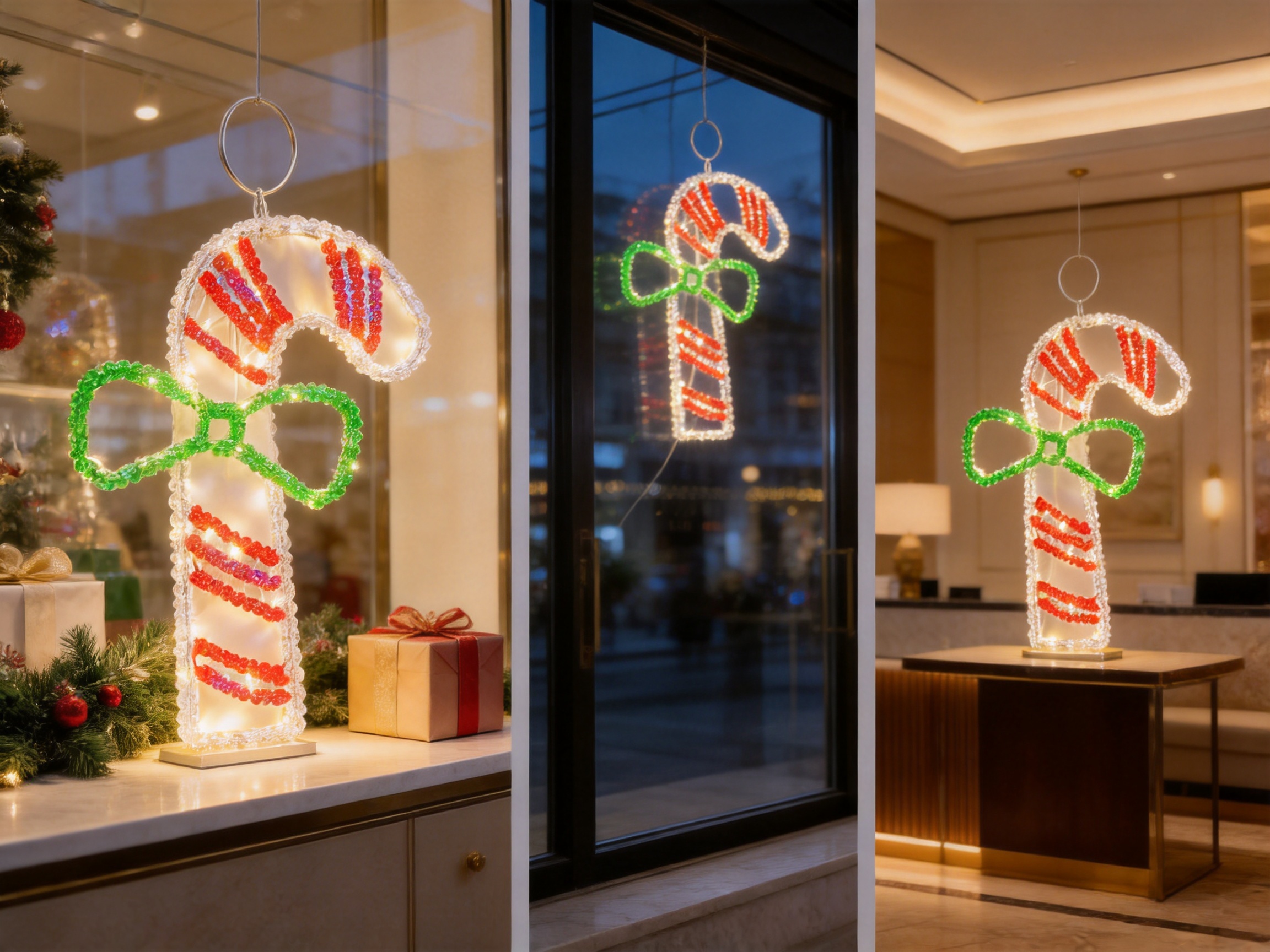
Storefront windows need decorations that attract attention without hiding merchandise. The candy cane form communicates a seasonal message quickly and can be positioned alongside products, signage, snow effects, artificial greenery, or other lights. Its reflective sequins may catch the attention of pedestrians, while the warm white LEDs create a welcoming evening display.
Retailers can place individual units at different heights or combine several units to create a repeated visual rhythm. A larger window may use the lights as foreground accents, while a smaller window may use one unit as the primary seasonal focal point.
6.2 Hotel and Restaurant Interiors
Hotels, restaurants, cafés, and event venues often seek holiday decorations that feel festive without appearing overly informal. The silk-wrapped surface supports a more polished visual language than many basic seasonal products. The light can be displayed at reception areas, entrance tables, bar counters, private dining rooms, buffet stations, and waiting areas.
In hospitality settings, the hanging ring may allow the product to be suspended in windows or from decorative frames. When used in groups, the units can help establish a consistent seasonal identity across multiple spaces.
6.3 Residential Decoration
For homes, the product can be placed on a mantel, sideboard, entryway table, bookshelf, bedroom console, or holiday display cabinet. Its size makes it suitable for accent decoration in apartments and smaller rooms where larger illuminated figures may be difficult to accommodate.
The battery-powered specification can be especially convenient for homeowners who do not want to route cords across a room. The product can be moved between rooms as the household’s decoration plan changes.
6.4 Events and Temporary Installations
Wedding venues, corporate parties, shopping events, winter markets, community celebrations, and seasonal photo areas can use shaped LED decorations to establish a festive environment quickly. A battery-operated design can simplify temporary placement, especially when the display is assembled for only a few hours or days.
Event planners may combine the lights with fabric backdrops, artificial snow, metallic ornaments, gift boxes, wreaths, or themed props. The candy cane silhouette can also serve as part of a larger color or shape concept.
6.5 Commercial Window and Point-of-Sale Displays
At the point of sale, decorative lighting can help direct attention toward a featured product or seasonal promotion. The compact form can be placed near gift collections, confectionery displays, holiday accessories, or promotional signage. Because it is a complete decorative object, it can be relocated without redesigning an entire lighting system.
7. Installation and Arrangement Recommendations
Before installation, buyers should inspect the frame, wrapped surface, LED wires, battery compartment, and hanging ring. The product should be placed on a stable and level surface when used as a tabletop decoration. If it is hung, the support point should be strong enough for the product and positioned so that the decoration remains clear of doors, moving equipment, heat sources, and sharp edges.
The top hanging ring expands the product’s application range. It can be used with a small hook, transparent line, ribbon, or compatible display fixture. When hanging several units, maintaining equal spacing can create a more orderly appearance. Using different heights can produce a layered effect, but the arrangement should remain balanced and should not place tension on the electrical connection or frame.
For a storefront, one option is to place the product near the lower or middle section of the window, where it can be viewed from the street. Another option is to suspend it near a corner or above a product group. The warm white light can be combined with darker backgrounds to increase contrast. Reflective sequins may be more visible when positioned where they can receive both the LED illumination and ambient light from the surrounding display.
For tabletop use, the product can be paired with small ornaments, pine branches, wrapped gifts, candles designed for safe decorative use, or neutral textile materials. The frame should not be covered by unrelated items, because doing so may reduce the visibility of the candy cane shape and interfere with light distribution.
Installers should avoid placing the product near water, excessive humidity, open flames, or high-temperature equipment unless the final product has been specifically certified for those conditions. Indoor and outdoor suitability should be confirmed before use. Seasonal decorations are often moved frequently, so careful handling is recommended to protect the silk wrapping, sequins, wire frame, and wiring connections.
8. Manufacturing Strengths Behind the Product
The product is supplied by Taizhou Mingde Decorative Lighting Co., Ltd., a Chinese manufacturer with a long history in the festive lighting industry. According to the supplied company information, the enterprise was founded in 1968 and was formerly connected with Zhejiang Festival Lighting General Factory. It has developed annual production capacity of approximately 10 million strings of festive lights and serves export markets including the United States and Central and South America.
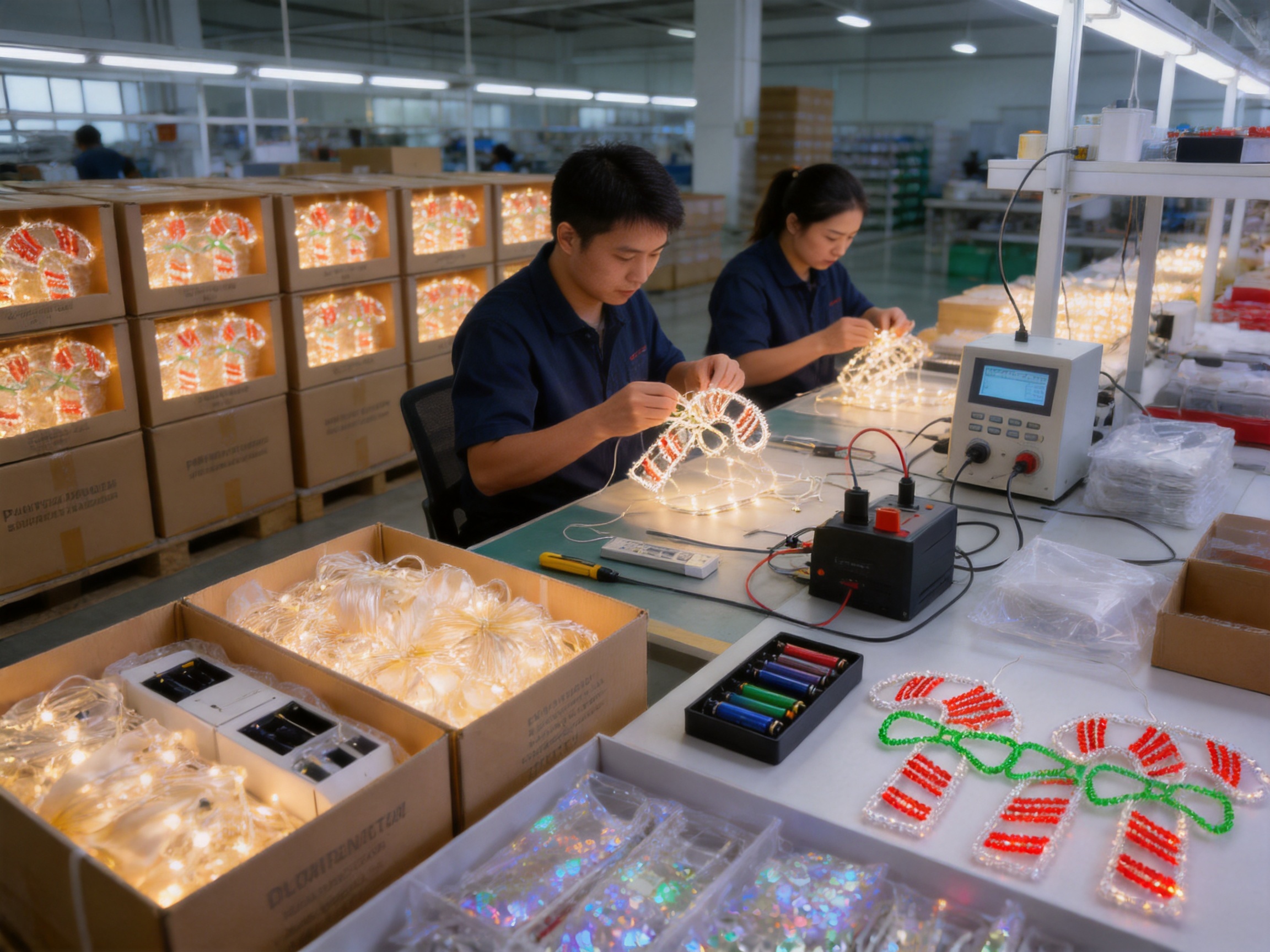
This scale is relevant to buyers evaluating shaped decorative lights because reliable production requires more than assembling individual LEDs. A product like the silk-wrapped candy cane light involves frame forming, material preparation, electrical assembly, decorative wrapping, sequin application, inspection, packaging, and shipment coordination. A manufacturer with established festive-lighting experience is better positioned to organize these stages consistently.
8.1 Integrated Production Capability
The company describes its operations as an integrated and standardized lighting enterprise. Integrated production can help coordinate component manufacturing and final assembly. When suppliers and production teams work within an organized quality system, it becomes easier to monitor material consistency, maintain production schedules, and address defects before shipment.
For shaped products, integrated control is especially useful because the physical design and electrical system must fit together accurately. The frame must support the LED layout, the wiring must follow the shape, and the decorative covering must not interfere with illumination or assembly. Coordinating these details reduces the risk of mismatched components and uneven finishing.
8.2 Production Equipment and Process Control
The supplied company profile states that advanced production equipment is used throughout the manufacturing process. Equipment suitable for wire forming, component assembly, electrical testing, and packaging can improve repeatability. Repeatability matters to distributors ordering 1,000 units or more, since customers expect products in the same shipment to have similar shape, brightness, finish, and packaging quality.
Process control also helps reduce variation in silk wrapping and sequin placement. Hand finishing may be part of the production process for a decorative item, but clear work instructions and inspection standards are needed to ensure that the finished products maintain a consistent appearance.
8.3 Quality Management Experience
The company reports that it established an ISO 9001 quality system in 1997. A quality management system provides a framework for documenting procedures, monitoring production, recording nonconformities, and supporting continual improvement. Certification or claimed implementation should always be verified through current documentation when required for a specific project, but the stated history indicates long-term attention to organized quality control.
The company also reports being among the first domestic festive-lighting companies to obtain U.S. UL certification. Buyers should request current certification information for the exact product, power supply, controller, and target market, because approvals may apply to particular models or configurations. Even so, the company’s stated certification history is a positive indicator of experience with international compliance expectations.
8.4 Experience in Export Markets
Export experience can help a manufacturer understand the practical requirements of overseas customers, including packaging, labeling, documentation, shipment coordination, and market-specific electrical expectations. For buyers importing seasonal lighting, these capabilities can reduce communication challenges and support more predictable order execution.
Experience serving the United States and Central and South American markets may also help the manufacturer accommodate different commercial practices, seasonal calendars, and product preferences. Buyers should still confirm all destination-specific requirements, including voltage, battery labeling, materials declarations, packaging language, testing, and applicable safety standards.
8.5 Broad Product Knowledge
The company’s product range includes linear lights, icicle lights, net lights, circular lights, spiral trees, LED string lights, copper wire lights, and cord lights. This broad category experience can support buyers who need coordinated seasonal collections. A distributor may source the silk-wrapped candy cane light together with other lighting formats while maintaining a consistent supplier relationship.
Knowledge across several lighting categories may also help with custom development. For example, a buyer may want a different shape, light color, surface textile, battery configuration, packaging style, or sequence of LEDs. The feasibility of such modifications must be assessed individually, but an established manufacturer with multiple product lines may be able to evaluate them more efficiently than a supplier focused on one simple item.
9. Quality Control Considerations for Buyers
Before approving a bulk order, buyers should evaluate both the sample and the documented production requirements. Important points include the accuracy of the product dimensions, the number and color of LEDs, the uniformity of illumination, the strength of the wire frame, the quality of the silk wrapping, and the security of the sequins.
Electrical checks should include continuity testing, basic insulation review, battery compartment inspection, switch or controller performance, and operating stability. If the product is supplied in a plug-in version, the adapter, plug type, input voltage, output voltage, cable length, and certification status should be confirmed separately. If the product is battery powered, the battery type, polarity markings, compartment closure, and expected runtime should be documented.
Visual inspection should look for loose threads, exposed wire, uneven wrapping, sharp frame ends, missing sequins, inconsistent LED spacing, and damage caused by packaging. A defined acceptable quality limit can help buyers and manufacturers use the same standard during pre-shipment inspection.
Packaging is also important. Silk and sequins can be damaged by compression, friction, or moisture during transport. The packaging design should protect the frame from bending and keep decorative surfaces from rubbing against abrasive materials. Inner cartons, protective separators, molded supports, or suitable wrapping materials may be considered according to the order quantity and shipping method.
10. Wholesale and Private-Label Potential
The stated minimum order quantity is 1,000 units, making the product suitable for wholesalers, importers, retail chains, event suppliers, hospitality groups, and seasonal merchandise distributors. A larger order volume can support coordinated retail programs and consistent visual presentation across multiple locations.
For retailers, the product can be positioned as a premium seasonal accent rather than a basic light string. Packaging may emphasize the shaped design, silk wrapping, warm white illumination, reflective sequins, and multiple placement options. Product photography should show both illuminated and non-illuminated views so customers understand the surface details as well as the lighting effect.
Private-label buyers should discuss carton markings, retail packaging, instruction sheets, barcode requirements, language requirements, color variations, and product naming before production. They should also verify whether any requested branding changes affect the minimum order, lead time, tooling, or approval process.
Distributors can use the product as part of a wider holiday collection. For example, the candy cane light may be paired with string lights for trees, curtain lights for windows, copper wire lights for table displays, and spiral trees for entrances. A coordinated assortment can help retailers create complete seasonal solutions instead of selling isolated products.
11. Sustainability and Responsible Use
LED technology can support more efficient decorative lighting than traditional incandescent sources, particularly when used for long seasonal display periods. Lower heat output may also reduce heat-related concerns in certain indoor applications. However, responsible use depends on the complete product, including the power system, materials, operating schedule, and end-of-life handling.
Battery-powered products require appropriate battery management. Users should install the correct battery type, observe polarity markings, remove batteries during long-term storage, and dispose of depleted batteries according to local requirements. Retail packaging can include clear battery instructions to reduce misuse and improve the customer experience.
Manufacturers and buyers can also consider packaging efficiency, durable materials, repair or replacement policies, and shipping optimization. Because seasonal decorations are often stored for much of the year, durable packaging and clear storage instructions can help extend the product’s useful life across multiple seasons.
The company’s stated mission includes nature-friendly home ambient lighting. Buyers seeking environmental claims for marketing purposes should request specific supporting information rather than relying on general wording. Useful documentation may include material declarations, packaging information, energy data, compliance reports, and instructions for responsible disposal.
12. Selecting the Right Version for a Project
Different projects require different power and display arrangements. A homeowner may prioritize battery convenience, while a permanent retail window may prefer a continuous plug-in supply. A hotel may require a coordinated collection with matching light colors, while an event planner may need easy setup and removal. The product concept can serve all of these applications, but the exact configuration should be selected carefully.
Buyers should confirm the following details during inquiry and sample approval:
1. Final product dimensions and measurement tolerance.
2. LED quantity, LED color, brightness, and spacing.
3. Battery or plug-in power configuration.
4. Battery runtime or adapter specifications.
5. Whether a timer, switch, controller, or mode function is included.
6. Silk color, wrapping density, and decorative sequin finish.
7. Frame material, coating, and resistance to deformation.
8. Hanging ring dimensions and recommended support method.
9. Indoor or outdoor suitability.
10. Retail packaging, master carton quantity, and shipping protection.
11. Applicable certification and test documentation.
12. Production lead time and pre-shipment inspection arrangements.
These questions are especially important when the product will be sold in multiple countries. Electrical requirements, consumer instructions, packaging rules, and labeling obligations can differ by market. Confirming them before mass production helps reduce delays and protects both the supplier and the buyer.
13. Merchandising Ideas for Stronger Sales
The product’s strongest selling point is its combination of recognizable holiday symbolism and premium decorative texture. Merchandising should therefore show the item in a complete environment rather than presenting it only as an isolated technical product. A warm interior scene can demonstrate how the light works with furniture, greenery, gifts, and other seasonal elements.
Retailers can create a “small-space holiday” theme around the product, showing how one compact light can add seasonal atmosphere to an apartment, office, reception desk, or narrow shop window. Another merchandising theme can focus on premium textile decoration, pairing the silk-wrapped surface with ribbons, ornaments, table linens, and upscale gift packaging.
For commercial buyers, the product can be presented as a modular display element. One unit can create a subtle accent, while several units can establish repetition across a window or venue. Buyers may also combine different sizes or related shapes if the manufacturer offers them as part of a broader collection.
Product descriptions should clearly explain that the decoration is intended for atmosphere and visual enhancement. They should also provide accurate information about power, battery requirements, intended location, handling, and care. Clear communication helps prevent customer confusion and supports better reviews after purchase.
14. Care, Storage, and Service Life
Careful storage is essential for preserving the silk wrapping and sequins between holiday seasons. The product should be stored in a dry, clean environment away from direct heat, moisture, sharp objects, and heavy pressure. Avoid placing heavy cartons on top of the decoration, because the frame may bend or the wrapped surface may become compressed.
If the product is battery powered, batteries should be removed before long-term storage unless the manufacturer’s instructions state otherwise. The wiring should not be tightly folded or pulled around the frame. When preparing the decoration for storage, it is better to support the shape and use protective packaging that prevents the surface from rubbing against rough cardboard or metal edges.
Before the next season, users should inspect the frame, wiring, LEDs, battery compartment, hanging ring, and surface decoration. Any damaged electrical component should be handled according to the manufacturer’s service guidance. Users should not modify the wiring, replace components with incompatible parts, or operate a damaged product in a way that could create a safety risk.
15. Overall Assessment
The Silk-Wrapped Candy Cane LED Decorative Light occupies a useful position between simple string lighting and large illuminated holiday sculptures. It is more visually complete than a loose strand of bulbs, more textile-rich than a basic plastic ornament, and more space-efficient than a large three-dimensional figure. Its 60 warm white LEDs provide decorative illumination, while the iron wire frame, silk wrapping, and iridescent sequins create a layered appearance that remains attractive from different viewing angles.
The product is particularly strong for buyers who need a recognizable seasonal symbol with flexible placement options. The top hanging ring supports suspended displays, while the compact form can also be used on tables, shelves, counters, and window platforms. The stated 3AA battery power offers freedom from fixed outlets, although the separate reference to plug-in operation should be clarified for every order.
From a sourcing perspective, the manufacturer’s long history, reported production scale, quality-system experience, certification background, export knowledge, and broad festive-lighting portfolio provide a strong foundation for commercial cooperation. These factors are valuable when buyers require stable production, repeat orders, coordinated product collections, and market-specific documentation.
The greatest competitive advantage is the combination of design and manufacturing practicality. The light is decorative enough for premium environments, compact enough for flexible placement, distinctive enough for seasonal merchandising, and structured enough for repeat production. With appropriate quality verification, packaging protection, and power specification confirmation, it can serve as an effective addition to holiday lighting collections for homes, stores, hotels, restaurants, event venues, and public-facing seasonal displays.
Questions and Answers
Q1: What type of product is the Silk-Wrapped Candy Cane LED Decorative Light?
It is a shaped LED decorative light featuring a three-dimensional metal wire frame, silk wrapping, iridescent sequins, and warm white LED illumination. It is designed primarily for seasonal and festive decoration rather than general room lighting.
Q2: How many LEDs does the product contain?
The supplied specification lists 60 LED lights. Buyers should confirm the final LED arrangement, light color, brightness, and spacing during sample approval.
Q3: What materials are used?
The listed materials are iron, copper, PVC, LED components, and silk. These materials support the frame, electrical circuit, insulation, lighting, and decorative surface.
Q4: Is the product battery powered or plug-in powered?
The specification table lists 3AA battery power, while the descriptive information mentions plug-in operation. This apparent difference should be clarified with the supplier before ordering. The final power method may depend on the selected version or production configuration.
Q5: Can it be hung on a wall or in a window?
Yes. The product includes a top hanging ring intended to make suspension easier. The selected hook, line, or fixture should be strong enough to support the product, and the installation should avoid heat, water, moving equipment, and excessive tension on the wiring.
Q6: Can it be placed on a table?
Yes. The product is described as suitable for tabletop placement, including use on entryway furniture, counters, shelves, reception desks, and seasonal display platforms. It should be placed on a stable surface and arranged so that the shape and light remain visible.
Q7: What atmosphere does the warm white LED create?
Warm white light generally creates a soft, welcoming, traditional, and comfortable holiday atmosphere. It can coordinate with Christmas greenery, wood, gold decorations, red accents, textiles, and neutral interior finishes.
Q8: What do the sequins add to the design?
The iridescent sequins reflect and refract portions of the LED light, creating changing highlights and subtle rainbow-like effects. They also add visual interest when the product is viewed from different angles or during daylight display periods.
Q9: How is this product different from ordinary string lights?
Ordinary string lights provide individual points of illumination along a cable and usually require the user to create the final shape. This product is a complete shaped decoration with its own metal frame, surface finish, and hanging feature, allowing it to function as a ready-made visual centerpiece.
Q10: What is the minimum order quantity?
The supplied product information lists a minimum order quantity of 1,000 units. Buyers should confirm whether packaging customization, color changes, or special electrical configurations affect the minimum order.
Q11: Is the product suitable for outdoor use?
Outdoor suitability is not established by the supplied information. Buyers should request confirmation of the product’s ingress protection, material treatment, power-system suitability, and applicable outdoor safety testing before using it outside.
Q12: What should commercial buyers verify before mass production?
They should verify dimensions, LED quantity and color, power configuration, runtime or adapter data, frame quality, silk and sequin finish, packaging, labeling, certifications, country-specific requirements, lead time, and inspection standards.
Q13: What manufacturing strengths support this product?
The manufacturer reports a history dating to 1968, annual production capacity of approximately 10 million strings of festive lights, an ISO 9001 quality system established in 1997, experience with U.S. UL certification, advanced production equipment, integrated manufacturing, and export experience in several international markets.
Q14: How should the product be stored?
It should be stored in a dry, clean location away from heat, moisture, heavy pressure, and sharp objects. Battery-powered versions should generally be stored without batteries unless the manufacturer provides different instructions. Protective packaging should prevent the silk and sequins from rubbing against rough surfaces.
Q15: Who is the product best suited for?
It is suitable for holiday lighting distributors, retail chains, hospitality businesses, event planners, gift shops, seasonal decorators, commercial window designers, and homeowners seeking a compact premium decorative light with flexible placement options.
References
1. Product specification supplied for the Silk-Wrapped Candy Cane LED Decorative Light, including dimensions, LED quantity, materials, power information, and minimum order quantity.
2. Product information supplied for the silk-wrapped candy cane-shaped decorative lighting design, including use scenarios, hanging ring, warm white illumination, and sequin effect.
3. Company information supplied for Taizhou Mingde Decorative Lighting Co., Ltd., including production capacity, company history, export markets, product range, and manufacturing capabilities.
4. ISO 9001 quality management principles, with emphasis on documented processes, continual improvement, inspection, and customer-focused production control.
5. General LED lighting engineering principles relating to energy efficiency, low heat output, circuit design, and decorative illumination.
6. General retail visual merchandising principles for seasonal displays, focal-point decoration, customer attention, and coordinated product presentation.
Product: Candy Cane LED Decorative Lights with Silk Wrapped


Don't Miss New Releases & Subscriber Exclusives
Sign up for our newsletter to stay in the holidy spirit all year.
Further Questions? Contact Us
-
Useful Links
Home Products About Us Production Services News Contact Us -
Classification
Mini String Light LED Light Set Garland Light Light-up Spiral Trees LED Curtain Lights Battery Light LED Copper Wire Light Decorative Light -
Contact Info
zd@zflgf.com.cn+86-576-82467401
+86-13968612122 ( Ms. Zhang )
+86-13505747679 ( Mr. Tan )
+86-15062835074 ( Mr. Cheng )No.270 Zhenxi Road, Xinqiao Town, Luqiao District, Taizhou City, Zhejiang Province, China -


Holiday Lights Supplier