

 中文简体
Small Bell LED Decorative Lights with Silk-Wrapped Radiance
Decorative lighting has evolved far beyond simple illumination. Today, buyers look for products that provide reliable light while also adding texture, color, movement, and emotional appeal to an interior or seasonal display. The Small Bell LED Decorative Lights with Silk Wrapped are designed to meet this demand through a combination of sculptural form, warm LED illumination, reflective decoration, and flexible placement options.
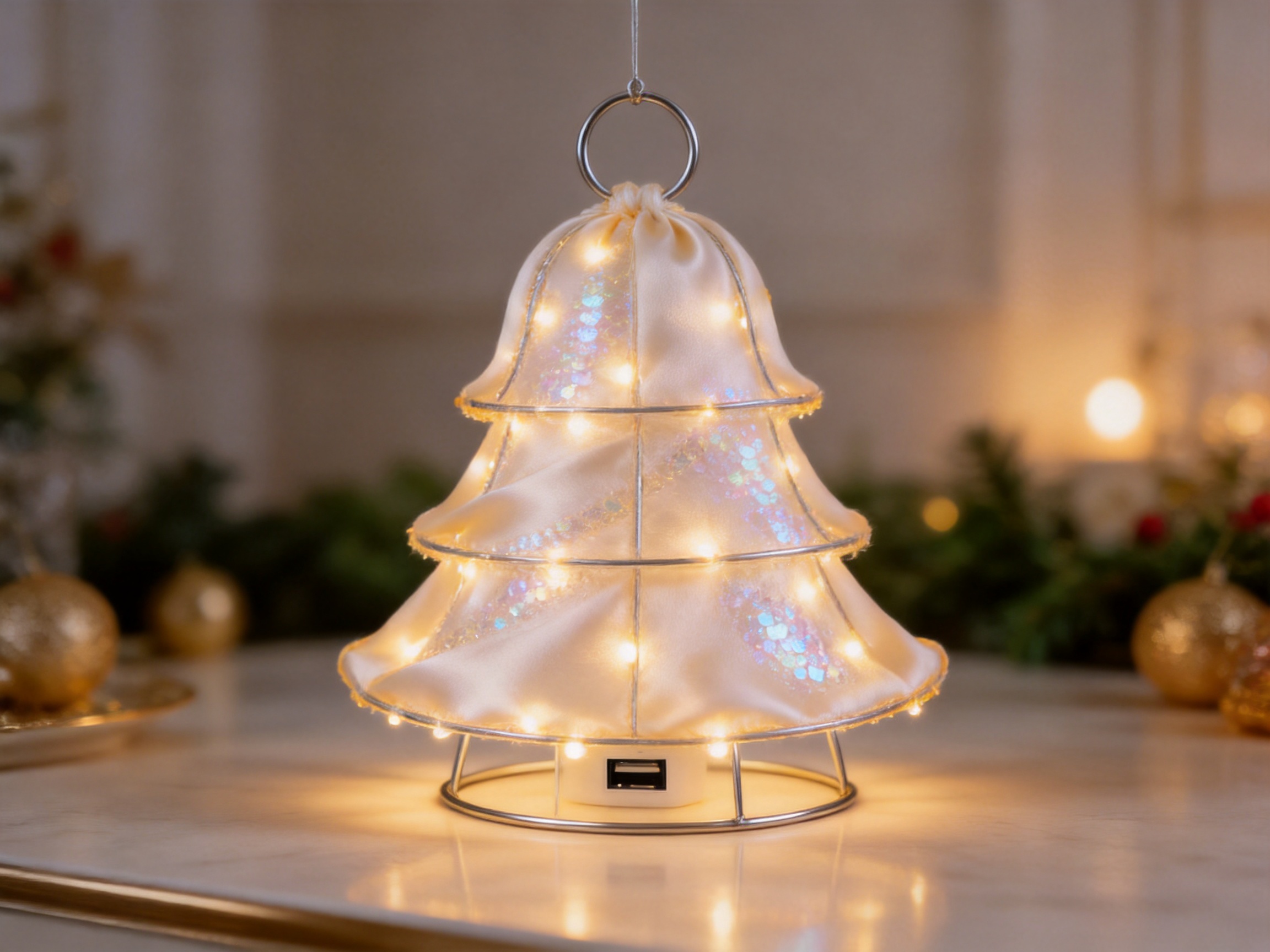
With a compact size of 27 × 5 × 30 cm, this decorative light is suitable for tabletops, entryways, display counters, windows, walls, and seasonal merchandising installations. Its three-dimensional bell-shaped tree silhouette creates a recognizable festive impression, while the silk wrapping and iridescent sequins give the product a more refined appearance than a basic plastic ornament or ordinary string light.
The design is especially suitable for Christmas, New Year celebrations, winter events, hospitality interiors, retail displays, restaurants, shopping centers, and residential spaces. It can serve as a single accent piece or become part of a larger coordinated lighting arrangement. Its built-in warm white LEDs produce a soft visual effect, while the reflective surface of the sequins adds color and depth when the light is switched on.
This article examines the product’s design, materials, lighting performance, applications, quality considerations, manufacturing background, procurement value, and competitive advantages. It also explains how an experienced festive-lighting manufacturer can support wholesalers, retailers, project buyers, and commercial customers seeking dependable decorative lighting products.

Small Bell LED Decorative Lights with Silk Wrapped
Product Overview
The Small Bell LED Decorative Lights with Silk Wrapped combine a metal framework, copper wiring, PVC components, LED light sources, and silk decoration. The framework forms the basic three-dimensional silhouette. Silk threads are wrapped around the structure to soften its appearance and create a handcrafted visual effect. Iridescent sequins are incorporated into the decorative surface so that they catch and reflect the LED light.
The product includes 60 lights and is powered by three AA batteries according to the supplied specification. Battery operation gives the product considerable flexibility because it does not need to be installed close to a wall outlet. It can therefore be positioned on a reception desk, inside a display cabinet, on a dining table, in a shop window, or in another location where exposed power cables would be inconvenient or visually distracting.
A top hanging ring supports suspended installation. This feature allows the product to function not only as a tabletop ornament but also as a hanging decoration. It can be attached to a wall hook, ceiling point, display frame, window structure, or seasonal merchandising fixture, subject to the requirements of the installation environment.
| Product Name | Small Bell LED Decorative Lights with Silk Wrapped |
| Product Category | Decorative Light |
| Approximate Size | 27 × 5 × 30 cm |
| Number of Lights | 60 LEDs |
| Primary Materials | Iron, copper, PVC, LED, and silk |
| Power Supply | Three AA batteries |
| Installation Options | Tabletop placement or hanging installation |
| Minimum Order Quantity | 1,000 units |
| Typical Applications | Christmas, New Year, parties, retail displays, hospitality interiors, and home decoration |
The compact proportions make the light easy to integrate into existing displays. At approximately 30 cm in height, it has enough presence to attract attention without overwhelming a table, shelf, or window arrangement. The narrow profile also helps buyers create repeated installations using multiple units in a row, cluster, or layered composition.
A Decorative Form with Strong Visual Recognition
One of the product’s most important advantages is its recognizable silhouette. The bell-shaped tree form combines two familiar seasonal symbols: the bell and the Christmas tree. This creates an immediate festive association without requiring additional signage or decoration. Consumers can understand the intended mood at a glance, which is valuable for retail displays and event decoration where products must communicate their theme quickly.
The metal wire framework gives the ornament a defined outline and a three-dimensional profile. Instead of appearing as a flat printed decoration, the light has volume and visible depth. The layered construction allows light to travel across different sections of the shape, producing a fuller appearance when illuminated.
Silk wrapping changes the character of the product. A plain wire frame may appear industrial or unfinished, while a silk-covered structure has a softer and more decorative surface. The silk fibers create subtle texture and help the light appear more integrated into the ornament. This is particularly useful in interiors where buyers want a warm, elegant, or gift-oriented appearance rather than a purely technical lighting effect.
The inclusion of iridescent sequins adds another level of visual interest. Sequins reflect the surrounding light and the warm white LEDs, producing small color variations as the viewing angle changes. These reflections can introduce hints of rainbow color without requiring multicolor LEDs. The result is a gentle combination of warm illumination and prismatic sparkle.
Compared with ordinary battery-operated string lights, the product offers a more complete decorative form. A string light generally requires the user to shape, wrap, or arrange it before it looks attractive. This small bell light already has a defined structure and can be displayed immediately. That reduces setup time and makes it easier for retailers, venues, and homeowners to achieve a polished result.
Warm White Illumination for Comfortable Ambience
The product uses 60 built-in LED light sources that emit warm white light. Warm white illumination is widely used in festive and hospitality environments because it creates a welcoming atmosphere without the harsh appearance sometimes associated with cool white lighting. It can complement wood, fabric, metallic ornaments, glass, greenery, and other seasonal materials.
The LEDs are distributed through the decorative structure so that the light is not concentrated in only one small area. This helps the entire tree-like form remain visible when switched on. The illuminated silhouette can function as a focal point during evening events while still remaining suitable for relaxed indoor settings.
LED technology also supports efficient operation compared with many traditional incandescent decorative lamps. LED light sources generally produce less heat during normal use, consume less electrical power, and provide a longer service life when properly manufactured and operated. These qualities are valuable for battery-powered products, where energy efficiency has a direct effect on operating convenience.
Soft illumination is particularly important for a small decorative product. Excessively bright light could make the sequins appear distracting or reduce the sense of elegance. The warm white LED arrangement is intended to create a comfortable glow rather than a strong task-lighting effect. It works as atmospheric lighting, accent lighting, and seasonal ornamentation.
The reflective sequins help increase the visual impact of the LEDs without requiring a large number of additional components. When light reaches the reflective surfaces, the product may appear brighter and more animated from different angles. This helps it remain noticeable in a shop window, on a reception counter, or among other holiday decorations.
Material Selection and Construction
The product uses a combination of iron, copper, PVC, LED components, and silk. Each material contributes a different function to the finished light. Iron provides the structural support required to maintain the bell-shaped tree outline. Copper is suitable for electrical connections and internal conductive elements. PVC can provide insulation and protection for wiring or related components. LEDs produce the illumination, while silk creates the visible decorative surface.
Using a metal framework rather than relying entirely on flexible plastic helps the product retain its shape. This is important during transportation, storage, and repeated seasonal installation. A stable frame can also make the product appear more substantial and premium when displayed.
The silk wrapping is not simply a color treatment. It adds tactile and visual richness to a product that might otherwise be perceived as a basic wire ornament. The wrapping process must balance appearance and function. The material needs to cover the structure attractively while allowing the light to remain visible. It must also be applied consistently enough that multiple units in the same order present a coordinated appearance.
Copper wiring is commonly valued in decorative lighting because it can support neat routing through compact structures. In a product with many small LEDs, organized wiring is important for maintaining a clean appearance and reducing the risk of loose or visible connections. Wiring quality also influences assembly efficiency and the stability of the finished product.
PVC components can help protect conductive parts from contact and environmental handling. In battery-powered decorative products, the battery compartment and cable connections require particular attention because users may repeatedly install and remove batteries. Appropriate insulation, secure connection points, and careful assembly contribute to safer and more reliable use.
Advantages Over Basic Decorative Lighting
The product’s first competitive advantage is its integrated design. It combines a complete ornament, a light source, decorative fabric, reflective sequins, and a hanging feature in one unit. Buyers do not need to source separate frames, ornaments, light strings, or mounting accessories to create a similar visual effect.
Its second advantage is installation flexibility. Because it is specified for three AA batteries, the light can be used in locations without an immediately accessible power socket. This is useful for temporary displays, outdoor-covered areas, trade booths, event tables, seasonal retail windows, and spaces where electrical cables could interfere with appearance or visitor movement.
Its third advantage is portability. The compact dimensions allow the product to be moved between rooms, displays, and events. Retailers can reposition it as merchandising themes change. Hotels and restaurants can use it for seasonal decoration and then store it for future events. Consumers can move it from a living room to an entranceway or dining area without complex installation.
Its fourth advantage is visual layering. The metal frame establishes the shape, the silk wrapping adds texture, the LEDs provide illumination, and the sequins produce reflective highlights. Each layer contributes to the final appearance. By contrast, a basic plastic ornament may have only a printed surface, and an ordinary string light may offer illumination without a defined decorative form.
Its fifth advantage is suitability for premium presentation. The combination of fabric and reflective elements can support a more luxurious product assortment. Retailers may position it above simple battery candles, conventional plastic ornaments, or low-cost bare-wire lights. The appearance can appeal to consumers looking for refined holiday decoration, gift-shop merchandise, or accent pieces for hospitality environments.
Its sixth advantage is merchandising efficiency. A finished three-dimensional light can be displayed immediately in packaging, on a shelf, in a window, or in a promotional photograph. The product communicates its use visually and does not require extensive explanation. This can help retailers reduce the amount of demonstration material required at the point of sale.
Its seventh advantage is compatibility with multiple design themes. Although the product is naturally suited to Christmas and New Year decoration, it can also be used for winter weddings, festive dinners, shopping events, corporate celebrations, themed parties, and general decorative lighting. Its shape provides a seasonal reference, while the warm light and silk surface remain suitable for broader decorative applications.
Tabletop, Hanging, and Retail Applications
Tabletop Decoration
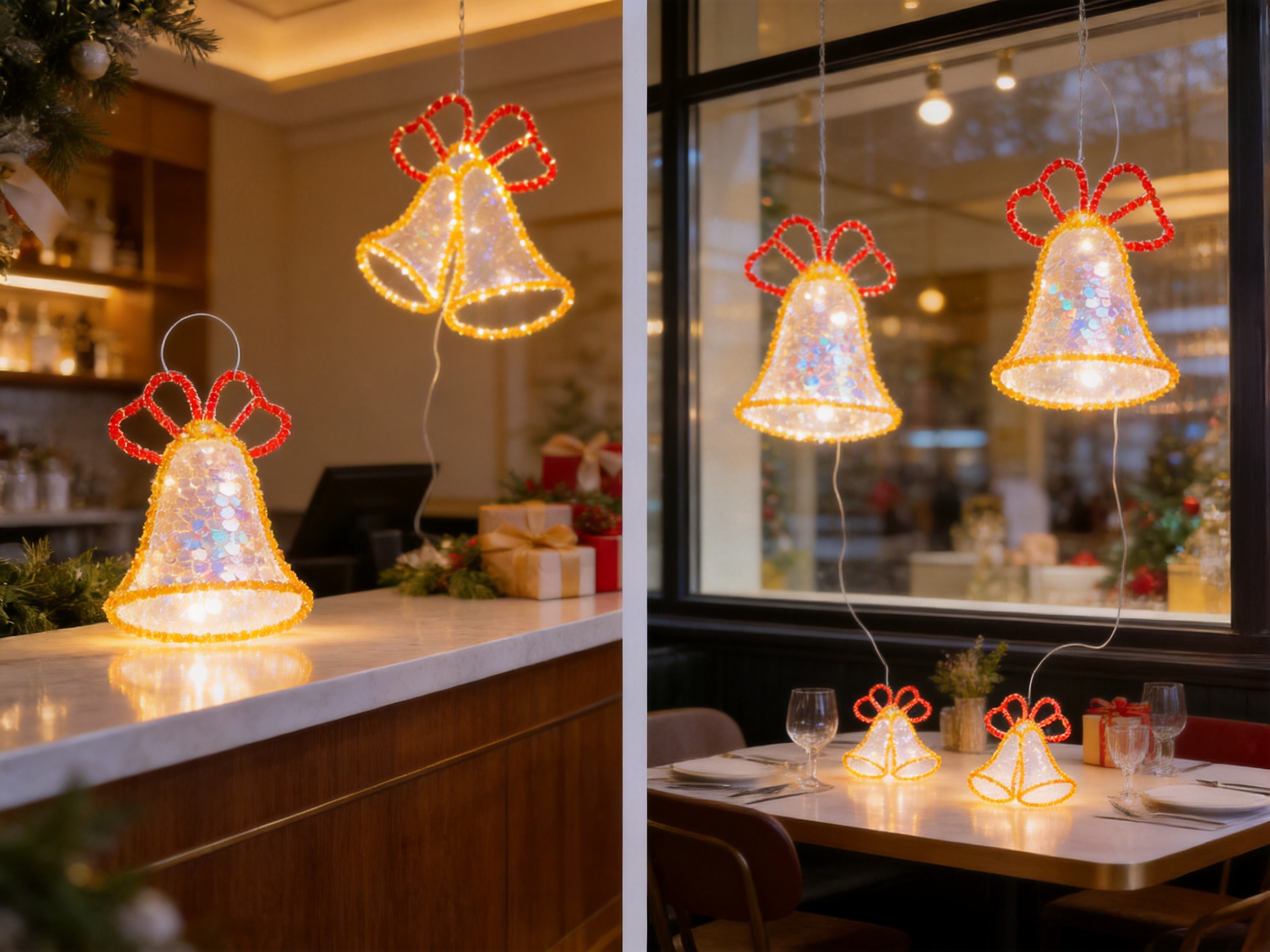
On a tabletop, the light can serve as a focal ornament near a reception desk, dining area, mantel, sideboard, or entryway. A single unit can provide a small seasonal accent, while several units can be grouped at different distances to create a layered display. The compact footprint helps preserve usable table space.
For restaurants and hotels, tabletop placement can create a welcoming seasonal atmosphere without requiring permanent electrical installation. The light may be positioned near reservation desks, buffet areas, lounges, guest reception points, or banquet tables. Its warm white LEDs are appropriate for settings where the goal is comfort and visual appeal rather than intense brightness.
Hanging Decoration
The top hanging ring allows the product to be suspended from suitable supports. Hanging several units at varied heights can create a floating festive arrangement. In a shop window, a group of lights may be combined with artificial branches, ribbons, gift boxes, or other seasonal products. In an event venue, the lights can contribute to a layered background or entrance display.
Hanging installation should always consider the strength and suitability of the supporting point. The product should be secured in a manner appropriate to the location, and installers should follow relevant safety practices. The hanging ring is a convenience feature, but the final installation method depends on the surface, height, access conditions, and local requirements.
Retail Window Displays
Retail windows require products that remain visually attractive from a distance and under changing light conditions. The reflective sequins can help the small bell light catch attention as viewers move past the display. Its three-dimensional form also creates shadows and highlights that can add depth to a window composition.
Because the unit is battery powered, display planners may have greater freedom when positioning it. They can avoid running cables across the window base or through visible parts of the arrangement. This can help maintain a cleaner presentation and simplify changes during the selling season.
Event and Hospitality Decoration
Event planners can use the lights as table accents, entrance decorations, stage details, or themed display components. The product can be incorporated into Christmas parties, New Year celebrations, winter markets, hotel functions, company gatherings, and seasonal promotional events.
For hospitality buyers, repeatability is important. A product should look consistent across a group of units and should be simple enough for staff to install, remove, and store. The defined shape and battery operation support a relatively straightforward seasonal workflow.
Manufacturing Strength and Production Capability
The supplier, Taizhou Mingde Decorative Lighting Co., Ltd., has a long history in the festive-lighting industry. The company was founded in 1968 and was formerly associated with Zhejiang Festival Lighting General Factory. Its stated annual production capacity is 10 million strings of festive lights, placing it among the large export-oriented production bases for festive lighting in China.
A long operating history can provide important advantages in product development, component sourcing, production organization, and export coordination. Decorative lighting products often contain many small parts and require careful integration of electrical, structural, and visual elements. Experience helps a manufacturer identify common assembly risks and create repeatable production procedures.
The company’s product range includes linear lights, icicle lights, net lights, circular lights, spiral trees, LED string lights, copper wire lights, cord lights, and other festive-lighting products. This broad product portfolio indicates familiarity with different construction methods, including flexible wiring, shaped frames, suspended arrangements, battery products, and large-scale seasonal displays.
For buyers, a broad product range can make supplier coordination easier. A wholesaler or project customer may be able to source multiple categories from one experienced manufacturer instead of working with several unrelated factories. This can simplify communication, sample review, packaging coordination, shipment planning, and quality documentation.
The company has also stated that it was among the first domestic festive-lighting companies to obtain United States UL certification and that it established an ISO 9001 quality system in 1997. Certification and quality-system experience do not replace product-specific verification, but they indicate familiarity with formal manufacturing controls and the documentation expectations of international markets.
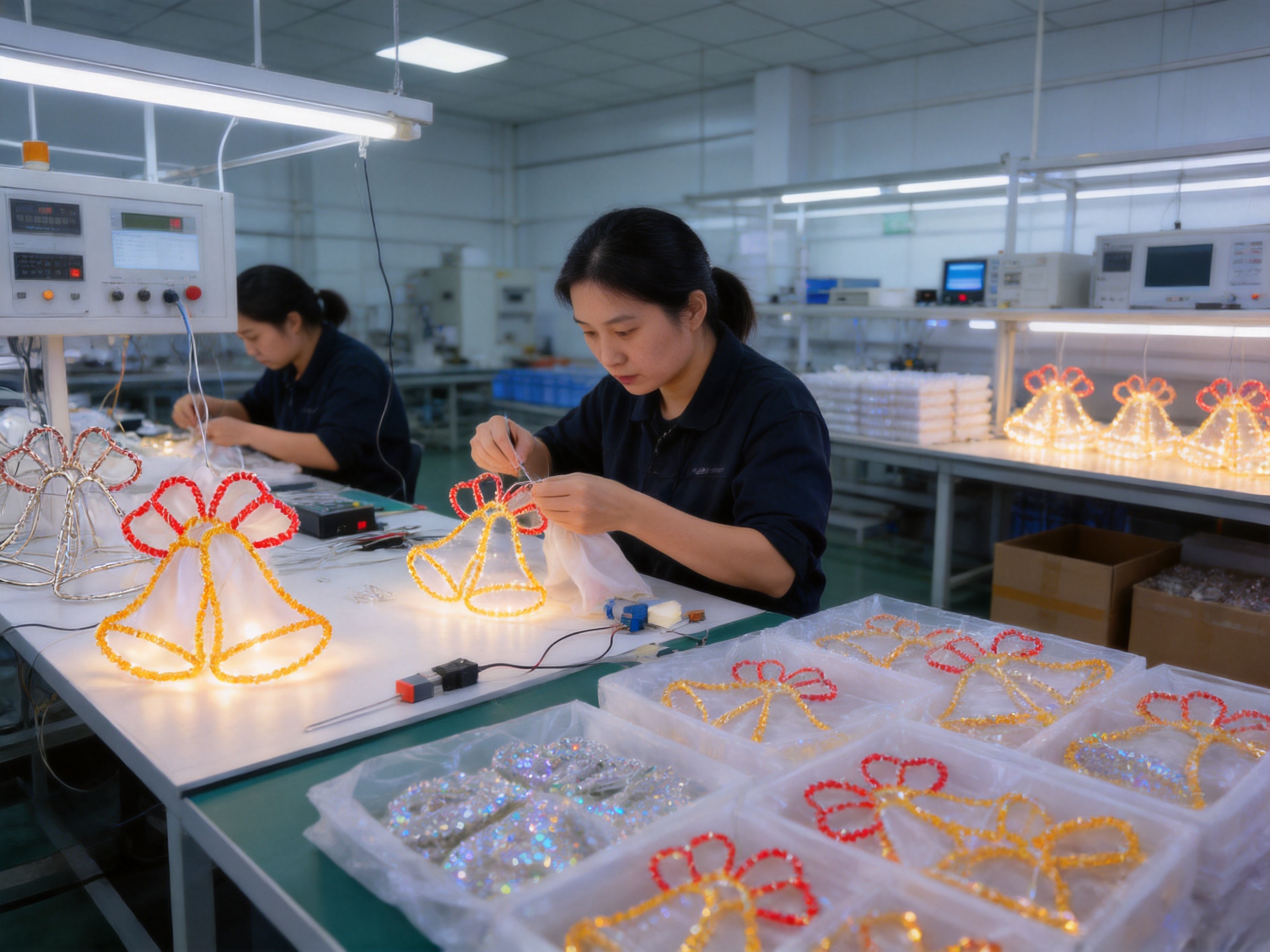
Quality management is especially important for decorative lighting because the final product depends on many stages. Wire preparation, LED placement, soldering or connection, insulation, frame forming, silk wrapping, sequin attachment, battery-box assembly, testing, and packing must all be coordinated. A weakness in any one stage can affect appearance, operation, safety, or customer satisfaction.
Integrated Manufacturing from Components to Finished Goods
The company describes its production system as integrated and standardized, with quality control extending from component manufacturing through final assembly and shipment. An integrated approach can improve communication between departments and provide stronger control over product consistency.
At the component stage, materials must be selected and prepared according to the product design. Metal wire needs appropriate dimensions and flexibility for frame forming. Copper conductors must be suitable for the electrical layout. PVC parts need to provide appropriate insulation and protection. LEDs should be matched for color temperature, brightness, and operating requirements.
During frame forming, the metal structure must be shaped accurately enough to maintain the intended silhouette. Consistent dimensions are important for both appearance and packing. If the frame varies significantly from one unit to another, the finished products may not align properly in a retail display or carton.
The electrical assembly stage requires orderly wire routing and secure connections. With 60 LEDs, the layout must be designed so that the illumination appears balanced across the form. Assembly workers and inspection personnel need to check for loose wires, incomplete connections, damaged insulation, and misplaced components.
Silk wrapping is a visually sensitive stage. The material should cover the frame evenly, without excessive gaps, loose threads, or visibly uneven tension. The wrapping must be attractive while preserving the visibility and function of the LED elements. Consistency at this stage has a direct effect on the perceived quality of the finished product.
Sequin application also requires attention to alignment and attachment. The reflective pieces should be secured well enough to withstand normal handling, packing, transportation, and installation. Their placement should complement the form rather than obscure the LEDs or create an untidy appearance.
Final assembly includes the battery compartment, switch or control arrangement where applicable, hanging ring, protective parts, and packaging. A finished-product inspection can include appearance checks, dimensional review, power-on testing, LED function testing, connection inspection, and packaging verification.
Shipment control is another important part of manufacturing strength. Seasonal lighting is often purchased according to fixed retail and event calendars. Delays can reduce the selling window and create additional storage or promotional costs. A manufacturer with established production planning and export experience may be better prepared to coordinate larger seasonal orders.
Quality Control Considerations for Buyers
Commercial buyers should evaluate more than the appearance shown in a product photograph. They should confirm the exact power configuration, battery compartment design, operating instructions, packaging method, carton dimensions, labeling, and market-specific requirements before placing a large order.
The supplied product specification identifies three AA batteries as the power source. The product description also refers to secure connection and instant lighting. Buyers should clarify whether the final production version is battery-only or whether a plug-in option is available for particular configurations. Confirming this detail before mass production helps prevent misunderstandings in product listings, packaging, and customer instructions.
LED function testing is essential. Every light source should be checked for operation, stable connection, and acceptable brightness. Where products are arranged in a series or parallel circuit, the manufacturer should confirm how one component affects the rest of the circuit and how the product behaves if a single LED is damaged.
Mechanical inspection should include the frame, hanging ring, silk wrapping, sequin attachment, battery compartment, and any switch or cable components. The product should maintain its intended shape and should not contain sharp or poorly finished metal points that could cause handling problems.
Appearance inspection is also important for a decorative product. Buyers may establish reference samples for silk color, wrapping density, sequin placement, LED tone, frame dimensions, and overall finish. A documented reference sample can help the factory and buyer maintain consistency across repeat orders.
Packaging should protect the three-dimensional structure during transport. The box should prevent excessive pressure on the frame and reduce the chance of tangling or crushing. Individual protective bags, separators, molded supports, or shaped inserts may be considered depending on the order quantity and shipping method.
For international markets, buyers should determine which safety tests, labels, warnings, battery instructions, and packaging markings are required. Requirements may vary according to the destination country, product voltage, battery configuration, indoor or outdoor use, and sales channel. The manufacturer’s previous export experience can support this process, but the importer remains responsible for confirming applicable requirements.
Commercial Value for Wholesalers and Retailers
The minimum order quantity is listed as 1,000 units, making the product suitable for wholesale distribution, seasonal retail programs, hospitality projects, and promotional campaigns rather than very small personal orders. A larger production run can help create a coordinated assortment across multiple stores or locations.
For wholesalers, the product fills a useful position between basic string lights and high-end illuminated sculptures. It offers a defined decorative form and premium-looking materials while remaining compact enough for efficient storage and shipping. A wholesaler may include it in a seasonal collection alongside garlands, curtain lights, spiral trees, copper-wire lights, and other festive products.
For retailers, the light can be sold as an individual accent item or presented in a multi-unit display. Its battery operation and hanging feature can be emphasized in product packaging and merchandising materials. Retailers may also pair it with ornaments, gift products, tableware, artificial greenery, candles, or other holiday merchandise.
For project buyers, the product offers repeatable visual identity. A hotel, restaurant group, shopping center, or event company can use multiple units to create a consistent decorative theme across several areas. The product’s compact size makes it easier to calculate the number of units required for a display plan.
For promotional campaigns, the product can be used as seasonal merchandise, a customer gift, a loyalty reward, or part of a holiday gift package. Its light-up function gives it a stronger perceived presence than a non-illuminated ornament, while its compact design supports easier storage and distribution.
Designing a More Sophisticated Seasonal Display
The Small Bell LED Decorative Lights with Silk Wrapped can be used alone, but its visual effect becomes stronger when incorporated into a complete display strategy. A single light can highlight a small area. Multiple lights can establish rhythm, repetition, and balance.
For a symmetrical arrangement, buyers can place matching units on opposite sides of a doorway, counter, fireplace, or display table. For a more dynamic installation, they can combine different heights and distances. The reflective sequins will respond differently to surrounding light depending on the angle and position of each unit.
The warm white illumination works well with natural materials such as wood, paper, linen, and greenery. It can also soften harder surfaces such as glass, metal, and polished stone. Retailers may use contrasting backgrounds to make the silhouette more visible, while event designers may use darker surroundings to emphasize the illuminated details.
Color coordination is another important consideration. Silk wrapping and sequin colors should be selected to complement the wider product range or event theme. Neutral or metallic surroundings can create an elegant presentation, while red, green, gold, or silver seasonal elements can strengthen the Christmas association.
The product may also be combined with other lighting categories. For example, curtain lights can create a background, copper wire lights can be woven through greenery, and spiral trees can provide height. The small bell lights can then be placed at eye level or on tables to add detail and visual connection between larger elements.
Storage, Handling, and Seasonal Reuse
Seasonal decorative lighting is often used for a limited period each year, so storage quality affects long-term value. Before storage, users should remove batteries to reduce the risk of leakage or corrosion. The product should be switched off, disconnected from any applicable power source, and allowed to remain dry and clean.
The three-dimensional frame should not be compressed under heavy objects. Packaging that preserves the original shape can help reduce the need for reshaping during the next season. Silk surfaces should be protected from moisture, dust, and sharp items that could pull or damage the fibers.
When unpacking, users should inspect the hanging ring, frame, wiring, battery compartment, and decorative surface. Any damaged unit should be removed from service until it has been evaluated or repaired by an appropriate professional. Batteries should be installed according to the product instructions and replaced when necessary.
Commercial operators can improve efficiency by labeling cartons according to location or display type. Hotels and retailers may also maintain a seasonal inventory record that identifies the number of units, storage condition, and any maintenance requirements. These practices can reduce setup time and help preserve the value of the lighting investment.
Why Manufacturer Experience Matters
Decorative lighting combines engineering and visual design. A product may look attractive in a sample but fail to perform commercially if the wiring is inconsistent, the frame is fragile, the packaging is inadequate, or the production schedule is unreliable. Manufacturer experience helps address these interconnected requirements.
A company operating in the industry since 1968 has had decades to develop knowledge of seasonal demand, export timing, component management, product testing, and customer expectations. Experience does not eliminate the need for inspection, but it can provide a stronger foundation for consistent production.
The stated annual capacity of 10 million strings demonstrates the ability to organize high-volume festive-lighting production. This is relevant to buyers that require large quantities or need a supplier capable of supporting repeat seasonal programs. Production scale may also improve access to specialized equipment, trained workers, testing procedures, and supply-chain resources.
The company’s experience with UL certification and ISO 9001 quality systems is also relevant to international buyers. It suggests familiarity with structured documentation and formal quality management. For each specific order, buyers should still request current documentation and confirm whether the exact product configuration meets the requirements of the intended market.
Its integrated production model can support coordination between design, components, assembly, inspection, packaging, and shipment. This is particularly valuable for a product such as the silk-wrapped small bell light, where the final result depends on both electrical reliability and decorative precision.
Procurement Guidance for International Buyers
Buyers should begin by defining the intended sales channel and use environment. A retailer selling indoor holiday decorations may require different packaging, labeling, and instructions from a hotel purchasing lights for a temporary display. Clarifying the application early helps determine the appropriate product configuration.
Product samples should be reviewed for size, materials, LED color, brightness, silk appearance, sequin reflection, battery access, hanging strength, and packaging. Buyers should compare the sample with the final purchase order and include important specifications in written documentation.
Order discussions should cover the minimum order quantity, production lead time, sample approval, carton packing, shipping marks, replacement policy, inspection arrangements, and after-sales communication. It is also useful to confirm whether color, packaging artwork, labels, or manuals can be customized for a specific market.
Because seasonal products are time-sensitive, the purchasing schedule should allow time for sample approval, production, inspection, shipping, customs clearance, and distribution. Early planning can reduce the risk of missing the main selling period. Buyers should also consider whether the product will be sold as a standalone unit or as part of a wider collection.
Clear communication about power supply is particularly important. The supplied specification identifies three AA batteries, and this information should be reflected consistently in the product listing, instructions, packaging, and retailer training materials. If other power options are discussed, they should be verified as separate configurations rather than assumed to be included.
Environmental and Operational Considerations
LED technology can support more efficient decorative lighting operation than traditional incandescent alternatives. Lower energy use is especially relevant when many lights operate for extended periods. Battery-powered operation can also reduce the need for temporary electrical wiring, although users should manage battery replacement and disposal responsibly.
The product’s reusable structure may allow it to serve across multiple seasons when handled and stored appropriately. Reuse can improve the value of the purchase and reduce the need to replace decorations each year. Proper storage, careful installation, and removal of batteries are practical steps that can extend service life.
Buyers may also ask about packaging materials, material composition, repairability, and end-of-life handling. Since the product contains metal, plastic, fabric, electrical parts, and batteries, disposal practices may vary by region. Importers and retailers should provide customers with instructions appropriate to local regulations and responsible waste management practices.
Environmental claims should be communicated accurately. The product can offer practical efficiency and reusability advantages, but buyers should avoid making unsupported claims about recyclability, energy savings, or environmental impact unless those claims are supported by appropriate documentation.
Frequently Asked Questions
What is the main design of this decorative light?
The product uses a small three-dimensional bell-shaped tree silhouette formed with a metal wire structure. Silk wrapping and iridescent sequins are applied to create a soft, reflective, and festive appearance.
How many LEDs are included?
The supplied specification lists 60 lights. They provide warm white illumination distributed across the decorative structure.
What powers the product?
The product specification lists three AA batteries. Buyers should confirm the final power configuration, battery compartment details, and operating instructions with the supplier before placing a mass order.
Can it be placed on a table?
Yes. Its compact dimensions make it suitable for tabletops, counters, shelves, reception desks, dining areas, and entryways. It can also be incorporated into larger tabletop displays.
Can it be hung?
Yes. A top hanging ring is included for suitable suspended installations. The support point and attachment method should be appropriate for the installation location and weight of the product.
Is the light suitable only for Christmas?
No. Christmas is a primary application, but the light can also be used for New Year celebrations, winter events, parties, hotel decoration, restaurant displays, retail windows, weddings, and other festive occasions.
What materials are used?
The listed materials are iron, copper, PVC, LED components, and silk. The iron supports the frame, copper is used in electrical connections, PVC helps protect wiring or related parts, LEDs provide illumination, and silk forms the decorative wrapping.
What is the minimum order quantity?
The listed minimum order quantity is 1,000 units. This makes the product appropriate for wholesalers, retailers, commercial projects, and seasonal distribution programs.
What should buyers inspect before approving a large order?
Buyers should inspect the dimensions, silhouette, silk wrapping, sequin attachment, LED operation, warm white color, battery compartment, hanging ring, packaging, labels, and overall consistency. They should also confirm market-specific safety and documentation requirements.
What manufacturing strengths support this product?
The manufacturer has operated in the festive-lighting industry since 1968, reports an annual production capacity of 10 million strings, offers a broad lighting portfolio, and has experience with UL certification and ISO 9001 quality systems. Its integrated production and quality-control approach supports large-scale international supply.
How does this product differ from a basic string light?
A basic string light is usually a flexible line of LEDs that must be arranged by the user. This product combines a complete three-dimensional decorative form with integrated LEDs, silk wrapping, reflective sequins, and a hanging ring, allowing it to function as a finished ornament immediately after installation.
How should the product be stored?
Remove the batteries before storage, keep the product dry and clean, protect the silk and frame from crushing, and use suitable packaging to preserve its shape. Inspect the unit before reuse in a later season.
Conclusion
The Small Bell LED Decorative Lights with Silk Wrapped offer a balanced combination of decorative appeal, practical flexibility, and commercial potential. Their bell-shaped tree silhouette creates immediate seasonal recognition, while the silk wrapping and iridescent sequins provide a more sophisticated appearance than a basic plastic ornament or exposed-wire light string.
With 60 warm white LEDs, a compact 27 × 5 × 30 cm format, three-AA-battery operation, and a top hanging ring, the product can be used across a wide range of indoor decorative settings. It can be placed on tables and counters or suspended in windows, retail displays, event spaces, and hospitality interiors.
The product is also supported by the strengths of an experienced festive-lighting manufacturer. A history dating back to 1968, stated annual production capacity of 10 million strings, a broad product portfolio, experience with UL certification, an ISO 9001 quality-system background, and integrated quality control all provide valuable support for international buyers.
For wholesalers and commercial purchasers, the product represents a useful middle ground between simple seasonal lights and larger decorative installations. It is visually distinctive, easy to position, suitable for repeat seasonal use, and adaptable to different merchandising concepts. When combined with clear specifications, careful sample approval, appropriate testing, and well-planned packaging, it can become a strong addition to a professional holiday-lighting assortment.
References
1. Product specification supplied for Small Bell LED Decorative Lights with Silk Wrapped, including dimensions, materials, LED quantity, power supply, and minimum order quantity.
2. Product information supplied for the design, applications, warm white illumination, silk wrapping, reflective sequins, and hanging-ring construction.
3. Company information supplied for Taizhou Mingde Decorative Lighting Co., Ltd., including company history, production capacity, product range, export background, and quality-system experience.
4. General principles of LED decorative-lighting design, battery-powered ornament construction, product testing, packaging, and seasonal storage.
5. General procurement considerations for international festive-lighting products, including sample approval, documentation, inspection, labeling, and market-specific compliance review.
Product: Small Bell LED Decorative Lights with Silk Wrapped


Don't Miss New Releases & Subscriber Exclusives
Sign up for our newsletter to stay in the holidy spirit all year.
Further Questions? Contact Us
-
Useful Links
Home Products About Us Production Services News Contact Us -
Classification
Mini String Light LED Light Set Garland Light Light-up Spiral Trees LED Curtain Lights Battery Light LED Copper Wire Light Decorative Light -
Contact Info
zd@zflgf.com.cn+86-576-82467401
+86-13968612122 ( Ms. Zhang )
+86-13505747679 ( Mr. Tan )
+86-15062835074 ( Mr. Cheng )No.270 Zhenxi Road, Xinqiao Town, Luqiao District, Taizhou City, Zhejiang Province, China -


Holiday Lights Supplier