

 中文简体
Standing Deer Acrylic LED Decorative Light: A Refined Choice for Premium Holiday Displays
Decorative lighting is no longer limited to simple strings of bulbs placed around a tree or window. Today, homeowners, retailers, hospitality venues, event planners, and commercial property managers increasingly look for lighting pieces that provide illumination while also functioning as distinctive seasonal décor. The Standing Deer Acrylic LED Decorative Light answers this demand with a sculptural silhouette, warm illumination, translucent acrylic detailing, and a practical battery-powered design.
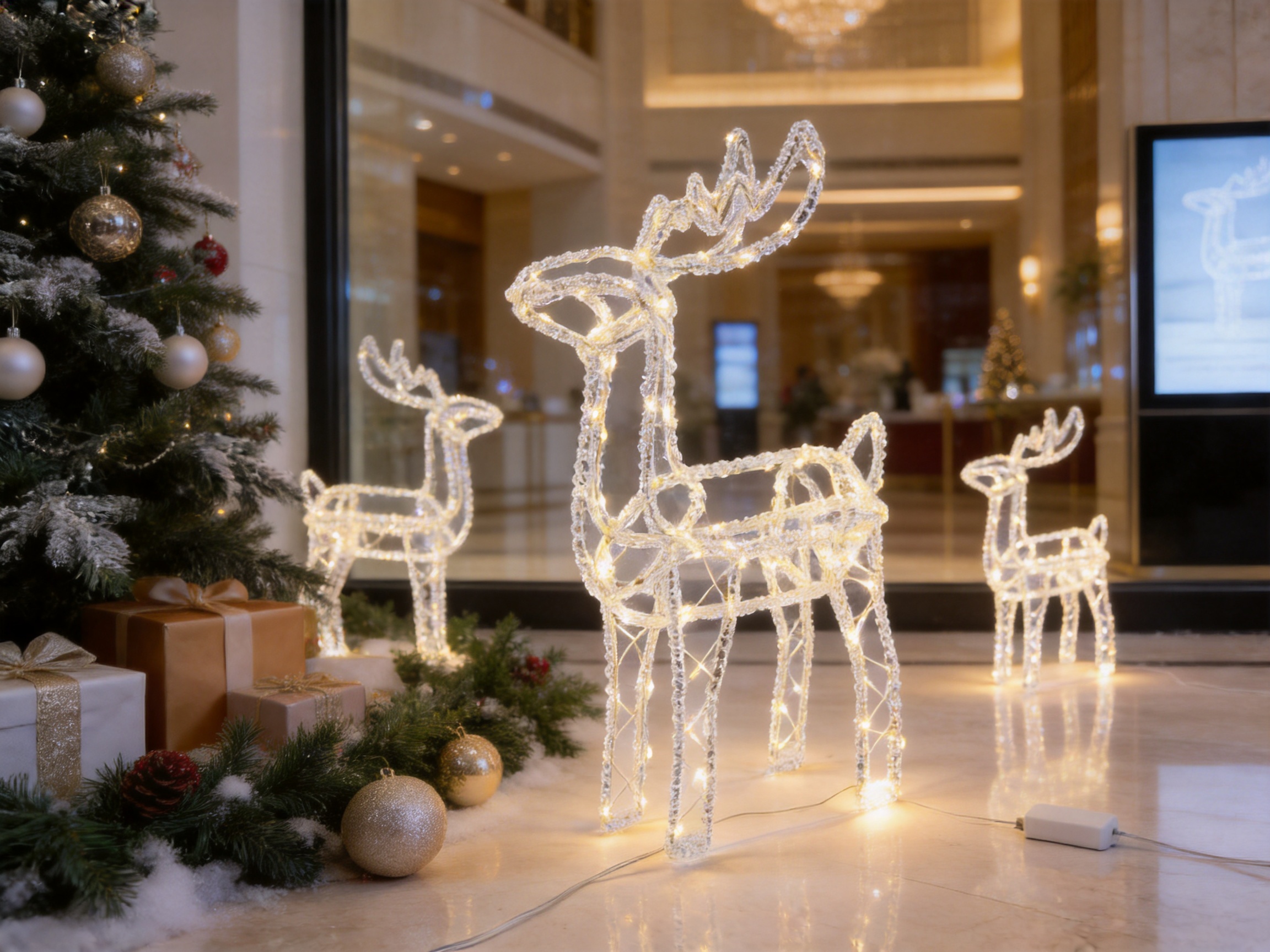
Designed in the form of a graceful standing deer, this decorative lamp combines an iron frame, copper conductors, PVC components, LED technology, and acrylic beads. The result is a three-dimensional illuminated figure that can be used as a Christmas decoration, winter display, entrance accent, living-room feature, retail presentation element, or festive hospitality accessory.
Unlike ordinary light strings, which usually require a supporting surface, this product is a freestanding decorative object. Unlike many purely ornamental figures, it contains evenly distributed LED light sources that outline the deer and create a soft, glowing appearance. This combination of structure, light, and decorative material gives the product a strong visual presence without making it excessively complicated to install.
A Sculptural Decorative Light for Contemporary Holiday Environments
The central appeal of the Standing Deer Acrylic LED Decorative Light is its ability to merge the appearance of a decorative sculpture with the atmosphere of a lighted ornament. The silhouette is inspired by the elegant posture of a deer. Its upright stance gives the product a natural sense of movement and personality, while the open outline allows the surrounding environment to remain visible.
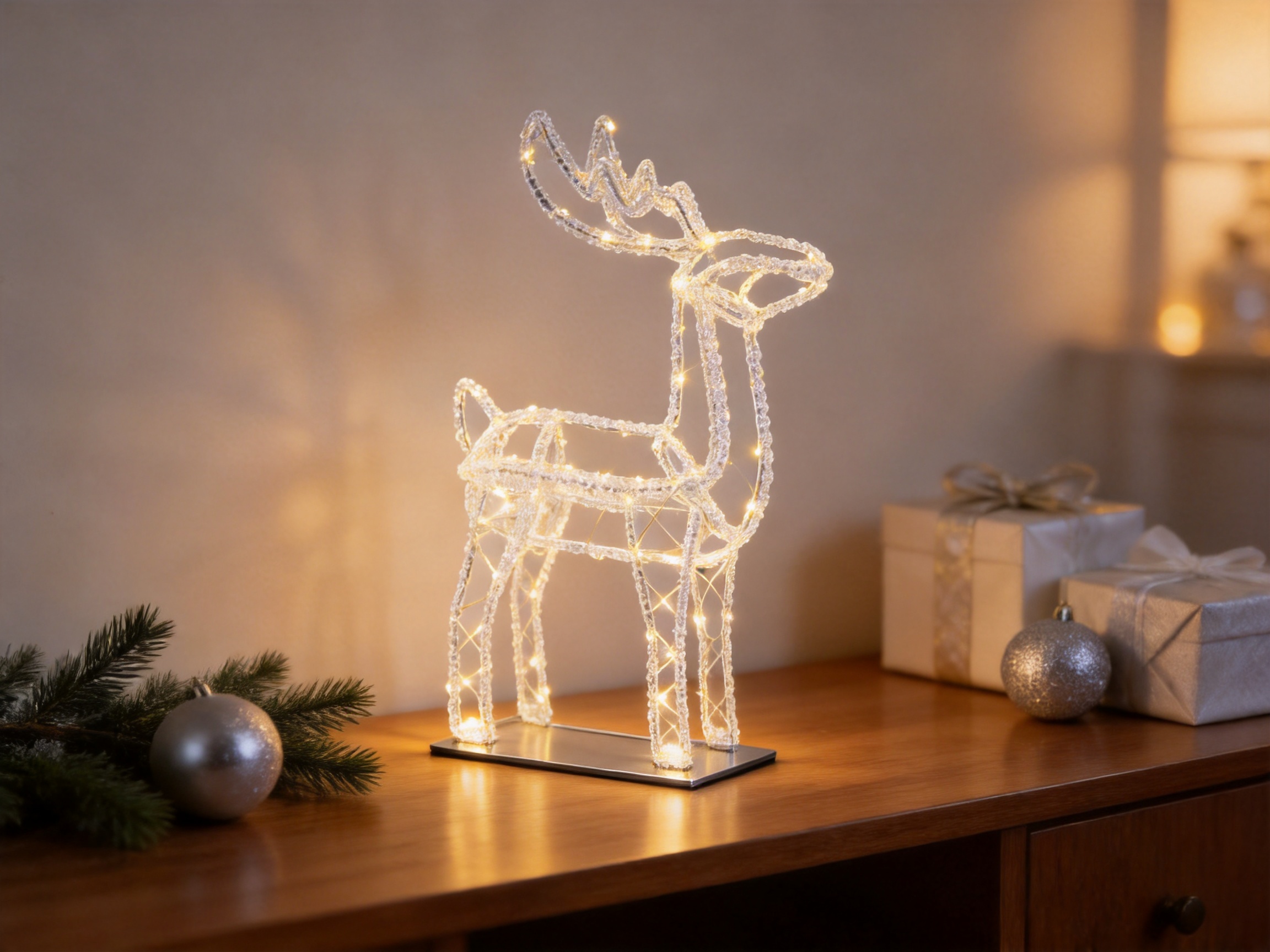
The deer shape is formed around a sturdy metal structure. Acrylic beads are arranged across the frame to provide translucent highlights and a crystalline visual effect. When the integrated warm white LEDs are switched on, light passes through and reflects across these acrylic elements. This creates a layered appearance rather than a flat line of illumination.
This design is especially suitable for settings where visual refinement matters. A retail window may use the deer to create a winter-themed focal point. A hotel lobby can position it near an entrance, reception area, or Christmas tree. A restaurant may place it beside a holiday sign or seasonal floral arrangement. In a private home, it can be used in an entryway, living room, hallway, covered porch, or festive display corner.
The product also benefits from its recognizable decorative theme. Deer are closely associated with winter landscapes, Christmas stories, forests, and seasonal celebrations. Because the form is familiar and emotionally appealing, it can communicate a festive message immediately without requiring additional signage or explanation.
Product Specifications at a Glance
| Specification | Details |
|---|---|
| Product name | Standing Deer LED Decorative Lights with Acrylic |
| Product category | Decorative Light |
| Approximate size | 30 × 7 × 35 |
| Lighting components | LED lights |
| Specification table light quantity | 80 lights |
| Materials | Iron, copper, PVC, LED, and acrylic |
| Power source | 3 AA batteries |
| Minimum order quantity | 1,000 units |
| Primary use | Christmas, winter, home, retail, hospitality, and event decoration |
The product title supplied for this model refers to 120 lights, while the detailed specification table identifies the configuration as 80 lights. This difference should be confirmed with the manufacturer before production, quotation, packaging, or final order approval. The final light quantity may depend on the selected version, production configuration, or catalog naming convention.
The stated size of 30 × 7 × 35 is also presented without a unit designation. Buyers should confirm whether the dimensions are expressed in centimeters or another measurement system before preparing display furniture, retail packaging, shipping cartons, or installation layouts.
Why Acrylic Creates a Premium Decorative Effect
Acrylic is an important visual component of this product. Compared with opaque plastic decorations, clear or translucent acrylic can create a brighter and more jewel-like appearance. It receives light from the embedded LEDs and distributes highlights across the deer outline. During the day, the beads can contribute a polished decorative appearance even when the lamp is switched off. At night, they become reflective points within the illuminated structure.
The acrylic elements help produce visual depth. A basic wire-frame figure may look attractive from a distance but can appear empty when viewed up close. The addition of acrylic beads gives the silhouette more texture and creates a richer interaction between light and material. Small changes in viewing angle can produce different reflections, helping the deer remain visually interesting in a busy display.
Acrylic is also a practical material for decorative lighting. It is lighter than glass, which can simplify handling, transportation, and seasonal storage. Its use can reduce the risk associated with fragile glass ornaments in retail, hospitality, family, and event environments. While all decorative products should still be handled responsibly, acrylic provides a useful balance between visual clarity and everyday practicality.
The crystal-clear appearance of the beads supports a luxury-oriented presentation. This makes the deer suitable for customers who want something more distinctive than low-cost seasonal ornaments. It can be positioned as a premium decorative accent while remaining easier to deploy than a large-scale illuminated sculpture or wired outdoor installation.

Standing Deer Acrylic LED Decorative 120 Lights
Warm White LED Illumination for a Comfortable Atmosphere
The built-in LEDs are arranged along the outline of the deer. This arrangement emphasizes the recognizable shape and helps the product remain legible as a deer rather than appearing as an undefined cluster of points. Even distribution is important because inconsistent spacing can create dark gaps, uneven brightness, or a visually unbalanced silhouette.
Warm white light is well suited to seasonal interiors. It produces a soft, welcoming atmosphere that works naturally with wood, fabric, greenery, metallic ornaments, and neutral architectural finishes. Compared with very cool white light, warm white illumination generally feels less severe and more comfortable in living rooms, hospitality spaces, and evening retail displays.
The light can also complement traditional Christmas color schemes. Warm white LEDs work with red, green, gold, silver, white, and natural evergreen decorations. This flexibility allows wholesalers, retailers, and commercial decorators to include the deer in multiple design themes rather than limiting it to one specific color palette.
Because the LEDs follow the outline, the product can create a subtle halo effect around the acrylic pieces. The acrylic beads catch and scatter the light, adding brightness without requiring the entire body of the deer to be filled with light. The result is decorative rather than aggressively luminous, making the product suitable as an accent piece or part of a larger lighting arrangement.
Battery Operation and Display Flexibility
The Standing Deer Acrylic LED Decorative Light operates with three AA batteries. Battery operation gives buyers greater freedom when planning a display. The product does not need to be positioned close to a wall outlet, extension cable, floor socket, or permanent electrical connection. This can be especially useful in retail windows, entrance displays, dining tables, reception areas, temporary event installations, and locations where exposed cables would affect appearance or safety.
A battery-powered design also supports rapid seasonal installation. Staff can unpack the product, insert the batteries, place the deer in the selected position, and turn on the illumination without coordinating electrical work. This can reduce setup time during busy holiday periods and make it easier to refresh a display across several locations.
For retailers, cordless operation helps keep merchandising areas visually clean. Cables can create clutter, interfere with customer movement, or require additional cable management. A battery-powered deer can stand independently on a counter, shelf, display platform, or side table, provided the surface is stable and appropriate for the product.
Battery performance will depend on the selected batteries, operating schedule, LED configuration, ambient temperature, and usage conditions. Buyers should request information about expected operating time, switch design, battery compartment construction, and recommended battery type. For commercial deployments, it may be useful to establish a replacement schedule and maintain spare batteries before the holiday season begins.
The battery compartment should be kept accessible but discreet. A well-planned display can conceal the compartment behind a seasonal arrangement or position it toward the rear of the display surface. Retail and hospitality users should ensure that staff can access the controls without disturbing the decorative composition.
Materials Selected for Structure, Conductivity, and Appearance
Iron Frame
The iron frame provides the basic shape and stability of the deer. A properly formed metal structure helps preserve the standing posture and gives the product enough rigidity for normal indoor display and careful seasonal handling. The frame also provides a defined route for arranging the lighting components and decorative acrylic elements.
Compared with a purely flexible decoration, a metal-framed figure can maintain a more deliberate silhouette. This is important for a deer design because the visual impact depends on the relationship between the body, legs, neck, head, and antlers or upper outline. A stable frame helps the product retain its intended form after unpacking.
Copper Conductors
Copper is included as part of the product’s material composition and supports electrical conductivity within the lighting system. Copper wiring is commonly used in decorative lighting because it can carry current efficiently while remaining suitable for compact arrangements. Its flexibility also supports the routing of wiring around a shaped decorative frame.
In a product where LEDs are distributed across a defined outline, the internal wiring must be arranged carefully. The conductors should be positioned so that they support reliable illumination without overwhelming the appearance of the acrylic and metal structure. Proper wire routing contributes to both performance and visual cleanliness.
PVC Components
PVC can be used for insulation, protective components, and selected structural or connection elements. In decorative lighting, appropriate insulation helps protect conductive parts and supports safer handling under normal operating conditions. The specific PVC components and their ratings should be confirmed in technical documentation for the intended market.
LED Components
LED technology provides the illumination source. LEDs are suitable for decorative products because they can be compact, efficient, and arranged in large numbers along a shaped outline. Their small size allows the designer to preserve the deer’s silhouette while integrating light into the decorative structure.
Acrylic Beads
The acrylic beads provide the product’s distinctive sparkling appearance. They interact with the warm white light and add decorative richness beyond the frame itself. Their transparency helps the lamp appear refined in both illuminated and non-illuminated conditions.
Advantages Compared with Ordinary String Lights
Ordinary string lights are versatile, but they normally depend on a tree, railing, wall, window frame, plant, or architectural edge for support. Their visual identity comes from the arrangement chosen by the user. The Standing Deer Acrylic LED Decorative Light provides a complete composition in one product. The shape, lighting route, material combination, and decorative theme are already integrated.
This integration can save planning time. A retailer does not need to build a deer silhouette from separate light strings. A hotel does not need to source a frame, attach bulbs, organize wiring, and test the final outline. A homeowner can obtain a finished decorative figure without undertaking a complicated craft project.
The product also creates a more memorable focal point than a simple line of lights. A string can frame a space, but the deer can communicate a theme and become an object that visitors notice. This is valuable for photographs, social media content, retail window appeal, and holiday hospitality experiences.
Another advantage is consistency. Multiple units placed across different stores, hotel entrances, restaurants, or event areas can present the same silhouette and illumination style. This supports coordinated seasonal merchandising and helps a business maintain a consistent visual identity without relying on individual staff members to recreate the same arrangement manually.
Advantages Compared with Flat Printed or Cutout Decorations
Printed signs and flat cutouts can be economical, but they generally provide limited dimensionality. The Standing Deer Acrylic LED Decorative Light creates a three-dimensional presence that can be viewed from multiple angles. Its translucent acrylic elements and illuminated frame remain visually active as customers move around the display.
Three-dimensional décor can also add depth to a window or room. A flat item may disappear against a background or look visually static. The standing deer can be positioned in front of greenery, beside wrapped gifts, near a tree, or within a layered scene. Its open structure allows other decorative elements to remain visible behind it.
The deer’s illuminated outline can be effective even when the surrounding decoration is relatively simple. A business does not necessarily need a large collection of accessories to create a festive impression. One or several carefully positioned deer figures can provide a clear seasonal message while leaving enough space for products, signage, seating, or customer movement.
Advantages Compared with Fragile Glass Ornaments
Glass can produce beautiful reflections, but it may be more vulnerable to breakage during handling, transportation, installation, and storage. Acrylic provides a clear decorative effect while offering a more practical choice for repeated seasonal use. This can be beneficial for commercial users that install and remove displays every year.
Retail staff, event crews, and hospitality employees often need to move decorations quickly. A lighter and less fragile material can simplify these operations. Acrylic does not eliminate the need for careful handling, but it can make the product more convenient for regular display cycles than a comparable glass-based ornament.
For family environments, acrylic can also be a sensible material choice where children or pets may be present. The product should still be placed securely and used according to appropriate safety guidance, but the material selection supports a more practical decorative experience.
Applications in Homes and Residential Spaces
In a home, the deer can serve as a focal point in the entryway. Guests see it immediately when they arrive, and its warm illumination can make the entrance feel welcoming during winter evenings. A small console table, sideboard, or display shelf may provide a suitable location if it offers enough stability and clearance.
In the living room, the deer can be positioned near the Christmas tree, fireplace, media cabinet, or window. Its open outline prevents it from competing heavily with other decorations. Instead, it can complement baubles, garlands, candles, stockings, and wrapped presents.
The product can also be used in bedrooms, studies, covered balconies, or seasonal reading corners. Since it operates on three AA batteries, placement is not limited by the location of a wall outlet. Users should nevertheless follow the manufacturer’s recommendations regarding indoor or outdoor suitability. Unless the product has a confirmed weather-resistance rating, it should be protected from rain, standing water, and prolonged exposure to moisture.
Several deer can be arranged together to create a small winter scene. One unit may serve as a subtle accent, while a group can represent a family or herd. When using multiple units, buyers can vary their spacing and orientation to create depth rather than placing every figure in a perfectly straight line.
Applications in Retail and Commercial Displays
Retailers can use the deer in Christmas window displays, seasonal product presentations, department entrances, checkout areas, gift sections, and promotional corners. Its recognizable form can draw attention from outside the store, especially when placed near the front of a window with darker background materials behind it.
The product can also support cross-merchandising. A retailer selling ornaments, home fragrance, winter textiles, giftware, or seasonal tableware may place the deer near related goods. Its warm light can make neighboring products appear more inviting and help create a coherent seasonal story.
For shopping centers and chain stores, standardized decorative figures can help maintain a coordinated holiday environment across multiple locations. Because the product is freestanding and battery powered, store managers can adapt placement according to the size and design of each sales area.
Commercial buyers should consider the number of units required, battery replacement logistics, storage conditions, packaging durability, and display guidelines. The stated minimum order quantity of 1,000 units indicates that this model is particularly appropriate for wholesalers, importers, chain retailers, project suppliers, and large-scale seasonal programs rather than small one-off purchases.
Applications in Hospitality and Events
Hotels can use illuminated deer figures in lobbies, corridors, breakfast areas, guest welcome zones, lounges, and event spaces. The product can contribute to a warm arrival experience without requiring a permanent electrical installation. It can be paired with pine branches, gift boxes, fabric ribbons, wreaths, or other seasonal objects.
Restaurants and cafés may place the deer near host stands, windows, waiting areas, or private dining rooms. Its gentle illumination can support a festive atmosphere without becoming the primary light source. Event venues can use it for Christmas parties, winter weddings, corporate celebrations, photography areas, and seasonal markets.
Event planners may appreciate the product’s relatively simple deployment. Units can be transported to the venue, positioned according to the event floor plan, and removed after the occasion. The battery-powered design may be useful in heritage buildings, temporary marquees, exhibition halls, and other locations where access to power points is limited.
For hospitality use, the decorative figure should be positioned where it will not obstruct emergency routes, door openings, stairways, or service paths. Stable placement is essential in areas with high foot traffic. Staff should inspect the frame, wiring, acrylic elements, and battery compartment before each event.
Manufacturing Strengths Behind the Product
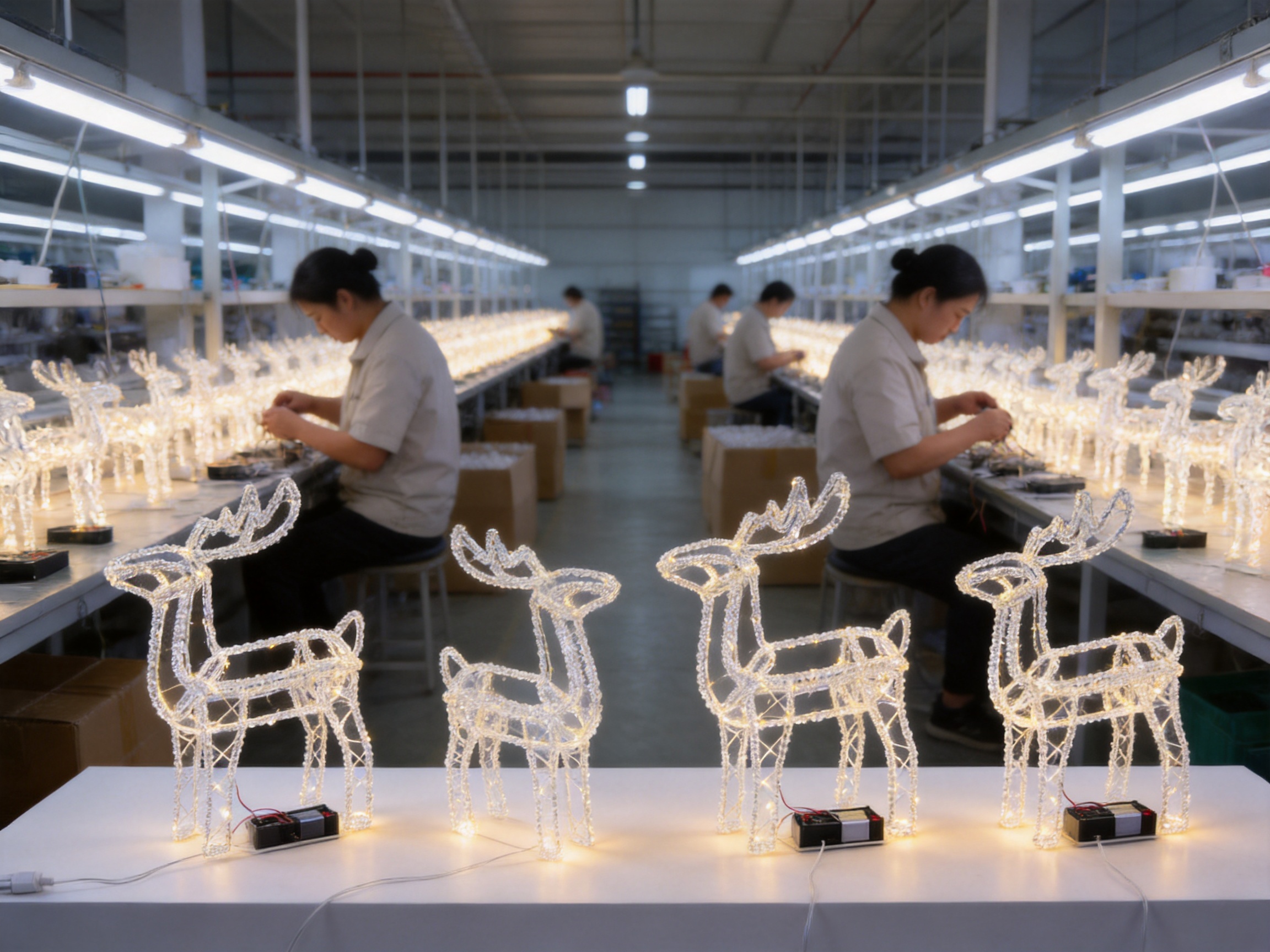
The manufacturer, Taizhou Mingde Decorative Lighting Co., Ltd., reports an annual production capacity of 10 million strings of festive lights. This scale indicates substantial experience with volume production, seasonal demand planning, component sourcing, assembly coordination, and export-oriented order management.
The company was founded in 1968 and was formerly part of Zhejiang Festival Lighting General Factory. Decades of industry involvement provide an important foundation for understanding festive lighting materials, product development, manufacturing schedules, seasonal purchasing cycles, and international customer expectations.
The company also reports that it was among the first domestic festive lighting companies to obtain United States UL certification. Certification requirements vary by product and market, so buyers should request documentation applicable to the exact model and destination. Nevertheless, the company’s history with certification reflects experience in preparing products for regulated export markets.
An ISO 9001 quality system was established in 1997, according to the supplied company information. A structured quality management system can support documented procedures, process control, corrective action, traceability, and continuous improvement. These practices are especially valuable in decorative lighting, where quality depends on many linked stages rather than on a single final inspection.
Integrated Production from Components to Shipment
The company describes itself as an integrated and standardized lighting enterprise. Its quality control is reported to cover component manufacturing through final assembly and shipment. This approach can provide advantages over fragmented production models in which separate suppliers handle key components without a unified quality system.
When a manufacturer has stronger control over multiple stages, it may be better positioned to coordinate material specifications, color consistency, wire routing, LED placement, assembly tolerances, and packaging requirements. Integrated oversight can also make it easier to identify the source of a problem when a production batch requires adjustment.
For a product such as the acrylic deer, manufacturing coordination matters because the visual result depends on the relationship between the frame, acrylic beads, LED arrangement, wiring, and final assembly. A small inconsistency in one area can affect the appearance of the complete figure. Standardized production helps support repeatability across large orders.
Large-scale capacity can also help the manufacturer plan for seasonal peaks. Holiday lighting orders are often placed well in advance, and production schedules must account for development, sampling, approval, component preparation, assembly, inspection, packing, and shipment. An experienced factory with established processes can be better prepared to manage this sequence.
Quality Control Considerations for the Standing Deer
Quality control for this product should begin with incoming materials. Iron should be checked for dimensions, surface condition, and suitability for forming. Acrylic beads should be inspected for clarity, shape, consistency, and visible defects. LED components should be verified for color, function, and electrical characteristics. Copper and PVC components should be checked against approved specifications.
During frame production, attention should be given to the accuracy of the deer silhouette. The standing posture should remain balanced, and the base or supporting portions should provide dependable stability. Edges should be properly finished to reduce the risk of sharp points or damage to wiring and packaging.
During assembly, LED spacing and orientation should be reviewed. The lights should follow the intended outline, and wiring should be secured without creating unnecessary visual clutter. Acrylic beads should be attached firmly enough for normal handling and packing while remaining visually aligned with the design.
Electrical inspection should include illumination testing, switch operation, battery compartment evaluation, and checks for intermittent connections. Products may need to undergo a continuous lighting test or other inspection defined by the manufacturer’s internal quality procedures and the destination market’s requirements.
Final inspection should review appearance, dimensions, light quantity, material condition, packaging, labeling, and accessories. For large orders, buyers may also establish an approved sample, inspection standard, defect classification, and batch approval procedure before mass production.
Packaging and Supply Chain Advantages
Decorative lighting products are often transported before their final seasonal use, which makes packaging an important part of product quality. The acrylic elements, metal frame, LED components, and battery compartment should be protected against abrasion, compression, and movement during handling.
A well-designed package can reduce the chance of scratches, deformation, missing parts, and assembly confusion. It should also provide clear identification for product models, quantities, battery requirements, and handling instructions. Buyers may request carton dimensions, packing method, gross weight, net weight, and loading information to support logistics planning.
The manufacturer’s experience with export markets can be valuable for customers who need international shipment coordination. Export orders may require documentation, labeling, carton marks, inspection records, compliance materials, and communication across multiple time zones. An established export supplier can help buyers organize these requirements more efficiently.
Because the stated minimum order quantity is 1,000 units, buyers should plan warehousing and distribution before placing an order. The product may be divided among stores, regional warehouses, promotional programs, or wholesale customers. Seasonal goods should be received early enough to allow inspection, allocation, and merchandising before the holiday sales period.
Design Advantages for Wholesale and Private-Label Programs
The deer’s clear decorative concept makes it suitable for wholesale catalogs and seasonal collections. Importers can present it as part of a winter lighting range that includes string lights, curtain lights, copper wire lights, spiral trees, garlands, and other decorative products. Its three-dimensional format can add variety to a catalog otherwise dominated by linear lighting products.
Retailers may also choose to include the deer in a premium collection. The combination of acrylic, warm white LEDs, and a structured silhouette gives it a more elevated appearance than a basic bulb string. Packaging, product photography, and merchandising can reinforce this positioning.
For private-label programs, buyers should discuss logo placement, packaging design, instruction sheets, carton markings, color options, light quantity, switch configuration, and any permitted design changes. Since the product is manufactured in volume, early communication is important when a customer requires customized packaging or a special production version.
Buyers should not assume that all modifications are available without technical review. Changes to dimensions, LED quantity, battery compartment, frame finish, acrylic components, or packaging may affect tooling, production time, testing, certification, and cost. A formal sample approval process is recommended for customized orders.
Display Planning for Maximum Visual Impact
Background contrast has a major influence on the appearance of an illuminated deer. A darker background can make the warm white lights and acrylic reflections more noticeable. Deep green foliage, dark wood, black display panels, or muted textile backdrops can help emphasize the outline.
At the same time, the product can be used against lighter surroundings when a softer, more understated effect is desired. White walls, pale fabrics, frosted ornaments, and silver décor can create a bright winter scene. The best background depends on whether the buyer wants contrast, elegance, warmth, or a snowy visual theme.
Height and viewing angle should also be considered. The stated product size is compact enough for tabletop or shelf display, but its exact dimensions should be confirmed before planning. The deer should be visible above surrounding products and not hidden behind tall gift boxes, plants, or signage.
For multiple units, varied spacing can create a more natural scene. A larger display may position one deer in the foreground and others slightly behind it. If all units are placed at exactly the same distance and angle, the display may appear repetitive. Thoughtful composition can make a group of identical products feel more dynamic.
Lighting from nearby sources should be evaluated as well. Strong overhead lighting may reduce the perceived glow of the LEDs, while a dimmer environment can make the warm white illumination more prominent. Retailers should test the product at the actual display location before finalizing the arrangement.
Care, Storage, and Responsible Use
Before use, buyers should inspect the deer for shipping damage, loose components, displaced acrylic beads, exposed conductors, or frame deformation. Batteries should be installed according to the polarity markings. If the product does not illuminate correctly, the battery connection, switch, and battery condition should be checked before further troubleshooting.
The product should be kept away from direct flame, intense heat, immersion in water, and conditions outside its specified operating environment. Unless an appropriate weather-resistance rating has been confirmed, the lamp should be treated as an indoor or protected decorative product.
When the holiday season ends, batteries should generally be removed before long-term storage to reduce the risk of leakage. The deer should be cleaned with a soft, dry or suitably approved cloth. Abrasive materials and harsh solvents may damage acrylic surfaces or finishes.
For storage, the product should be placed in packaging that prevents the frame from being bent and the acrylic beads from being scratched. Heavy cartons should not be stacked directly on top of delicate decorative units unless the packaging has been designed for that load. A dry, moderate storage environment is preferable.
Commercial users should keep a simple inventory record showing the number of units, condition, battery replacement needs, and storage location. This can reduce preparation time during the next holiday season and make it easier to identify products that require repair or replacement.
Ordering and Specification Confirmation
Before placing a purchase order, buyers should confirm the final product name, light quantity, dimensions, LED color, battery type, switch location, material finish, packaging format, and applicable compliance documentation. The supplied information identifies three AA batteries and a table specification of 80 lights, while the product title refers to 120 lights. This point should be resolved in writing.
Buyers should also confirm whether the size specification of 30 × 7 × 35 is in centimeters and whether it refers to the complete assembled product, the frame, or the packed unit. Accurate dimensions are essential for retail shelves, display platforms, shipping cartons, and warehouse planning.
The minimum order quantity is listed as 1,000 units. For an order of this scale, buyers may wish to request a pre-production sample, golden sample, packaging mock-up, inspection criteria, and production schedule. These documents can reduce misunderstandings between product development, purchasing, quality control, logistics, and sales teams.
It is also advisable to clarify battery inclusion. Some decorative lighting products are shipped without batteries because of transportation restrictions or market preferences. The quotation should clearly state whether batteries are included, excluded, separately packed, or intended for local purchase.
How the Product Supports Seasonal Merchandising Strategy
Seasonal merchandising is most effective when products create an emotional response quickly. A glowing deer can communicate winter warmth, celebration, nature, and family atmosphere at a glance. This makes it a useful visual tool for retailers and commercial spaces that need to transform an environment within a limited period.
The product can support several merchandising strategies. It may be used as a hero object in a window, as part of a coordinated Christmas collection, as a background element for product photography, or as a decorative accent near promotional signage. Its compact, freestanding format allows it to be moved as campaigns change.
For online retailers, the product’s three-dimensional form can be presented through multiple photographs showing the deer illuminated, unlit, positioned in a room, and viewed from different angles. Product descriptions should include accurate dimensions, materials, battery information, light quantity, and care guidance.
For physical retailers, the lamp can be placed where customers naturally pause. A display near an entrance may establish the seasonal mood, while a display near gift products can support purchase inspiration. A small illuminated figure may encourage customers to explore an otherwise overlooked section of the store.
Environmental and Operational Considerations
The company’s stated mission includes providing nature-friendly home ambient lighting. Battery-powered decorative products should be managed responsibly, particularly regarding battery disposal and seasonal replacement. Users should follow local rules for battery recycling and electronic product disposal.
LEDs can support efficient decorative illumination compared with some older lighting technologies, but responsible operation still matters. Turning the product off when it is not needed can extend battery life and reduce unnecessary consumption. Commercial users can establish operating hours that match store, hotel, or event schedules.
Longer product life also contributes to more responsible seasonal decoration. Careful installation, appropriate storage, and regular inspection can help preserve the deer for repeated use. For businesses, reusable décor may reduce the need to purchase disposable seasonal items every year.
Q&A: Standing Deer Acrylic LED Decorative Light
What type of product is this?
It is a freestanding decorative LED lamp shaped like a standing deer. It combines an iron frame, acrylic beads, LED lighting, copper components, and PVC elements for a sculptural seasonal display.
Where can the deer be used?
It can be used in entryways, living rooms, Christmas displays, retail windows, hotel lobbies, restaurants, event venues, reception areas, and other suitable decorative environments. The precise indoor or outdoor suitability should be confirmed with the manufacturer.
How is the product powered?
The supplied specification identifies three AA batteries as the power source. Buyers should confirm whether batteries are included with the shipment and request information about expected operating time.
How many LED lights does the product contain?
The detailed product table states 80 lights, while the supplied product title says 120 lights. This discrepancy should be confirmed before ordering so that the quotation, sample, packaging, and mass-production version all identify the same configuration.
What materials are used?
The listed materials are iron, copper, PVC, LED components, and acrylic. The iron supports the frame, copper is used in the electrical system, PVC may provide insulation or protective components, LEDs provide illumination, and acrylic beads create the translucent decorative effect.
What color is the light?
The product information describes warm white LED beads. Warm white illumination is suitable for cozy Christmas, winter, hospitality, retail, and residential settings.
Is the product suitable for outdoor use?
Outdoor suitability should not be assumed without a confirmed weather-resistance rating. If the product lacks a stated outdoor protection specification, it should be kept indoors or in a protected location away from rain and standing water.
What is the minimum order quantity?
The supplied specification lists a minimum order quantity of 1,000 units. This makes the product suitable for wholesalers, importers, chain retailers, project suppliers, and large seasonal purchasing programs.
Can the product be customized?
Potential customization may include packaging, labeling, light quantity, dimensions, finish, switch configuration, or other details, but each request must be reviewed by the manufacturer. Buyers should obtain a formal quotation and approve a production sample before mass manufacturing.
What should buyers confirm before ordering?
Buyers should confirm dimensions and units, final LED quantity, battery inclusion, product color, packaging, compliance requirements, sample approval, production schedule, shipping information, and the conditions of the commercial quotation.
Why is acrylic used instead of ordinary opaque plastic?
Acrylic can provide a clearer, more crystalline appearance and can reflect and scatter the warm white LED illumination. It helps create visual depth and a premium decorative effect while generally being more practical to handle than glass.
How should the product be stored?
Remove batteries for long-term storage, clean the product gently, protect the acrylic from scratches, avoid bending the frame, and keep the lamp in a dry environment. Original protective packaging should be retained whenever possible.
Conclusion
The Standing Deer Acrylic LED Decorative Light offers a distinctive alternative to ordinary seasonal lighting. Its freestanding deer silhouette, acrylic bead detailing, warm white LEDs, and battery-powered operation allow it to function as both a light source and a decorative sculpture. It can support residential displays, retail merchandising, hotel decoration, restaurant ambiance, event design, and large-scale seasonal programs.
Its key advantages include integrated design, three-dimensional visual impact, flexible placement, reduced dependence on electrical outlets, practical acrylic construction, and a recognizable winter theme. These qualities help it stand out from basic string lights, flat decorations, and fragile glass ornaments.
The manufacturer’s long history, reported large production capacity, certification experience, ISO 9001 quality system, integrated manufacturing approach, and export-market experience provide important support for wholesale and commercial buyers. These strengths can be especially valuable when customers require consistent production, coordinated packaging, quality documentation, and reliable seasonal supply.
Before purchase, buyers should verify the difference between the listed 80-light specification and the 120-light product title, confirm the measurement unit for the stated dimensions, and clarify battery inclusion and market-specific compliance requirements. Once these details are approved, the product can become a polished and memorable part of a premium holiday lighting collection.
References
1. Product specification sheet for Standing Deer LED Decorative Lights with Acrylic, including listed materials, dimensions, light quantity, battery power, and minimum order quantity.
2. Manufacturer-provided product information describing the acrylic deer design, warm white LED arrangement, intended decorative applications, and structural characteristics.
3. Manufacturer company profile describing production capacity, company history, export experience, certification background, and quality management practices.
4. General principles of LED decorative lighting design, battery-powered display planning, seasonal merchandising, and product quality inspection.
5. General guidance for acrylic care, battery handling, decorative product storage, and responsible seasonal lighting use.
Product: Standing Deer Acrylic LED Decorative 120 Lights


Don't Miss New Releases & Subscriber Exclusives
Sign up for our newsletter to stay in the holidy spirit all year.
Further Questions? Contact Us
-
Useful Links
Home Products About Us Production Services News Contact Us -
Classification
Mini String Light LED Light Set Garland Light Light-up Spiral Trees LED Curtain Lights Battery Light LED Copper Wire Light Decorative Light -
Contact Info
zd@zflgf.com.cn+86-576-82467401
+86-13968612122 ( Ms. Zhang )
+86-13505747679 ( Mr. Tan )
+86-15062835074 ( Mr. Cheng )No.270 Zhenxi Road, Xinqiao Town, Luqiao District, Taizhou City, Zhejiang Province, China -


Holiday Lights Supplier