

 中文简体
Standing Deer Acrylic LED Decorative Light: A Refined Winter Accent for Commercial and Residential Displays
Decorative lighting has evolved beyond simple illumination. Today, buyers, retailers, hospitality designers, event planners, and holiday display professionals increasingly look for products that combine visual character, dependable construction, efficient operation, and flexible placement. A decorative light must create an atmosphere while also meeting practical requirements related to safety, durability, assembly, battery operation, storage, and repeatable production quality.
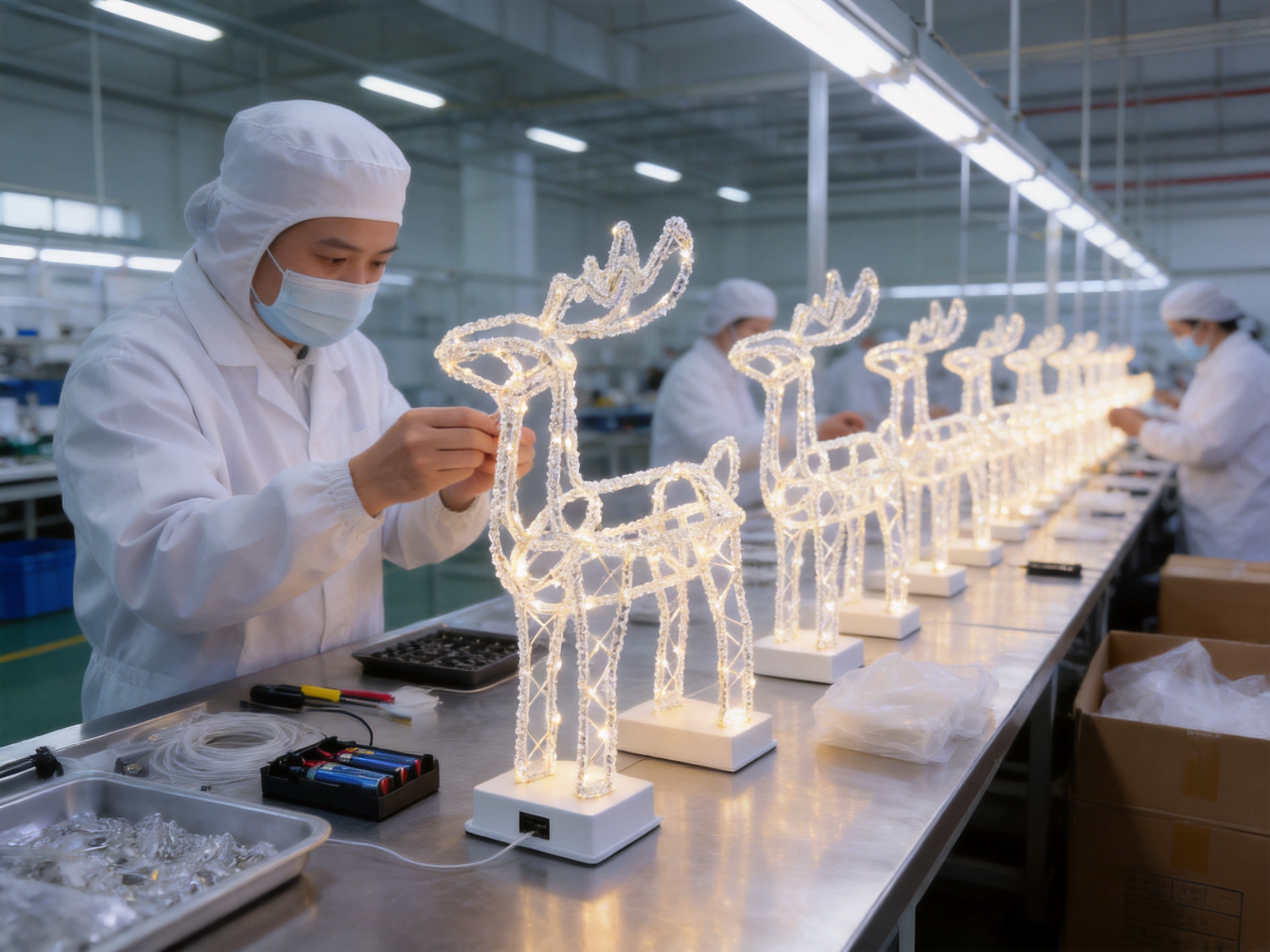
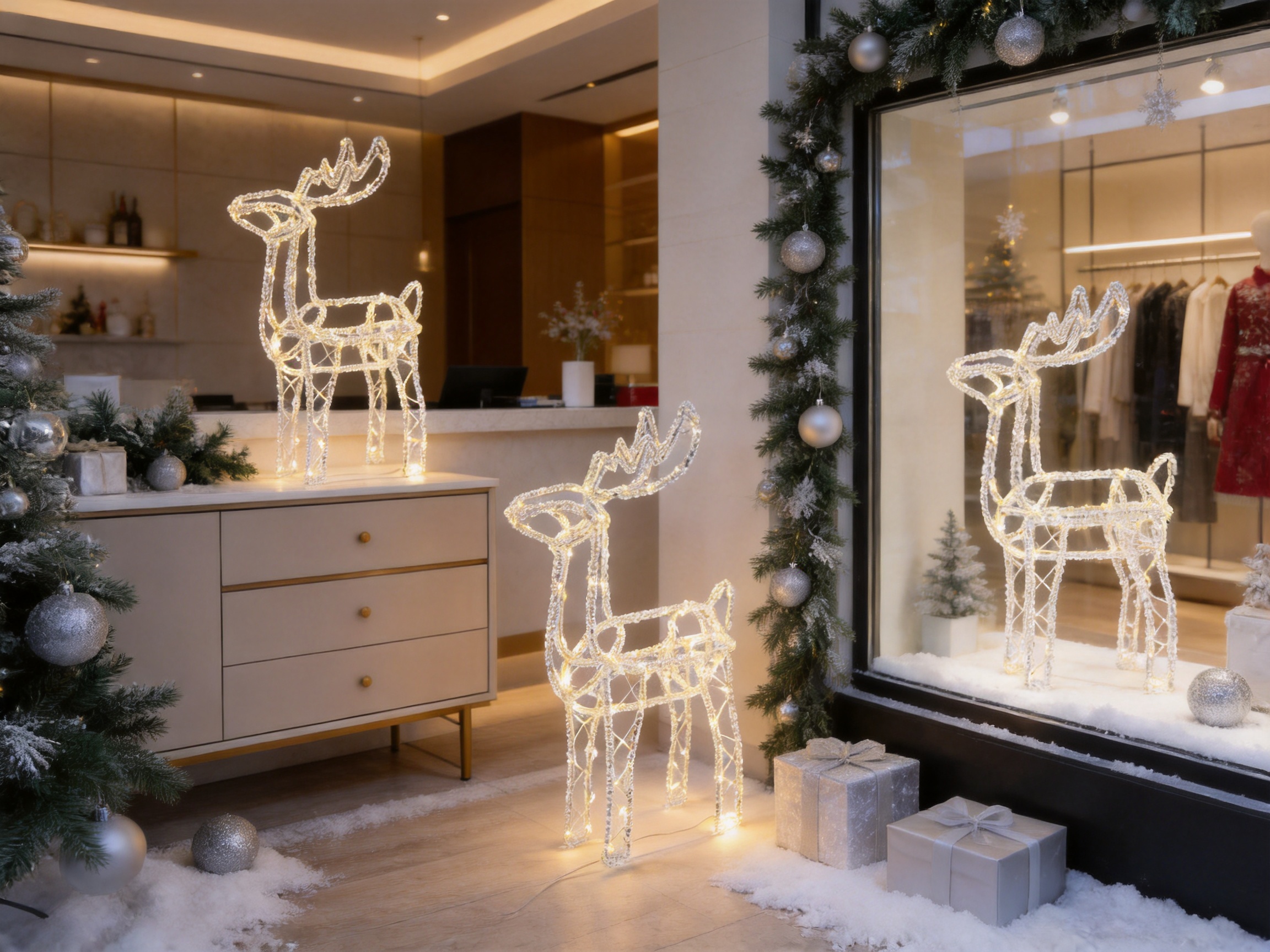
The Standing Deer Acrylic LED Decorative Light is designed to answer these needs with a graceful deer silhouette, a metal support frame, translucent acrylic elements, and warm white LED illumination. Its form is recognizable at a glance, yet refined enough for entryways, living rooms, hotel interiors, retail windows, seasonal installations, and Christmas displays. Rather than functioning as a basic string of bulbs, it acts as a freestanding decorative object with light integrated into its outline.
The design draws inspiration from the natural elegance of a standing deer. The upright posture gives the product a stable visual presence, while the carefully arranged acrylic beads provide a crystalline appearance. When the LEDs are switched on, the transparent or translucent acrylic surfaces catch and diffuse the light, creating a soft winter effect rather than a harsh point-light appearance.
For buyers comparing seasonal lighting products, the key value of this deer lamp lies in the combination of sculptural design, warm illumination, compact proportions, battery-powered convenience, and manufacturing expertise. It is suitable for settings where an attractive decorative centerpiece is needed without the installation complexity of a large wired display.
Product Overview
The product is a standing deer-shaped decorative lamp made from iron, copper, PVC, LED components, and acrylic. The metal frame establishes the overall deer profile and provides structural support. Copper and PVC components assist with the electrical and protective portions of the lighting assembly, while the acrylic elements add the product’s signature luminous appearance.
The listed product dimensions are 30 by 7 by 35, with the source specification not identifying a measurement unit. Buyers should confirm the final unit and packaging dimensions with the supplier before placing a production order. The compact vertical format allows the lamp to fit on furniture, display platforms, counters, shelves, window ledges, and other locations where floor space may be limited.
The supplied specification identifies a 3AA battery power system. This configuration allows the product to operate in areas where access to a wall outlet is inconvenient or unavailable. It also helps reduce visible cabling, which is valuable for retail displays, dining tables, reception areas, temporary event installations, and seasonal home decoration.
The product title refers to a 120-light version, while the detailed specification table lists 80 lights. This difference should be confirmed during quotation and sampling. The exact LED quantity may vary by configuration, production version, or sales listing. For procurement accuracy, buyers should request a final technical sheet identifying the LED count, light color, operating modes, battery life, switch type, and packaging details.
| Specification | Listed Detail | Purchasing Consideration |
|---|---|---|
| Product name | Standing Deer LED Decorative Lights with Acrylic | Confirm the final commercial name and configuration before ordering |
| Product category | Decorative Light | Suitable for seasonal, residential, commercial, and display decoration |
| Shape | Standing deer | Provides a recognizable winter and Christmas theme |
| Dimensions | 30 × 7 × 35 | Confirm the unit of measurement and packed size |
| Lighting quantity | 80 lights in the detailed specification; 120 lights in the title | Clarify the exact version required before production |
| Materials | Iron, copper, PVC, LED, acrylic | Combines a supportive frame with luminous decorative elements |
| Power supply | 3AA batteries | Verify battery life, battery compartment design, and whether batteries are included |
| Minimum order quantity | 1,000 units | Appropriate for wholesalers, retailers, project buyers, and seasonal programs |
A Sculptural Alternative to Conventional String Lights
Traditional string lights are versatile, but they generally depend on the user to create the final shape. They must be wrapped, hung, attached, or arranged before they produce a recognizable visual pattern. The Standing Deer Acrylic LED Decorative Light offers a different approach: the decorative form is built into the product itself.
This distinction gives the deer lamp an advantage in merchandising and installation. A retailer can place it on a display table and achieve an immediate seasonal effect without complex styling. A hotel or restaurant can position it near an entrance or reception desk as a complete decorative feature. A homeowner can place it in a living room or hallway without needing hooks, clips, extension cords, or a large supporting structure.
The deer silhouette also gives the product a strong emotional association. Deer are connected with winter landscapes, forests, Christmas stories, nature, and peaceful seasonal scenes. This makes the lamp suitable for a broad range of decorative concepts, including classic Christmas, Nordic winter, woodland themes, luxury holiday displays, and family-oriented festive environments.
Compared with flat light panels or ordinary illuminated signs, the standing deer has a three-dimensional presence. Its outline can be viewed from different angles, allowing it to function as part of a multidirectional display. The product is not merely a light source; it is a visual object that contributes shape, depth, and narrative to an interior setting.
The compact width is especially useful in areas where a broad decoration would obstruct movement or consume valuable display space. Multiple units can potentially be arranged in a row, grouped with artificial snow or greenery, or combined with other deer and woodland elements. Such arrangements can help retailers and event designers create tiered scenes while maintaining a consistent product language.
Acrylic Elements That Create a Crystal-Like Effect
Acrylic is one of the defining materials in this decorative lamp. The acrylic beads or acrylic decorative components are described as crystal clear and designed to refract a delicate luster under illumination. This visual behavior gives the product a brighter and more dimensional appearance than a plain metal outline with exposed LEDs.
When warm white LEDs are placed along the deer profile, the acrylic surfaces interact with the emitted light. Some light passes through the material, some is diffused, and some is reflected by the contours of the acrylic. The result is a layered appearance in which the decorative elements appear to shimmer around the metal frame.
Compared with glass, acrylic can offer practical advantages for many decorative applications. It is generally lighter and less vulnerable to shattering during handling, transportation, installation, and seasonal storage. These characteristics are valuable for products intended for repeated commercial use or shipment in large quantities.
The acrylic details also help soften the appearance of the metal structure. Without them, the product might look purely industrial or skeletal. With them, the deer gains a more festive and polished character. The transparent material can complement warm white lighting, white ornaments, silver decorations, natural greenery, and contemporary neutral interiors.
In a retail environment, the acrylic components can help the lamp stand out even when the LEDs are switched off. During daytime merchandising, the product retains its decorative silhouette and reflective surface. At night or in a dim display area, the illuminated acrylic creates a more dramatic effect.
For buyers seeking a premium appearance without the weight and fragility associated with traditional glass ornamentation, acrylic is a practical material choice. Its combination of visual clarity, low weight, and compatibility with LED lighting supports both product presentation and logistical efficiency.

Standing Deer Acrylic LED Decorative 120 Lights
Warm White Illumination for a Comfortable Atmosphere
The built-in LEDs are described as warm white and evenly arranged along the deer outline. Warm white light is widely used in residential and hospitality decoration because it creates a comfortable, welcoming, and intimate visual environment. It is generally less visually severe than cool white light and works well with wood, fabric, greenery, metallic ornaments, and warm interior finishes.
Even distribution is important in a sculptural decorative product. If the light sources are concentrated in only a few areas, the silhouette may appear incomplete or unbalanced. By arranging LEDs along the outline, the product can communicate the full deer shape more clearly. The illuminated contour helps viewers recognize the head, body, legs, and overall posture even from a moderate distance.
Warm white illumination also supports photography and visual merchandising. In retail displays, the lamp can add a soft glow to surrounding products without overwhelming them. In hospitality settings, it can enhance the background of photographs, dining areas, reception spaces, and seasonal promotional scenes. In a home, it can function as an accent light rather than the primary source of room illumination.
LED technology brings several benefits to decorative products. LEDs typically consume less power than traditional incandescent bulbs and produce less heat during normal operation. Lower heat output is helpful when the lamp is placed near ornaments, packaging materials, fabrics, artificial greenery, or other seasonal decorations. The 3AA battery design further supports low-complexity installation.
Because the product is intended primarily for atmosphere and decoration, the quality of the visual glow is more important than high brightness. The objective is a controlled, graceful radiance that makes the acrylic details appear luminous. This allows the deer to contribute to a scene without becoming visually distracting.
Battery-Powered Convenience
The 3AA battery power system is one of the product’s most practical features. Corded lighting can be effective, but power cables may limit placement, create visual clutter, or require access to a nearby socket. A battery-operated lamp can be positioned where the design concept requires it rather than where the electrical infrastructure happens to be located.
For retail buyers, battery operation can simplify store-floor presentation. A unit can be placed on a seasonal table, inside a window display, beside a product stack, or near a promotional sign. Staff do not need to route a long cord through the display, and the lamp can be moved quickly when the merchandise layout changes.
For event planners, battery power can reduce installation time. Temporary venues often have limited sockets or strict rules about cable management. A freestanding deer lamp can be positioned on a welcome table, buffet station, photo backdrop, gift table, or stage-side display without requiring a permanent electrical connection.
For household users, the absence of a power cord increases flexibility. The lamp may be used in a hallway, on a mantel, inside a bedroom, near a window, or in a seasonal arrangement that changes from year to year. It can also be stored compactly after the holiday season and brought out when needed.
Buyers should confirm the expected battery runtime, switch location, timer function, lighting modes, and battery compartment access before finalizing a purchase. These details can affect the user experience and should be standardized when the product is purchased for a private-label, retail, or project program.
Battery operation does not eliminate the importance of responsible use. The product should be used with suitable batteries, and batteries should be removed during long-term storage. The battery compartment should be kept dry, and the lamp should be operated according to the supplier’s instructions.
Freestanding Design and Placement Flexibility
The standing format gives the product a natural vertical orientation. The deer can be displayed independently rather than suspended from a ceiling or attached to a wall. This makes it suitable for areas where a self-supporting decorative object is more appropriate than a hanging light.
Possible placement areas include entryway consoles, living-room sideboards, reception counters, retail platforms, hotel lobbies, restaurant host stands, fireplace surrounds, seasonal window displays, office reception areas, and event tables. The product can also be incorporated into a larger Christmas scene with garlands, artificial snow, pine branches, gift boxes, ornaments, and other illuminated figures.
The product’s relatively narrow listed depth can help it fit on shelves and counters without taking up excessive surface area. Its vertical height gives it visibility above low display items, while the deer profile remains small enough for grouped merchandising. Buyers who plan to use several units should evaluate spacing, viewing angles, and the visual balance of the group.
A single unit can provide a subtle accent. Multiple units can create a more immersive woodland concept. For example, different deer lamps may be placed at varying distances or heights, with greenery used to connect the composition. In a retail window, the lamps can be combined with product packaging or seasonal signage to create a layered backdrop.
The metal frame contributes to the product’s standing structure. A stable frame is particularly important because the lamp may be placed on smooth surfaces where movement could affect the presentation. During sample approval, importers should inspect the base, joints, welding or fastening points, surface finish, and resistance to ordinary handling.
Advantages for Retailers and Wholesale Buyers
The product offers several characteristics that can support a seasonal retail program. First, its deer shape is immediately understandable. Consumers do not need extensive explanation to recognize its purpose. Second, the acrylic and warm white LED combination gives it a more premium appearance than a basic plastic figure or unadorned string light. Third, the battery-powered design makes it easy to demonstrate in a store.
The 1,000-unit minimum order quantity is oriented toward wholesalers, importers, retail chains, project buyers, and distributors rather than very small custom orders. A buyer ordering at this volume may be able to establish consistent packaging, labeling, carton design, product photography, and market positioning across a seasonal collection.
Retailers can present the lamp as a giftable home decoration, a Christmas accent, a winter window ornament, or a decorative ambient light. Its compact form may help reduce shelf-space requirements compared with large illuminated sculptures. The product can also be marketed as a tabletop or console decoration, provided the final dimensions and recommended placement are clearly communicated.
For online sellers, the product has strong visual merchandising potential. The silhouette can be shown in both illuminated and unlit images. Close-up photography can highlight the acrylic details, while room-scene photography can communicate scale and atmosphere. Accurate listing information should state the battery type, LED quantity, dimensions, materials, and whether batteries are included.
Because the title and detailed specification currently show different LED quantities, a professional buyer should resolve this issue before printing packaging or publishing a final catalog. Clear technical consistency is especially important for retail compliance, customer expectations, and product reviews.
Advantages for Hospitality, Events, and Commercial Spaces
Hotels, restaurants, shopping centers, offices, and event venues often need seasonal decorations that are attractive but easy to deploy. A large permanent installation may require significant labor, electrical planning, and storage space. A compact battery-operated deer lamp offers a simpler option for accent areas.
In a hotel lobby, the lamp can be placed near a seating area, reception desk, elevator entrance, or seasonal floral arrangement. In a restaurant, it can add warmth to a host station, dessert counter, private dining room, or holiday buffet. In a retail store, several units can frame a promotional display or guide attention toward a seasonal collection.
Event planners may use the product as part of a winter wedding, company celebration, holiday market, charity event, or family festival. Because it is freestanding, the lamp can be moved during setup and removed quickly after the event. Battery operation can also help preserve a clean appearance in photographs and videos.
Commercial buyers should assess the intended environment. If the product is to be used outdoors, the supplier must confirm whether the specific configuration is suitable for outdoor conditions. The supplied information describes a decorative indoor-oriented product but does not provide an outdoor protection rating. It should not be assumed to be weatherproof without written confirmation.
Material Engineering and Structural Considerations
The product combines several materials, each selected for a different function. Iron forms the primary structural framework and helps maintain the deer’s shape. Copper is associated with the conductive wiring or electrical elements. PVC can provide insulation and protective covering around wiring. LEDs supply the light source, and acrylic provides the transparent decorative finish.
A successful decorative lamp depends on the interaction of these materials. The frame must be shaped accurately enough to preserve the deer profile. Wiring must be routed neatly and protected from abrasion. Acrylic components must be positioned consistently so the visual effect remains uniform from one unit to the next. The electrical assembly must be integrated without compromising the appearance of the product.
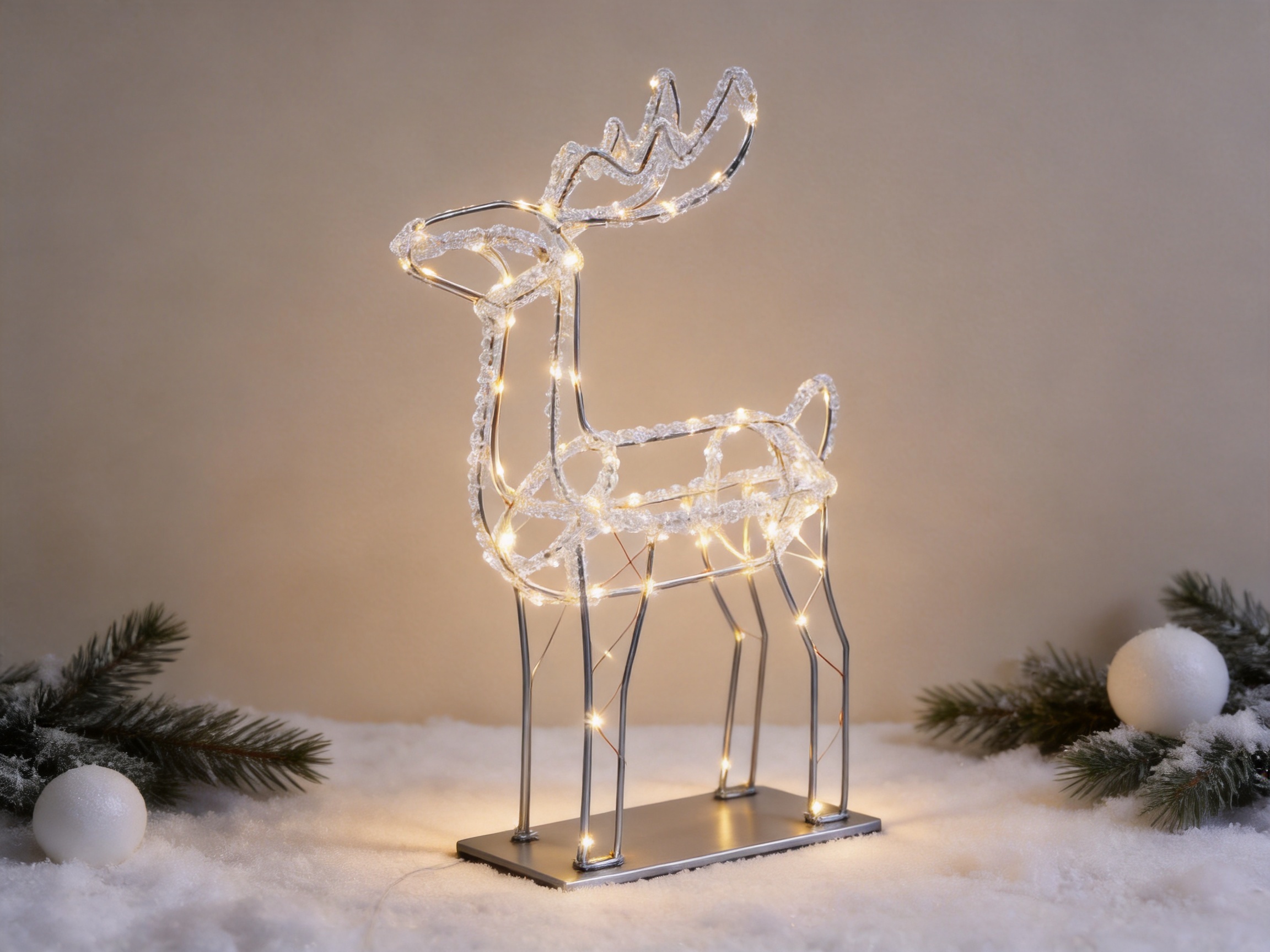
Manufacturing quality can be evaluated through several visible and functional details. These include smooth frame joints, consistent coating, secure acrylic attachment, even LED spacing, clean wire routing, firm battery-compartment construction, and a stable base. Packaging should also protect the acrylic surfaces and prevent the frame from being bent during transport.
For a product intended for repeated seasonal use, storage is an important consideration. Buyers may prefer packaging that allows the lamp to be returned to its original carton after use. Protective separators, suitable internal supports, and clear handling instructions can help reduce damage during the off-season.
Material selection also affects shipping economics. Acrylic generally weighs less than glass, while the compact design helps limit the overall volume of each unit. The exact packed weight and carton dimensions should be requested for freight planning, container loading, warehouse calculations, and landed-cost analysis.
Manufacturing Strengths of an Established Lighting Producer
Taizhou Mingde Decorative Lighting Co., Ltd. is presented as an experienced manufacturer with a long history in the festive lighting industry. The company was founded in 1968 and was formerly associated with Zhejiang Festival Lighting General Factory. Its stated annual production capacity is 10 million strings of festive lights, positioning it as a large-scale producer rather than a small workshop focused on limited manual assembly.
Large production capacity can provide important advantages for buyers. It may support more stable component sourcing, better production scheduling, larger quality-control teams, and greater ability to handle seasonal demand. For importers and retail chains, the ability to support repeat orders is often as important as the quality of the initial sample.
The company’s product range includes linear lights, icicle lights, net lights, circular lights, spiral trees, LED string lights, copper wire lights, and cord lights. This broad portfolio indicates experience across multiple lighting structures and product formats. The Standing Deer Acrylic LED Decorative Light benefits from this wider manufacturing background because it combines wiring, LED placement, a metal frame, decorative acrylic components, and battery operation.
The company states that it was among the first domestic companies in the industry to obtain U.S. UL certification and that it established an ISO 9001 quality system in 1997. Certification claims should always be verified for the specific product, factory, production site, and current certificate scope. Nevertheless, this history suggests an awareness of export-market requirements and formal quality-management practices.
The manufacturer also describes an integrated production model covering component manufacturing through final assembly and shipment. Vertical integration can improve control over product consistency. When a company manages more stages internally, it may be able to coordinate component specifications, production timing, inspection procedures, and corrective actions more efficiently than a business that depends entirely on unrelated subcontractors.
For buyers, an integrated system can be particularly valuable for seasonal products. Holiday lighting programs operate under strict deadlines, and late component deliveries can affect the entire retail calendar. Coordinated production resources may help reduce the risk of schedule disruption, although lead times and production capacity must still be confirmed for each order.
Quality-Control Priorities for This Product
Quality control for the deer lamp should begin with incoming materials. Iron components should be checked for dimensions, surface condition, and resistance to visible defects. Acrylic components should be inspected for clarity, scratches, cloudiness, burrs, and consistent size. Copper wiring and PVC insulation should be checked against approved specifications.
During frame production, the deer outline should be measured against an approved sample or technical drawing. The head, antlers, body, legs, and base must retain the intended proportions. Uneven shaping can affect stability and visual appeal. The frame finish should be consistent, with attention to coating adhesion, exposed metal, sharp edges, and possible corrosion risks.
Electrical assembly should include checks for LED function, polarity, wire connections, insulation, switch operation, battery contact quality, and resistance to ordinary handling. Every lighting unit should be tested before packing. If multiple lighting modes or a timer function are offered in a future configuration, those functions should also be tested systematically.
Acrylic attachment is another important inspection point. Components should remain secure during normal movement and should not rattle excessively inside the package. Their spacing should be consistent so that the illuminated outline looks balanced. Any adhesive or mechanical fastening method should be selected for long-term stability under the intended indoor conditions.
Final inspection should evaluate the complete product rather than isolated parts. The finished lamp should stand correctly, illuminate evenly, match the approved color temperature, and fit inside its packaging without pressure on the acrylic. Carton markings, product labels, battery warnings, and quantity information should also be checked before shipment.
For larger orders, buyers may request a pre-production sample, golden sample, inspection standard, production photographs, and third-party inspection. These measures can help ensure that the delivered goods remain aligned with the approved design.
Export Experience and Market Suitability
The company identifies the United States, Central America, and South America among its served markets. Experience with international distribution can help a manufacturer understand differences in packaging, labeling, electrical expectations, shipping documentation, and seasonal sales cycles. However, importers remain responsible for confirming the regulatory requirements that apply in their destination markets.
North American and Latin American buyers may have different expectations regarding battery compartments, warning labels, carton language, retail packaging, and product testing. The exact requirements can also vary according to whether the lamp is sold as an indoor decorative article, a toy-like seasonal item, or an electrical lighting product. Buyers should provide the intended market and request the relevant compliance documentation.
The manufacturer’s history with export lighting suggests that it may be able to support documentation and production communication for international programs. Buyers should still establish clear specifications in writing, including LED quantity, color temperature, battery type, product dimensions, materials, packaging, operating instructions, and quality standards.
For seasonal products, timing is critical. Retailers often need goods months before the holiday selling period begins. A professional purchasing plan should account for sample approval, material preparation, production, inspection, ocean or air freight, customs clearance, warehouse receiving, and retail distribution. Early communication with the manufacturer can reduce the risk of missed seasonal opportunities.
Design Applications in Residential Spaces
At home, the standing deer lamp can be used as a seasonal accent in several ways. Placed on an entryway table, it can welcome guests with a gentle winter glow. Positioned on a sideboard or mantel, it can complement garlands, candles, stockings, ornaments, and natural branches. On a bookshelf, it can add a small illuminated focal point without requiring a large reorganization of the room.
The lamp can also be used in a child’s family living area, provided it is positioned safely and used according to the product instructions. Its soft warm white light may contribute to a calm evening atmosphere. Because it is battery-powered, the product can be moved from room to room as family activities change.
Interior designers can incorporate the deer into neutral, rustic, Scandinavian, traditional, or contemporary holiday concepts. The acrylic components work well with white and silver palettes, while the metal frame can complement darker wood, black accents, or industrial-inspired interiors. The form is festive without depending on excessive color or flashing effects.
For homeowners who prefer subtle decoration, one lamp may be enough to establish a seasonal mood. For those who enjoy more elaborate displays, several units can form a small herd. Grouping should be planned carefully so that the lamps remain visually distinct rather than appearing crowded.
Design Applications in Retail and Window Displays
Retail windows depend on visual impact, especially during the holiday season. A recognizable illuminated object can help create a theme quickly. The standing deer can serve as a central figure surrounded by merchandise, gift boxes, greenery, or other lights. Its three-dimensional shape can add depth to a window arrangement that might otherwise rely only on flat graphics.
Inside the store, the lamp can be placed near seasonal apparel, home goods, gifts, ornaments, or winter accessories. Its warm glow may attract attention to a particular display zone. Since the product is freestanding, it can be integrated into a merchandising table without permanent installation.
Retailers can also use the deer lamp as part of an endcap or promotional display. The product itself may be offered for sale, or it may be used as a visual prop to support a broader seasonal collection. If it is sold, packaging should clearly communicate the battery requirement, dimensions, light color, and intended use.
Commercial buyers should consider display security in high-traffic stores. The lamp should be positioned where it is visible but not easily knocked over. If several units are used, staff should inspect them regularly for battery performance, frame alignment, and acrylic condition.
Packaging, Logistics, and Order Planning
Decorative lighting products can be vulnerable to damage if packaging is not matched to their structure. The deer lamp contains a shaped metal frame and acrylic details that should be protected from bending, scratching, and compression. Packaging should hold the product securely while avoiding unnecessary pressure on delicate components.
For wholesale orders, buyers should request the unit packing method, inner carton dimensions, master carton dimensions, gross weight, net weight, carton quantity, and loading information. These details are important for calculating freight costs and planning warehouse space. Because the minimum order quantity is listed as 1,000 units, logistics efficiency can have a significant effect on the total landed cost.
Product labels should identify the model, battery requirement, quantity, materials where required, country of origin, and relevant safety information. If the product is intended for a particular export market, packaging language and symbols should be adapted to local requirements.
Buyers should also confirm whether batteries are included. Many battery-powered lighting products are shipped without batteries because of transport, cost, or market-specific considerations. The packaging should state this clearly to avoid customer confusion.
Before mass production, a complete packed sample is recommended. A loose product sample may look satisfactory, but its packaging can reveal problems such as insufficient cushioning, difficult unpacking, excessive plastic, unstable internal supports, or a carton that does not withstand normal handling.
How the Product Compares with Other Decorative Light Options
Compared with standard LED string lights, the deer lamp offers a defined three-dimensional form and faster setup. String lights may cover a larger area and provide more installation flexibility, but they require the user to create the visual arrangement. The deer lamp delivers a finished decorative shape immediately.
Compared with illuminated fabric figures, the acrylic deer has a more open and lightweight visual structure. Fabric figures can create large silhouettes, but they may require more floor space, additional support, or a continuous power connection. The acrylic lamp is more compact and can work well on furniture and counters.
Compared with glass ornaments, acrylic components offer a practical balance between clarity and handling convenience. The lamp can deliver a crystal-like appearance while reducing some of the breakage concerns associated with glass. The final durability still depends on construction quality and proper use.
Compared with plastic molded figures, the metal-and-acrylic combination can provide a more refined appearance. The frame communicates the deer outline, while the acrylic details create sparkle and depth. This may position the product toward buyers seeking a decorative accent with a premium visual character.
Compared with plug-in sculptures, the 3AA battery design provides greater placement flexibility and reduces visible wiring. The trade-off is that users must monitor battery condition. For many tabletop and short-term decorative applications, the convenience can outweigh this limitation.
| Product Type | Primary Strength | Potential Limitation | Positioning of the Standing Deer Lamp |
|---|---|---|---|
| Standard string light | Flexible coverage and length | Requires arrangement or attachment | Provides a finished sculptural form with integrated lighting |
| Fabric light figure | Large, soft, highly visible silhouette | May require more space and support | Offers a compact, structured alternative |
| Glass ornament light | High visual clarity and traditional appeal | More vulnerable to breakage and heavier handling | Uses acrylic for a lighter crystal-like effect |
| Molded plastic figure | Simple production and solid form | May appear less delicate or premium | Combines a metal outline with luminous acrylic details |
| Plug-in light sculpture | Continuous power availability | Requires access to a socket and cable management | Uses 3AA batteries for flexible placement |
Procurement Questions Buyers Should Resolve
Before issuing a purchase order, buyers should confirm the exact LED quantity because the supplied title and detailed specification differ. The buyer should also confirm whether the product is available in only warm white or whether other colors can be produced. If the lighting color is important to the brand or display concept, it should be defined using an approved sample or a measurable specification.
Dimensions should be confirmed with units, tolerances, and packed measurements. The buyer should ask whether the stated size refers to the full deer including the base, antlers, or battery compartment. Such details affect shelf planning and product photography.
Battery information should include the required battery type, expected operating duration, switch design, timer availability, and whether batteries are included. If the product will be used in a commercial environment, buyers may also want to understand how frequently batteries need to be replaced during a typical display schedule.
Safety and compliance documentation should be requested for the target market. Depending on the destination and sales channel, this may include test reports, component documentation, factory certificates, labeling guidance, and declarations related to the applicable product category.
Finally, buyers should confirm the production lead time, sample approval process, payment terms, packaging options, carton details, inspection arrangements, and after-sales procedure. These commercial details are especially important for an order with a minimum quantity of 1,000 units.
Recommended Use and Care
The lamp should be placed on a stable, dry, level surface. Users should avoid positioning it where it may be frequently bumped, exposed to water, or subjected to excessive heat. If the lamp is displayed with greenery, fabric, gift wrap, or other decorative materials, adequate clearance should be maintained around the battery compartment and wiring.
The acrylic surfaces should be cleaned with a soft, dry or lightly damp cloth. Abrasive cleaners, rough materials, and strong solvents may affect the finish or clarity of the acrylic. The frame should be handled by its stronger structural areas rather than by delicate decorative components.
Batteries should be installed with the correct polarity. If the lamp will not be used for an extended period, the batteries should be removed to reduce the risk of leakage. The product should be stored in its protective packaging in a dry location after the holiday season.
Commercial users should include basic inspection in their display routine. Staff can check that the lamp is standing securely, the LEDs are operating, the acrylic components remain attached, and the battery compartment is closed properly. Simple routine care can help maintain the appearance of a seasonal display.
Why Manufacturing Experience Matters in Seasonal Lighting
Holiday lighting is a highly seasonal business. Demand often rises sharply before Christmas and winter holidays, while delivery deadlines are fixed by retail calendars and promotional schedules. A supplier’s production experience, capacity, component control, and export familiarity can therefore directly affect the buyer’s ability to launch products on time.
An established manufacturer with a broad lighting portfolio may be better prepared to manage shared components, production planning, quality systems, and packaging requirements. The stated production capacity of 10 million strings of festive lights demonstrates substantial experience in high-volume lighting production. This does not automatically guarantee that every product will meet every buyer’s requirements, but it provides a meaningful foundation for scale and repeatability.
The company’s stated history since 1968 also indicates long-term participation in the industry. Long operating experience can support knowledge of seasonal demand, common product defects, export procedures, and evolving consumer preferences. When combined with modern quality systems and production equipment, this experience can help transform a decorative concept into a repeatable commercial product.
For the Standing Deer Acrylic LED Decorative Light, manufacturing expertise is important because the product includes multiple coordinated elements. The deer must maintain its shape, the LEDs must be distributed evenly, the acrylic must be positioned attractively, the wiring must be protected, and the battery system must function reliably. These requirements call for more than simple bulb assembly.
Conclusion
The Standing Deer Acrylic LED Decorative Light is a compact, freestanding seasonal decoration that combines a graceful animal silhouette with warm white LED illumination and crystal-like acrylic details. Its metal frame provides structure, while the acrylic elements help create a luminous winter effect. The 3AA battery system increases placement flexibility and reduces the need for visible power cables.
For residential users, the product can add a welcoming accent to entryways, living rooms, shelves, mantels, and holiday scenes. For retailers, it offers a visually recognizable item suitable for window displays, seasonal tables, and gift-oriented merchandising. For hotels, restaurants, offices, and event planners, it provides a portable decorative feature that can be positioned without complex wiring.
Its advantages over conventional decorative lighting include an integrated three-dimensional form, acrylic-enhanced sparkle, warm and comfortable illumination, compact proportions, and battery-powered convenience. Its commercial value is further supported by the manufacturer’s stated long-term industry experience, large production capacity, broad product range, quality-system history, and integrated manufacturing approach.
Before purchase, buyers should resolve the discrepancy between the 120-light product title and the 80-light detailed specification. They should also confirm dimensions, battery life, packaging, compliance documents, operating instructions, and target-market requirements. With these points clarified, the product can serve as a distinctive and scalable addition to a seasonal decorative lighting program.
Questions and Answers
What type of product is the Standing Deer Acrylic LED Decorative Light?
It is a freestanding decorative lamp shaped like a standing deer. It combines a metal frame, acrylic decorative elements, LED lighting components, wiring, and a battery power system.
Where can the deer lamp be used?
It can be used in entryways, living rooms, hotel lobbies, restaurant interiors, retail windows, reception areas, seasonal displays, event venues, and Christmas decoration settings. Outdoor use should not be assumed unless the supplier confirms suitable weather resistance and an applicable protection rating.
What color light does it produce?
The supplied product information describes the built-in LEDs as warm white. Buyers should confirm the exact color temperature or approve a sample if a specific lighting appearance is required.
How is the product powered?
The listed power supply is three AA batteries. The buyer should confirm whether batteries are included, the expected operating time, the switch location, and whether timer or flashing functions are available.
How many LEDs does the product contain?
The detailed specification lists 80 lights, while the product title refers to 120 lights. This discrepancy should be resolved with the supplier before ordering, packaging, or publishing product information.
What materials are used?
The listed materials are iron, copper, PVC, LED components, and acrylic. Iron supports the frame, copper and PVC are associated with the electrical assembly, LEDs provide illumination, and acrylic creates the transparent decorative effect.
What makes acrylic useful in this product?
Acrylic can provide a clear, reflective, crystal-like appearance while generally being lighter and less fragile than glass. It catches and diffuses the warm white LED glow, helping the deer silhouette appear more dimensional.
What is the listed minimum order quantity?
The listed minimum order quantity is 1,000 units. This quantity is more suitable for wholesalers, distributors, retail chains, seasonal programs, and commercial project buyers than for small individual purchases.
What should buyers confirm about the dimensions?
The listed dimensions are 30 by 7 by 35, but the specification does not identify the unit. Buyers should confirm the measurement unit, dimensional tolerances, total product height, base dimensions, and packed dimensions before ordering.
Can the product be customized?
The supplied information does not specify customization options. Buyers should ask whether the LED quantity, light color, frame finish, acrylic style, packaging, labels, battery compartment, or product dimensions can be modified.
What manufacturing strengths does the supplier present?
The supplier states that it was founded in 1968, has an annual production capacity of 10 million strings of festive lights, operates an integrated manufacturing system, has experience with international markets, and established an ISO 9001 quality system in 1997. Buyers should verify current certificates and their applicability to the exact product.
Is the product suitable for outdoor use?
The provided information does not identify an outdoor rating. Buyers should obtain written confirmation before using it outdoors or in areas exposed to moisture, rain, condensation, or extreme temperature changes.
How should the product be stored?
It should be switched off, have its batteries removed for long-term storage, and be returned to suitable protective packaging. The product should be stored in a dry location away from pressure, excessive heat, and objects that could scratch the acrylic.
References
1. Product specification supplied for the Standing Deer Acrylic LED Decorative Light, including listed materials, dimensions, lighting quantity, battery power, and minimum order quantity.
2. Product information supplied for the acrylic standing deer lamp, including design description, warm white LED arrangement, intended applications, and decorative characteristics.
3. Company information supplied for Taizhou Mingde Decorative Lighting Co., Ltd., including founding history, production capacity, product range, quality-system history, and export-market experience.
4. General principles of LED decorative lighting design, including light distribution, low-voltage battery operation, seasonal merchandising, and ambient illumination.
5. General packaging and quality-control practices for metal-frame, acrylic, and battery-powered decorative lighting products.
Product: Standing Deer Acrylic LED Decorative 120 Lights


Don't Miss New Releases & Subscriber Exclusives
Sign up for our newsletter to stay in the holidy spirit all year.
Further Questions? Contact Us
-
Useful Links
Home Products About Us Production Services News Contact Us -
Classification
Mini String Light LED Light Set Garland Light Light-up Spiral Trees LED Curtain Lights Battery Light LED Copper Wire Light Decorative Light -
Contact Info
zd@zflgf.com.cn+86-576-82467401
+86-13968612122 ( Ms. Zhang )
+86-13505747679 ( Mr. Tan )
+86-15062835074 ( Mr. Cheng )No.270 Zhenxi Road, Xinqiao Town, Luqiao District, Taizhou City, Zhejiang Province, China -


Holiday Lights Supplier