

 中文简体
中文简体

What Makes Commercial LED Mini Lights Ready for Large Displays
Large Christmas displays create a different set of requirements from decorating a single tree or mantel. A shopping center, hotel, public venue, restaurant, or outdoor event may need hundreds of feet of illuminated coverage, consistent light distribution, and a connection system that can handle multiple strings.
This is where commercial LED mini Christmas lights stand apart from many basic decorative light strings. Their value is not simply related to the number of LEDs. String length, bulb spacing, wiring, connectors, rectification, construction, and certification all influence how suitable a product is for a large installation.
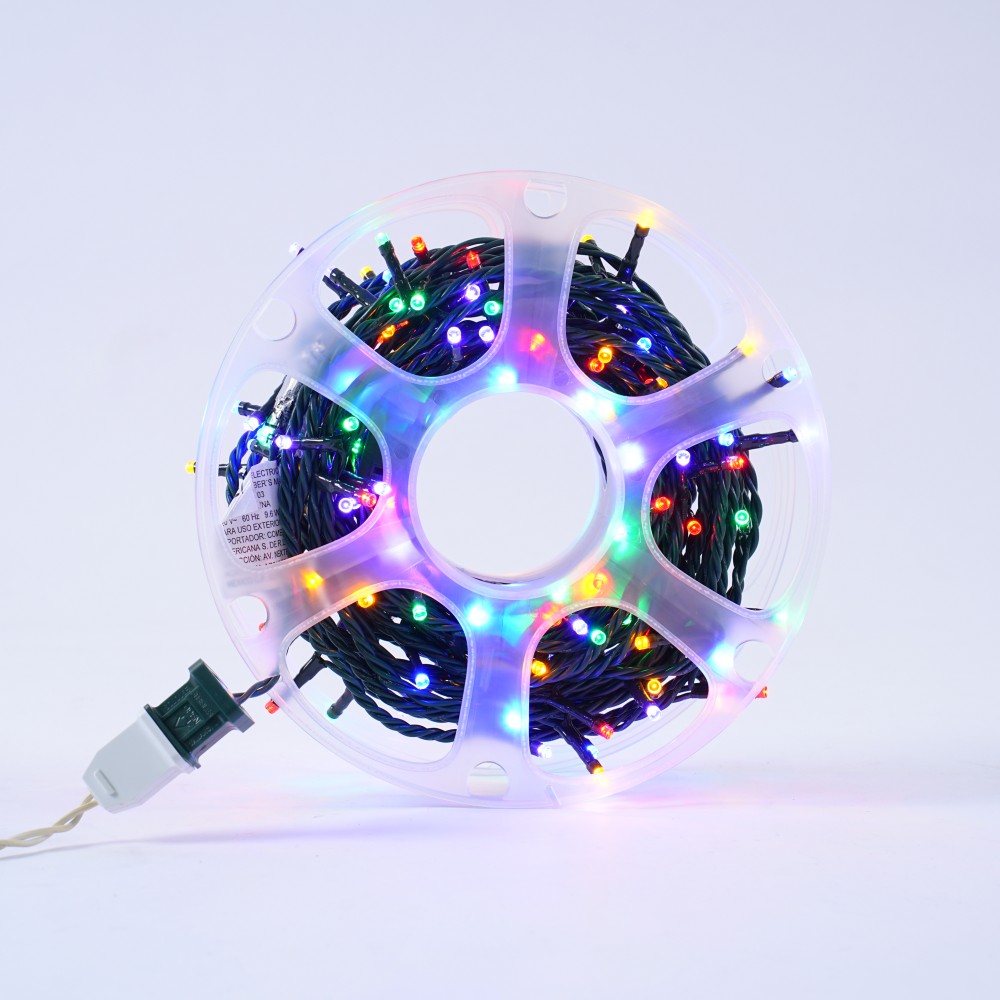
Large Displays Start With String Configuration
A large installation rarely consists of a single continuous light string. Commercial products are commonly designed to connect multiple sets end-to-end, allowing installers to build longer runs from standardized sections.
| Example Configuration | LED Count | Lighted Length | Connection Capacity |
| 50-light mini string | 50 LEDs | Approx. 17 ft | Up to 43 sets |
| 70-light mini string | 70 LEDs | Approx. 24–35.5 ft | Up to 43 sets |
| 100-light mini string | 100 LEDs | Approx. 34–50 ft | Up to 21 sets |
These figures vary by product design and electrical configuration. Current commercial examples show 50-light strings connecting up to 43 sets, while 100-light versions may support 21 sets.
That difference matters for large displays. A project manager can calculate the approximate number of strings required based on the target length, spacing, and connection limits rather than treating every light set as an isolated product.
Bulb Spacing Changes Coverage
Two strings with the same LED count can create very different visual patterns. Four-inch spacing produces a denser arrangement, while six-inch spacing distributes the bulbs over a longer area.
- 4-inch spacing: Useful for trees, wreaths, signs, and displays that require a concentrated light pattern.
- 6-inch spacing: Extends the illuminated area and can suit rooflines, railings, larger trees, and architectural outlines.
- Different string lengths: Give installers more options when planning displays with different dimensions.
Commercial 5 mm LED mini strings currently appear in both four-inch and six-inch spacing configurations.
Why Does Bulb Construction Matter?
Large displays can contain thousands of individual light sources. A loose or removable bulb can become a weak point in a high-count installation. Some commercial-grade mini lights therefore use permanently molded, non-removable LED bulbs.
Current 100-light commercial strings, for example, use non-removable LEDs and sealed wide-angle bulb construction. The design avoids issues associated with loose or removed bulbs and keeps the light source integrated with the string.
Wide-Angle Lenses Improve Visual Coverage
The lens shape also affects how the light appears from different viewing positions. Concave 5 mm lenses are used in some commercial products to spread light across a wider viewing angle.
This characteristic becomes useful around retail windows, public walkways, trees, rooflines, and event installations where viewers may approach the display from different directions.
Electrical Design Becomes More Important as Displays Grow
Connecting many strings together requires more than simply adding plugs. Electrical characteristics need to match the intended connection configuration.
- Voltage: Commercial mini-light sets designed for North American applications commonly operate at 120 V.
- Current: A 100-LED example is listed at approximately 0.08 A per string.
- Rectification: Full-wave rectification can reduce visible flicker associated with conventional half-wave LED operation.
- Fused plugs: Some products use stackable plugs with additional fuses as part of their electrical design.
A current 100-light commercial string, for example, is specified at 9.6 W and 0.08 A, with a built-in rectifier and fused stackable plug.
Wire Specifications Can Influence Installation
The wire itself may receive less attention than the LEDs, but it becomes significant across long installations. Commercial examples commonly use 22 AWG wire, with different wire colors available to blend with trees, garlands, buildings, or architectural backgrounds.
Wire color can have a surprisingly strong visual effect. Green wire can disappear into evergreen branches, black wire can work against darker architectural surfaces, while white wire can blend with light-colored structures or winter-themed displays.
Certification Is Part of Commercial Specifications
Large public or commercial installations may have stricter product requirements than a small residential display. Certifications and indoor/outdoor ratings therefore deserve attention during product evaluation.
| Specification | Why It Matters |
| UL Listed | Relevant to electrical product acceptance and installation requirements |
| Indoor/Outdoor Rating | Indicates the intended application environment |
| Fused Connector | Supports the electrical design of connectable strings |
| Sealed LED Construction | Integrates the LED with the string structure |
| Commercial-Grade Wire | Designed around repeated decorative installation use |
Several current commercial mini-light products are UL listed for indoor and outdoor use, while some also carry additional energy-related certifications.
Large Displays Need More Than More Bulbs
A visually impressive Christmas display is not created simply by increasing the LED count. The relationship between bulb spacing, string length, connection limits, lens design, wiring, and electrical architecture determines how a large installation can be planned.
Commercial LED mini Christmas lights are designed around these larger-scale requirements. Connectable strings make long runs easier to configure, wide-angle 5 mm LEDs provide broader visual coverage, and specifications such as 22 AWG wire, full-wave rectification, fused plugs, and UL listing address practical installation considerations.
For large holiday displays, these details turn a collection of small decorative bulbs into a coordinated lighting system that can cover trees, buildings, walkways, storefronts, rooflines, and event spaces with a consistent visual pattern.

Don't Miss New Releases & Subscriber Exclusives
Sign up for our newsletter to stay in the holidy spirit all year.
Further Questions? Contact Us
-
Useful Links
Home Products About Us Production Services News Contact Us -
Classification
Mini String Light LED Light Set Garland Light Light-up Spiral Trees LED Curtain Lights Battery Light LED Copper Wire Light Decorative Light -
Contact Info
zd@zflgf.com.cn+86-576-82467401
+86-13968612122 ( Ms. Zhang )
+86-13505747679 ( Mr. Tan )
+86-15062835074 ( Mr. Cheng )No.270 Zhenxi Road, Xinqiao Town, Luqiao District, Taizhou City, Zhejiang Province, China -


Holiday Lights Supplier