

 中文简体
100 LED Light Set: A Practical Guide to Compact, Flexible, and Commercial-Grade Decorative Lighting
Decorative lighting has become an important part of seasonal merchandising, interior styling, event design, hospitality presentation, and everyday home decoration. Among the many available formats, LED light sets remain one of the most versatile choices because they combine low energy consumption, flexible installation, compact construction, and attractive visual performance. A well-designed light set can outline a window, enhance a Christmas tree, decorate a retail display, illuminate a table arrangement, or add a gentle glow to a small outdoor setting without requiring complicated installation.
The 100 LED Light Set is designed for users who want a compact decorative lighting solution with the visual appeal of multiple LED bulbs and the handling convenience of a flexible wire. The supplied product information identifies the associated technical model as MDSL060, described as a 60 LED Light Set with 5 mm diameter bulbs and a total length of 13 feet. Because the commercial title refers to a 100 LED Light Set while the specification table describes a 60 LED model, purchasers should confirm the final LED quantity, configuration, and packaging before placing a production order. This clarification is especially important for wholesale, private-label, and project-based purchases.
Regardless of the final bulb count selected, the product concept is clear: it is a compact LED string light intended for targeted decoration, small-scale illumination, and flexible seasonal applications. Its PP, PVC, copper, and LED construction provides a practical balance between flexibility, durability, weight, and manufacturing efficiency. Green or white wire options, white or multicolor LED bulbs, and additional color choices support a broad range of visual themes.

100 LED Light Set
Product Overview and Intended Use
A compact LED light set is made up of a series of light-emitting diodes distributed along an insulated electrical wire. Compared with traditional incandescent string lights, LED systems generally produce less heat, consume less electricity, and offer a longer operating life. These characteristics make them particularly suitable for decorations that remain illuminated for extended periods, such as holiday displays, retail windows, hospitality venues, and residential interiors.
The supplied product information describes the light set as approximately 13 feet in total length. This size is suitable for small Christmas trees, tabletop arrangements, shelves, window frames, vases, gift displays, furniture accents, and localized festive installations. It is long enough to create a noticeable lighting effect while remaining easy to handle and store. Unlike long commercial strings intended to cover large buildings or expansive landscapes, a compact set can be positioned accurately without excessive unused wire.
The light set is also lightweight. This is a meaningful advantage when decorating delicate branches, artificial foliage, display props, paper ornaments, glass containers, or temporary retail fixtures. Heavy lighting products may pull down branches or require additional supports, while a lighter string can often be installed using simple clips, ties, hooks, or its own wrapping tension.
The flexible main wire allows the user to follow curves and irregular outlines. It can be wrapped around a narrow tree trunk, guided around a mirror, arranged along a shelf edge, or woven through a centerpiece. Flexibility also makes packaging and transportation more efficient because the product can be coiled into a compact form before shipment and storage.
Core Technical Specifications
The following table summarizes the supplied technical information. Since the commercial product title and the model description do not identify the same LED quantity, buyers should request confirmation of the final production specification.
| Specification | Supplied Information |
| Commercial product title | 100 LED Light Set |
| Model listed in technical table | MDSL060 |
| Model description | 60 LED Light Set, 5 mm diameter |
| Materials | PP, PVC, copper, and LED components |
| Wire colors | Green or white wire |
| Light colors | White, multicolor LED bulbs, and additional colors by choice |
| Total length | 13 feet |
| Application characteristic | Indoor and outdoor use |
| Minimum order quantity | 3,000 units |
| Listed power | 7.2 watts |
| Certification information | UL, NOM, CE, REACH, and BSCI |
Specifications such as LED quantity, bulb spacing, wire gauge, controller type, power supply, waterproofing level, plug configuration, and lighting modes should be confirmed in a formal quotation or technical drawing. These details can vary according to destination market, customer requirements, and production batch configuration.
Advantages of LED Technology
Lower Energy Consumption
One of the most important advantages of LED decorative lighting is its efficient use of electrical power. LEDs convert electrical energy into visible light more effectively than traditional incandescent bulbs. The supplied specification lists the product power at 7.2 watts, which is appropriate for a small decorative set. Lower power consumption can reduce operating expenses for retailers, hotels, restaurants, event venues, and households that use decorative lights for many hours.
Energy efficiency is also valuable when many individual sets are used together. A large display may contain dozens or hundreds of light strings. The cumulative load can become significant if every string uses a high-wattage traditional bulb. LED technology allows designers to create bright, attractive displays while keeping the overall electrical demand more manageable.
Reduced Heat Generation
Traditional incandescent bulbs release a substantial portion of their energy as heat. LED bulbs generally operate at a lower temperature, which is beneficial when the light set is positioned near ornaments, fabric, paper products, artificial leaves, gift packaging, or wooden display materials. Lower heat output does not eliminate all safety considerations, but it can make LED strings more suitable for decorative environments where heat management is important.
Longer Service Potential
High-quality LED beads are designed for a long service life when operated within their intended electrical and environmental conditions. The product information specifically emphasizes long lifespan and low energy consumption. For commercial buyers, longer service potential can reduce the frequency of replacement and simplify seasonal installation programs. For consumers, it means that a well-maintained light set may be used across multiple holiday seasons.
Actual service life depends on several factors, including the quality of the LED chips, resistor selection, power supply stability, insulation, operating temperature, moisture exposure, mechanical stress, and storage conditions. A responsible buyer should evaluate the complete system rather than judging durability only by the LED bead itself.
Consistent Decorative Appearance
LED bulbs provide a clean and consistent light source across the string. White LEDs can support elegant winter themes, hospitality displays, wedding décor, and modern interior styling. Multicolor bulbs are suitable for traditional Christmas displays, children’s spaces, parties, festivals, and energetic retail presentations. The availability of different wire colors also helps the string blend into its surroundings.
Material Construction and Functional Benefits
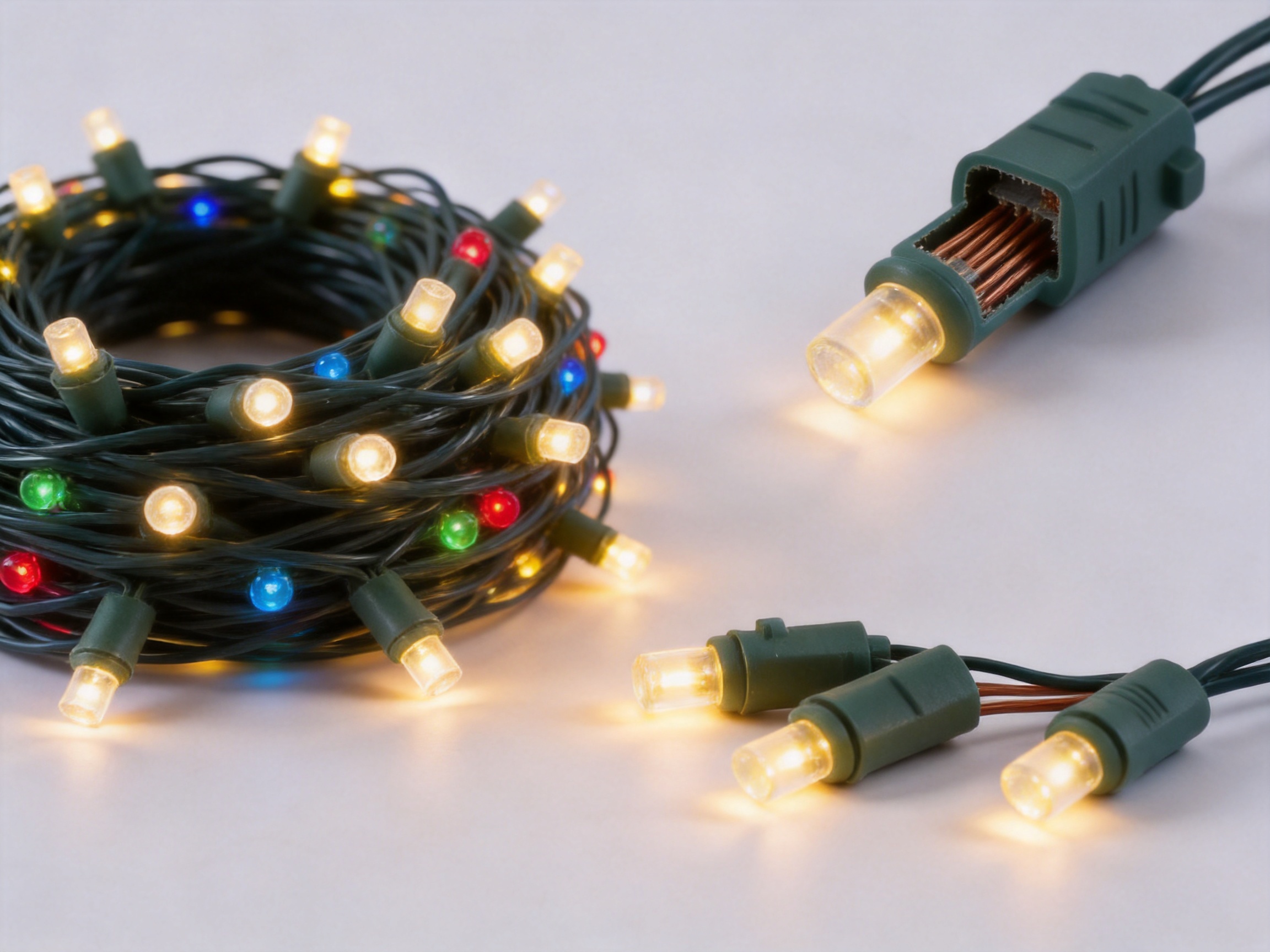
PP Components
Polypropylene, commonly identified as PP, is frequently used in decorative lighting components because it is lightweight, moldable, and suitable for high-volume manufacturing. It can be shaped into small protective parts, holders, covers, or related components. Its low weight contributes to easier handling and reduces the load placed on branches, display structures, and temporary supports.
PP also supports efficient production of consistent component shapes. Uniform molding can help maintain a regular appearance across large production quantities, which is especially important when the product is manufactured for wholesale distribution. Consistency in component dimensions can also simplify assembly and packaging.
PVC Insulation
PVC is widely used as an electrical insulation material because it can cover conductors effectively while maintaining flexibility. In a decorative light set, insulation protects the copper conductor from direct contact and helps form the external wire surface. The correct formulation and thickness are important for mechanical protection, flexibility, and resistance to ordinary handling.
For indoor and outdoor applications, buyers should confirm the applicable environmental protection requirements. Outdoor use may require specific sealing, connector protection, insulation performance, and water-resistance testing. The phrase “indoor and outdoor use” should therefore be considered an intended application statement, while the precise outdoor limitations should be verified through product documentation.
Copper Conductors
Copper is valued for its electrical conductivity and flexibility. In a light set, copper conductors help transmit power along the length of the string while allowing the wire to bend around decorative objects. This combination of electrical performance and flexibility is particularly useful for small-radius wrapping and detailed arrangement.
The conductor design, wire diameter, insulation quality, connection method, and strain relief all influence the overall performance of the finished product. Advanced production control is necessary to maintain stable connections between the wire, LED components, resistors, and any power-related parts.
LED Bulbs
The LED bulbs are the visible portion of the product and define much of its decorative identity. A 5 mm bulb format, as listed for model MDSL060, is compact enough for fine decorative work while remaining visible in a display. The bulb size can create a balanced appearance between brightness and delicacy. White and multicolor options allow the same basic product platform to serve different markets and seasonal themes.
Flexible Installation for Small and Targeted Spaces
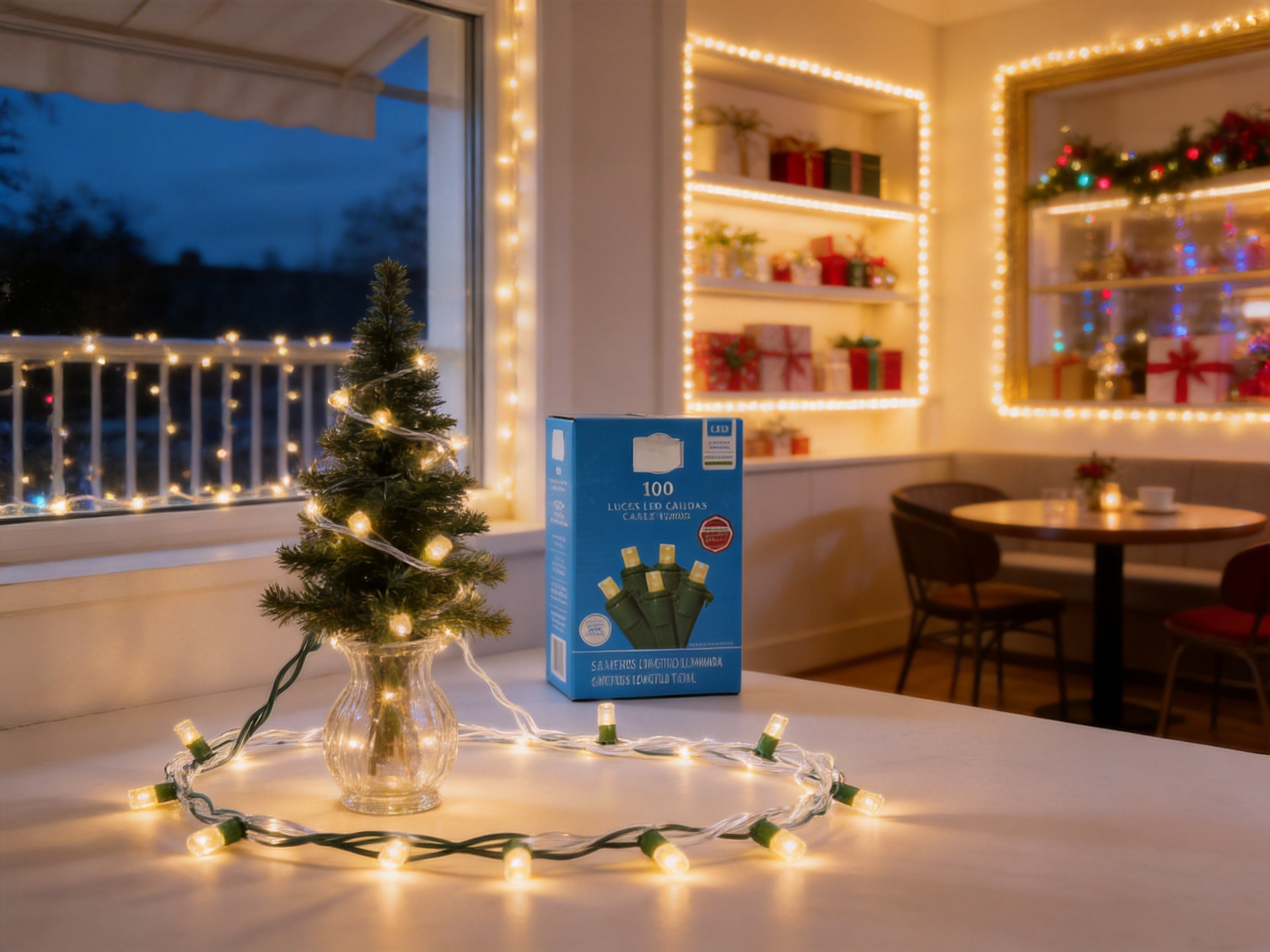
Large lighting systems are useful for broad façades, public trees, and major event structures, but they may be excessive for a tabletop, shelf, or small window. A compact light set provides a more controlled alternative. It can be wrapped around a vase, placed within a centerpiece, traced along a cabinet, or arranged around a framed picture without producing a surplus of wire that must be hidden.
The flexibility of the string supports several installation techniques. Users can wrap it in a spiral around a narrow object, drape it in gentle curves across a horizontal surface, weave it through branches, or place it behind translucent materials to create indirect illumination. The wire can also be shaped into simple outlines, although sharp bending or repeated folding should be avoided because mechanical stress may damage internal conductors or connections.
Green wire is especially suitable for Christmas trees, wreaths, garlands, artificial plants, and natural-looking seasonal arrangements. White wire can blend more effectively with light-colored furniture, winter displays, wedding décor, white shelving, curtains, and contemporary interiors. The choice of wire color can therefore affect the visual result even when the LED color remains unchanged.
Because the product is compact, it is also easier to combine with other decorative elements. Several strings can be installed in separate locations, allowing the designer to create a balanced arrangement rather than concentrating all illumination in one place. This modular approach is useful in retail merchandising, where displays may be rearranged frequently.
Indoor and Outdoor Decorative Applications
Home Holiday Decoration
In residential settings, the light set can be used around Christmas trees, mantels, stair railings, shelves, windows, dining tables, and entryway furniture. Its compact length is practical for apartments, bedrooms, home offices, and other spaces where a long commercial string would be inconvenient. It can provide a warm seasonal atmosphere without dominating the room.
The string is also appropriate for gift embellishment. It may be arranged around a gift table, incorporated into a holiday centerpiece, or used to highlight wrapped packages. White LEDs can create a refined appearance, while multicolor LEDs can provide a more playful and traditional festive effect.
Retail Windows and Product Displays
Retailers often need lighting that highlights selected products rather than illuminating an entire room. A compact light set can be positioned around mannequins, shelves, promotional signage, seasonal merchandise, or window props. Its small size makes it possible to direct customer attention toward a specific area.
Retail displays are frequently changed according to promotions and seasons. A lightweight flexible string can be removed, stored, and installed again with relatively little labor. Its compact packaging also supports inventory management when stores need to keep multiple color variants or seasonal designs on hand.
Hospitality and Event Styling
Restaurants, cafés, hotels, wedding venues, and event planners can use small LED light sets to create localized decorative accents. They may be placed around reception desks, buffet tables, bar counters, floral arrangements, photo areas, or outdoor seating. The product can contribute to atmosphere without requiring a permanent electrical installation.
For event use, appearance consistency is important. Sets used across multiple tables or display areas should have matching bulb color, wire color, brightness, spacing, and power configuration. Buyers ordering for events should request samples before approving a large quantity.
Outdoor Seasonal Displays
The supplied product information identifies the light set for indoor and outdoor use. Potential outdoor applications include covered patios, balcony railings, garden features, small shrubs, door surrounds, and temporary holiday displays. Outdoor installation should follow the manufacturer’s instructions regarding exposure to rain, snow, standing water, direct sunlight, connectors, and power supplies.
Outdoor conditions can be more demanding than indoor environments. Moisture, ultraviolet exposure, temperature changes, wind, and repeated movement may affect the wire and connections. Proper installation should prevent water from entering electrical components and should avoid placing excessive tension on the string.
Advantages Compared with Less Specialized Alternatives
More Flexible Than Rigid Decorative Fixtures
Rigid light bars, fixed panels, and preformed illuminated ornaments can create strong visual effects, but they are limited to the shape for which they were manufactured. A flexible light set can adapt to different objects and display layouts. This adaptability reduces the need to purchase a separate fixture for every decorative concept.
More Targeted Than Long Commercial Strings
Long strings may be efficient for large areas, but they can be inconvenient for small displays. Excess wire may need to be concealed, coiled, or secured, increasing installation time. A compact set is better suited to localized decoration and can deliver an organized appearance with less unused material.
More Efficient Than Incandescent Strings
Compared with incandescent decorative strings, LED technology typically offers lower energy consumption, reduced heat generation, and longer service potential. These benefits can improve the total cost of ownership, particularly in commercial settings where lights operate for extended periods or where many strings are used simultaneously.
More Visually Versatile Than Single-Color Products
The availability of white and multicolor LED options allows buyers to select a product suitable for different markets. White light may appeal to customers seeking a modern or premium look, while multicolor light supports traditional festive decoration. Additional color choices can help importers, retailers, and private-label customers develop collections for specific seasons or customer preferences.
More Suitable for Wholesale Customization
The product supports variations in wire color, LED color, and potentially power configuration. This makes it a useful base for wholesale programs. Importers can request a color assortment, match packaging to their market, or select a configuration for a particular retail channel. The listed minimum order quantity of 3,000 units indicates that the product is oriented toward commercial purchasing rather than one-off consumer orders.
Manufacturing Capacity and Industrial Strength
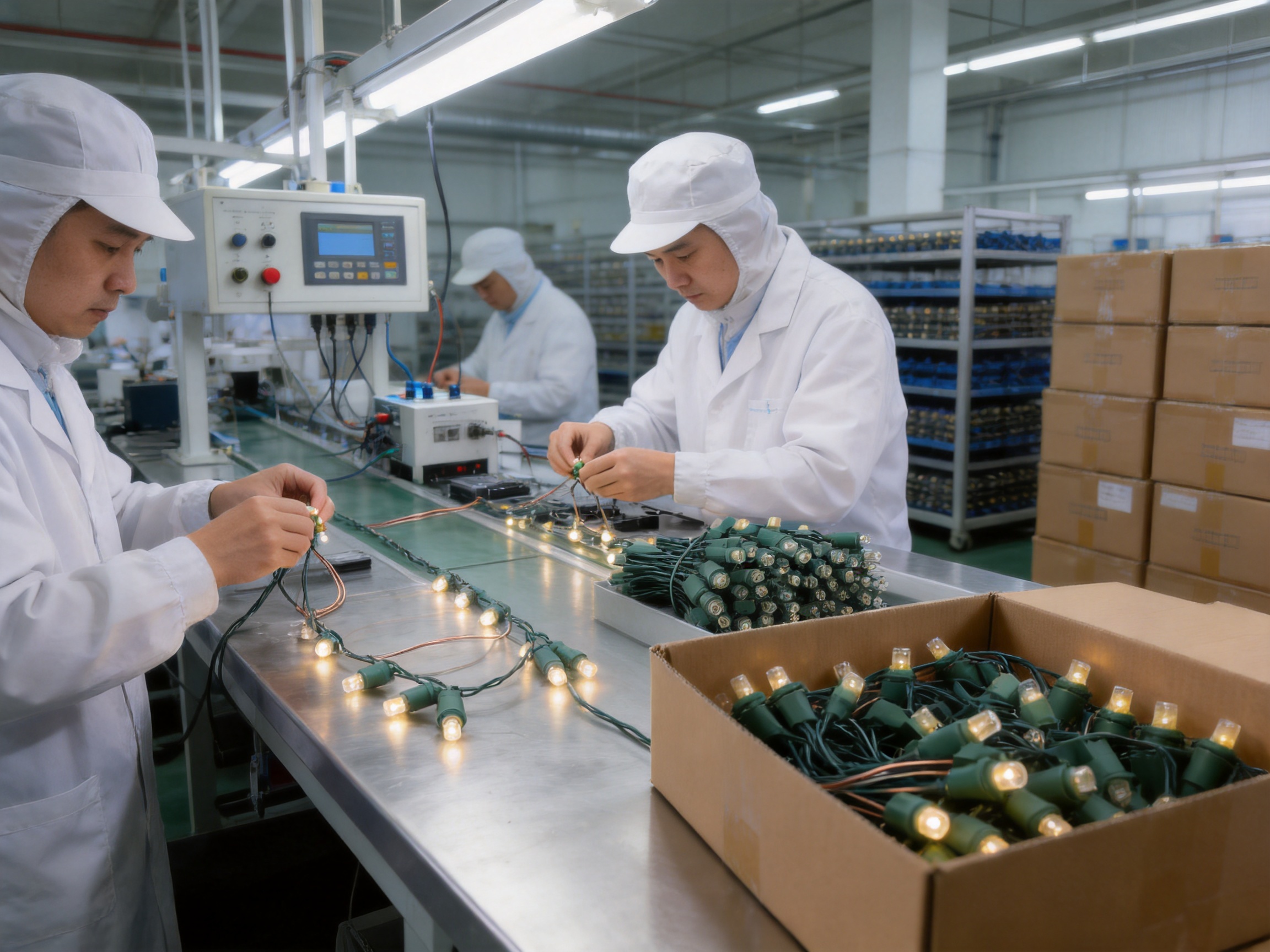
The manufacturer, Taizhou Mingde Decorative Lighting Co., Ltd., is described as having an annual production capacity of 10 million strings of festive lights. This capacity is significant for buyers who need reliable volume, repeat orders, and seasonal delivery planning. High-volume production capability can help support national retail programs, distributor inventories, promotional campaigns, and multi-market shipments.
The company is also described as one of China’s major export bases for festive lighting. Export experience can be valuable because international orders involve more than manufacturing the product itself. They require attention to documentation, packaging, destination-market requirements, electrical standards, shipping schedules, labeling, and communication across different time zones and commercial practices.
The company’s history extends back to 1968, when it was formerly associated with Zhejiang Festival Lighting General Factory. A long operating history does not automatically guarantee the quality of every individual product, but it can indicate accumulated experience in seasonal lighting, product development, production planning, and international customer service.
The company reportedly became one of the early domestic festive-lighting manufacturers to obtain U.S. UL certification and established an ISO 9001 quality system in 1997. These historical milestones suggest an emphasis on structured quality management and compliance awareness. Buyers should still verify current certificates, their scope, expiration dates, and whether they apply to the exact light-set configuration being purchased.
Advanced Manufacturing Processes
Component Preparation
A dependable LED light set begins with controlled component preparation. LEDs, resistors, conductors, insulation materials, plastic parts, connectors, and packaging components must be specified before assembly. Component consistency is important because a variation in one part can affect brightness, electrical loading, appearance, or reliability.
For a manufacturer producing millions of strings each year, component sourcing and incoming inspection are fundamental. Materials may be checked for dimensions, color, electrical properties, surface condition, and conformity with purchasing specifications. Systematic incoming control helps prevent defective materials from entering the assembly line.
Wire Cutting and Processing
The wire must be cut to the required length and processed for connection with the LED units. Accurate cutting supports consistent spacing and ensures that the final product meets the specified total length. Preparation may include stripping insulation, forming conductor ends, and creating connection points.
Automated or semi-automated wire processing can improve repeatability and production efficiency. However, equipment must be calibrated, and operators must monitor the process to ensure that stripping does not damage the copper conductor or leave insufficient insulation for safe assembly.
LED Assembly and Electrical Connection
LED components are connected along the wire according to the electrical design. The assembly process must maintain correct polarity, spacing, and connection quality. Poor soldering, weak crimping, incorrect polarity, or inconsistent resistor placement can lead to flickering, partial failure, or reduced service life.
Professional production lines use work instructions, process controls, visual checks, and electrical tests to reduce these risks. Depending on the exact product structure, assembly may include soldering, welding, crimping, injection molding, sealing, or protective encapsulation.
Insulation and Protection
After electrical connections are made, the exposed areas must be insulated and mechanically protected. PVC components and other protective materials help reduce the risk of conductor contact, abrasion, and moisture entry. The quality of insulation depends on material formulation, application method, thickness, curing or cooling conditions, and inspection.
For products intended for outdoor use, protection around LED holders, wire junctions, connectors, and power interfaces is particularly important. The manufacturer’s stated application should be supported by appropriate testing and clear installation guidance.
Lighting and Electrical Testing
Testing is a critical stage in the manufacture of string lights. Finished products may be checked for illumination, color consistency, electrical continuity, power consumption, polarity, insulation performance, and overall appearance. Testing can identify dark sections, intermittent connections, incorrect colors, damaged insulation, and assembly defects before shipment.
Quality control may include sample testing, full-function testing, aging tests, and inspection after packaging. The exact process depends on the product design, certification requirements, customer specifications, and destination market. Buyers seeking large quantities should request information about the manufacturer’s inspection plan and defect-handling procedure.
Final Assembly and Packaging
After testing, strings are coiled or arranged for packaging. Proper winding is important because aggressive or uneven coiling can create sharp bends, tangles, or stress on connection points. Packaging should protect the light set during handling, container loading, sea transportation, warehouse storage, and retail distribution.
Commercial buyers may require custom cartons, multilingual labels, barcode systems, retail packaging, instruction sheets, color identification, or private-label branding. A manufacturer with an integrated production structure is often better positioned to coordinate these requirements across manufacturing, quality control, and shipping departments.
Quality Management and Certifications
The supplied information lists UL, NOM, CE, REACH, and BSCI among the company or product certifications. Each designation has a different purpose and should not be treated as interchangeable. UL is associated with safety certification or evaluation in relevant product categories. NOM relates to Mexican standards and conformity requirements. CE indicates conformity with applicable European Union requirements for products within the relevant regulatory scope. REACH concerns chemical substances and responsibilities in the European market, while BSCI relates to social compliance and responsible supply-chain practices.
Certification status should always be checked against the exact model, voltage, power supply, plug, controller, and intended market. A certificate covering one product family may not automatically cover every configuration. Importers should request copies of current documentation and confirm whether the documents are issued by recognized bodies and remain valid for the planned shipment.
Quality management also includes traceability. A well-organized manufacturer should be able to identify production batches, material sources, inspection results, and shipment records. Traceability can make it easier to investigate a complaint, isolate a production issue, and maintain consistency between repeat orders.
For large buyers, quality expectations should be documented in advance. A purchase agreement may specify acceptable quality limits, sample approval procedures, color tolerances, packaging requirements, testing responsibilities, and corrective-action processes. Clear documentation protects both the buyer and the manufacturer by reducing uncertainty.
Commercial Considerations for Wholesale Buyers
The minimum order quantity is listed as 3,000 units. This quantity is appropriate for importers, distributors, seasonal retailers, e-commerce businesses, promotional suppliers, and event-product wholesalers. Buyers should evaluate the order according to expected seasonal demand, storage capacity, lead time, shipping method, and the number of color or packaging variations planned.
When ordering multiple variants, the buyer should clarify whether the minimum quantity applies to the total order or to each color, wire type, packaging style, and electrical configuration. A mixed-color order may have different production requirements from a single-color order.
Sample approval is recommended before mass production. A sample should be checked for LED quantity, spacing, wire color, total length, brightness, light color, plug or battery configuration, packaging, labeling, and overall workmanship. If the product title identifies one LED quantity while the technical table identifies another, sample verification becomes especially important.
Buyers should also consider seasonal timing. Christmas and holiday lighting demand is concentrated in certain months, and production schedules may become crowded before peak shipping periods. Early confirmation of specifications, packaging, forecasts, and purchase orders can reduce the risk of missed selling seasons.
How to Select the Right Configuration
Choosing Light Color
White light is suitable for clean, elegant, and contemporary themes. It can complement silver ornaments, white furniture, glass decorations, winter displays, and hospitality environments. Multicolor light is more expressive and traditional, making it suitable for Christmas trees, parties, children’s areas, and festive retail windows.
Color temperature and exact visual tone should be confirmed through samples. Terms such as white, warm white, cool white, and multicolor can be interpreted differently by different suppliers or markets. A sample viewed under the intended display conditions gives a more reliable impression than a written description alone.
Choosing Wire Color
Green wire generally blends with foliage and evergreen trees. White wire can disappear more effectively against light walls, snowy themes, white shelves, and wedding décor. The wire should be selected based on the background where the product will be installed, not only on the bulb color.
Choosing Power Supply
The supplied information indicates that the compact design may support battery or plug-in power supply. The final power method should be confirmed because battery operation and plug-in operation serve different applications. Battery-powered products are convenient for locations without a nearby outlet and for temporary displays. Plug-in products are more suitable for extended operation and locations where stable power is readily available.
Voltage, plug type, adapter specifications, battery quantity, operating time, switch design, timer functions, and controller options should be documented before ordering. These details may vary for different export markets.
Choosing the Appropriate Length
A 13-foot string is appropriate for small and targeted displays. Buyers should measure the installation area before selecting the product. It is better to understand whether the string will be wrapped tightly, arranged loosely, or used to outline a shape. The required length may change depending on the spacing between turns.
Installation and Maintenance Guidance
Before installation, inspect the light set for damaged insulation, broken bulbs, loose connections, or packaging-related deformation. Do not use a product with exposed conductors or damaged power components. Arrange the string gently and avoid pulling it forcefully from a tight coil.
When wrapping the string, maintain a smooth curve instead of creating sharp angles. Avoid pinching the wire under furniture, closing it in doors or windows, or placing heavy objects on top of it. These actions can damage insulation or stress the internal conductor.
For outdoor use, position connectors and power components according to the manufacturer’s instructions. Prevent water from collecting around electrical connections, and do not place components in standing water unless they are specifically rated for that condition. Temporary outdoor installations should be removed or protected when severe weather is expected.
After use, clean the product with a dry or slightly damp cloth if permitted by the product instructions. Do not immerse electrical components. Allow the string to dry fully before storage, then coil it loosely in a cool, dry location away from sharp objects, heat sources, and rodents.
Proper storage is particularly important for seasonal lighting. A light set that is thrown into a storage box may become tangled, bent, or crushed. Organized storage helps preserve the wire, shortens installation time during the next season, and makes it easier to inspect the product before reuse.
Frequently Asked Questions
Is this product a 100 LED or 60 LED light set?
The commercial title identifies a 100 LED Light Set, while the supplied technical table identifies model MDSL060 as a 60 LED Light Set with 5 mm bulbs. This discrepancy should be resolved with the supplier before ordering. Buyers should request a confirmed specification sheet and approve a physical sample showing the final LED quantity.
What is the listed total length?
The technical information lists a total length of 13 feet. Buyers should confirm whether this measurement includes only the illuminated section or also includes the lead wire and tail wire.
Can the light set be used outdoors?
The product information identifies it for indoor and outdoor use. Outdoor users should confirm the applicable weather-resistance conditions, connector protection, power-supply requirements, and installation limitations before exposure to rain, snow, moisture, or direct sunlight.
What materials are used?
The listed materials are PP, PVC, copper, and LED components. PP may be used for molded parts, PVC for insulation, copper for electrical conductors, and LED components for illumination.
What colors are available?
The listed options include green or white wire, white light, and multicolor LED bulbs. Additional colors may be available by choice, subject to production requirements and order quantity.
What is the listed power consumption?
The technical table lists power at 7.2 watts. The final value should be confirmed for the exact LED quantity, voltage, power supply, and configuration being ordered.
What is the minimum order quantity?
The listed minimum order quantity is 3,000 units. Buyers should confirm whether this quantity applies to the complete order or to each individual variation.
Is the light set suitable for Christmas trees?
Yes. The flexible wire and compact design are suitable for wrapping around Christmas trees, small artificial trees, branches, wreaths, and related seasonal displays. Green wire is often preferred when the string is installed among green foliage.
Can it be used for retail displays?
Yes. Its compact length is useful for windows, shelves, promotional displays, gift tables, and small product arrangements. Different bulb colors and wire colors allow retailers to match the light set to seasonal merchandise and store design.
Does the company support large-volume orders?
The company is described as having an annual capacity of 10 million strings of festive lights and an export-oriented manufacturing background. Buyers should still confirm production lead time, available capacity, packaging requirements, and shipment schedules for a specific order.
What certifications are associated with the supplier?
The supplied information lists UL, NOM, CE, REACH, and BSCI. Buyers should request current documentation and verify that the certification scope covers the exact product configuration and destination market.
Is a sample recommended before mass production?
Yes. A sample should be inspected for LED quantity, wire color, bulb color, spacing, total length, power supply, brightness, packaging, markings, and workmanship. Sample approval is especially important because the commercial title and technical model currently show different LED quantities.
Why Manufacturing Experience Matters
Decorative lighting may appear simple, but a reliable light set depends on many coordinated details. Electrical connections must be secure, insulation must be consistent, bulbs must be correctly positioned, plastic components must fit properly, and the final string must survive handling and transportation. Manufacturing experience helps a supplier understand how these details interact.
A company with decades of experience in festive lighting is more likely to have established production procedures, trained personnel, supplier networks, testing methods, and seasonal planning systems. Its product range, reportedly including linear lights, icicle lights, net lights, circular lights, spiral trees, LED string lights, copper wire lights, and cord lights, also indicates familiarity with multiple decorative-lighting formats.
Integrated production can provide additional advantages. When component manufacturing, assembly, testing, quality control, and shipment preparation are coordinated within one organization, communication may be faster and process responsibility clearer. This can be beneficial when a customer requires a customized color, package, wire arrangement, or export specification.
However, buyers should evaluate every order using objective documentation. Manufacturing history and production capacity are valuable, but they should be combined with sample approval, certification verification, inspection records, and clearly defined commercial terms.
Environmental and Responsible Production Considerations
LED lighting can support lower electricity consumption during operation, which may help reduce the energy demand associated with seasonal displays. Long service potential can also reduce the frequency with which products are discarded and replaced. These benefits are strongest when the light set is used, maintained, and stored correctly over multiple seasons.
Responsible production also includes attention to materials, chemical compliance, worker conditions, packaging efficiency, and waste control. The listed REACH and BSCI references indicate that chemical and social-compliance considerations are part of the supplier’s stated qualification profile. Buyers should request relevant documentation and discuss packaging reduction, recyclable materials, and responsible disposal where these factors are important to their market.
Environmental performance should be evaluated across the product life cycle. A low-power LED set may reduce operating energy, but transportation, packaging, component sourcing, and end-of-life handling also matter. Durable construction, repair or replacement policies where applicable, and reusable packaging can contribute to a more responsible product program.
Conclusion
The 100 LED Light Set is positioned as a compact and flexible decorative-lighting solution for homes, retailers, event venues, hospitality spaces, and seasonal displays. The supplied technical data describes a related MDSL060 model with 60 5 mm LEDs, a 13-foot total length, PP and PVC components, copper conductors, 7.2 watts of listed power, indoor and outdoor application, and a minimum order quantity of 3,000 units. White and multicolor LED options, together with green or white wire, provide useful design flexibility.
Its main advantages include low-energy LED operation, lightweight construction, flexible installation, compact storage, targeted decorative coverage, and suitability for customized wholesale programs. Compared with rigid fixtures, long oversized strings, incandescent products, and single-configuration alternatives, it can offer a more adaptable and efficient approach to small-scale decorative lighting.
The supplier’s reported annual production capacity of 10 million festive-light strings, long industry history, export experience, quality-system background, and broad product range provide a strong manufacturing foundation. Advanced component control, wire processing, LED assembly, insulation, electrical testing, final inspection, and packaging are all important to producing a dependable commercial product.
Before purchase, buyers should resolve the difference between the 100 LED commercial title and the 60 LED technical model, confirm the final power and power-supply configuration, verify outdoor-use conditions, review certification documents, and approve a production sample. With these details clearly documented, the light set can serve as a practical, attractive, and scalable option for seasonal decoration and targeted ambient lighting.
References
1. Supplied product specification for the MDSL060 LED Light Set, including materials, length, colors, power, minimum order quantity, and certification references.
2. Supplied product information describing compact LED string-light applications for Christmas trees, vases, window frames, furniture, gift displays, and small spaces.
3. General principles of LED lighting efficiency, thermal performance, service life, and decorative-lighting applications.
4. General quality-management practices for electrical component inspection, wire processing, assembly, insulation, testing, and packaging.
5. General guidance concerning electrical-product certification, market conformity, chemical compliance, and social-responsibility assessment.
6. Supplied company profile describing manufacturing capacity, export experience, company history, quality systems, product categories, and integrated production capabilities.
Product: 100 LED Light Set


Don't Miss New Releases & Subscriber Exclusives
Sign up for our newsletter to stay in the holidy spirit all year.
Further Questions? Contact Us
-
Useful Links
Home Products About Us Production Services News Contact Us -
Classification
Mini String Light LED Light Set Garland Light Light-up Spiral Trees LED Curtain Lights Battery Light LED Copper Wire Light Decorative Light -
Contact Info
zd@zflgf.com.cn+86-576-82467401
+86-13968612122 ( Ms. Zhang )
+86-13505747679 ( Mr. Tan )
+86-15062835074 ( Mr. Cheng )No.270 Zhenxi Road, Xinqiao Town, Luqiao District, Taizhou City, Zhejiang Province, China -


Holiday Lights Supplier