

 中文简体
50-Meter Flexible Lamp Tape for Commercial, Residential, and Outdoor Decorative Lighting
Flexible lighting has become an important part of modern decoration, seasonal merchandising, event design, hospitality styling, and architectural accent lighting. Unlike rigid fixtures, flexible lamp tape can follow curves, outline structures, trace furniture, frame windows, illuminate displays, and create continuous visual effects across a broad installation area. The 50 Meter Flexible Lamp Tape described in this article is designed as a versatile cool-white lighting solution for indoor and outdoor applications.
Built with copper, LED components, and silica gel, this flexible lamp tape combines electrical conductivity, compact construction, and a soft protective exterior. Its 15W power rating supports efficient decorative illumination, while its cool-white color characteristic provides a clean and contemporary appearance. The product is supplied by Taizhou Mingde Decorative Lighting Co., Ltd., an established Chinese decorative-lighting manufacturer with decades of industry experience, large-scale production capacity, export expertise, and integrated quality-control procedures.
This article examines the product’s construction, applications, performance advantages, purchasing considerations, and manufacturing background. It also explains how flexible lamp tape compares with conventional string lights, rigid light bars, and less-protected low-cost alternatives. Because the provided product specification identifies the model as a 50-meter product while also listing a length of 16.4 feet or more, buyers should confirm the final production length, reel configuration, and packaging details with the manufacturer before placing an order.

50 Meter Flexible Lamp Tape
Product Overview
The product model is identified as MDFL006, with the product name listed as 50 Meter Flexible Lamp Tape. It belongs to the flexible lamp tape category within a broader decorative-lighting range that includes mini string lights, LED light sets, garland lights, light-up spiral trees, LED curtain lights, battery lights, LED copper wire lights, and other decorative lighting products.
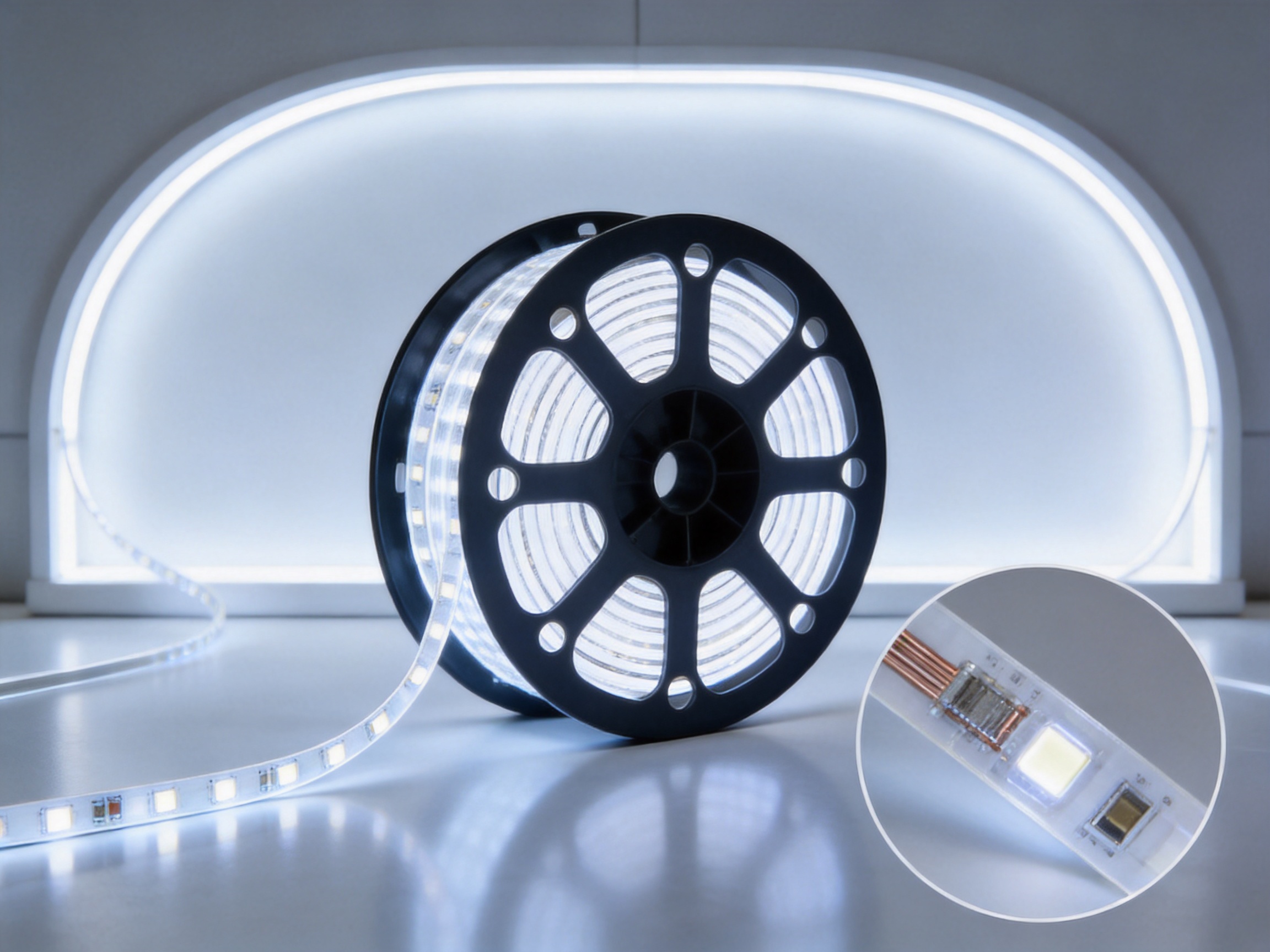
The lamp tape uses three principal material groups: copper, LED components, and silica gel. Copper is commonly selected for flexible lighting because it offers dependable electrical conductivity while remaining suitable for compact wiring structures. LED technology supplies the light source, providing a long-service alternative to many traditional incandescent products. Silica gel forms the flexible protective layer or housing, helping the lighting element remain bendable while providing a barrier against ordinary environmental contact.
The listed color is cool white. Cool white illumination is particularly suitable for retail windows, modern interiors, commercial displays, architectural outlines, restaurants, hotels, event venues, seasonal installations, and contemporary residential decoration. It offers a brighter and more neutral visual impression than warm white, making objects, signage, metallic surfaces, glass, and white décor appear crisp and clearly defined.
The listed power is 15W. A relatively low power rating is useful for decorative applications because it can help reduce operating consumption compared with higher-wattage conventional lighting systems. Actual energy performance will depend on the final length, voltage system, controller or power supply, operating schedule, and installation method. Purchasers should request the complete electrical specification, including input voltage, output voltage, current, connector type, maximum continuous run, and power-supply requirements.
The product is identified for indoor and outdoor use. Outdoor suitability is valuable for seasonal displays, building outlines, patios, gardens, balconies, storefronts, holiday installations, and temporary event decoration. Nevertheless, “indoor and outdoor use” should not be interpreted as unlimited exposure protection. The buyer should verify the product’s ingress-protection rating, sealing method, connector protection, operating temperature range, and installation instructions before using it in rain, snow, standing water, or permanently exposed locations.
Key Product Specifications
| Specification | Details |
|---|---|
| Model | MDFL006 |
| Product name | 50 Meter Flexible Lamp Tape |
| Material | Copper, LED, and silica gel |
| Light color | Cool white |
| Listed length | 50 meters in the product title; the supplied table states 16.4 feet in length or more |
| Application | Indoor and outdoor decorative lighting |
| Power | 15W |
| Minimum order quantity | 500 units |
| Certificates and management qualifications | CE, REACH, and BSCI listed for the product or supply program |
| Manufacturer | Taizhou Mingde Decorative Lighting Co., Ltd. |
The table provides a concise summary, but commercial buyers should treat it as an initial specification rather than a substitute for a technical data sheet. Flexible lighting products may be manufactured in different lengths, voltage versions, reel formats, connector systems, and packaging arrangements for different markets. Confirmation before mass production is especially important when the buyer’s installation design depends on a precise continuous length.
Flexible Construction and Installation Adaptability
The most immediate advantage of flexible lamp tape is its ability to follow non-linear surfaces. Rigid light bars require accurate cutting, corner connectors, or multiple fixture sections to navigate curves. Flexible tape can often be guided around a sign, along a decorative edge, beneath a counter, across a display frame, or around a column with fewer visible breaks.
This adaptability can simplify design work and reduce the visual interruption associated with conventional fixtures. When installed correctly, a continuous flexible product can create a smoother line of light. It is suitable for outlining architectural details, emphasizing borders, highlighting shelves, illuminating display cases, and creating a controlled perimeter around seasonal decorations.
The silica-gel exterior is important to the product’s physical design. It allows the lamp tape to bend while helping shield internal components from dust, handling, and ordinary environmental contact. The protective material can also make the product more comfortable to handle during installation than exposed wiring or uncoated LED assemblies. However, the minimum bending radius should be confirmed before installation, since forcing a flexible lamp tape into a sharp fold may damage internal conductors or LED components.
Copper conductors support the product’s flexibility and electrical performance. Copper is widely used in lighting assemblies because it carries current effectively and can be formed into compact conductive paths. A properly designed copper-based structure may also support consistent operation across the specified product length. Uniformity depends on the full circuit design, LED spacing, voltage regulation, connection method, and maximum recommended run.
For professional installation, the tape should be placed on a clean, dry, and stable surface unless the manufacturer provides a specific mounting system. The installer should avoid crushing, twisting, puncturing, stapling through the conductive section, or placing excessive pressure on LED points. Corners should be formed with gradual bends, and electrical connections should be protected using compatible components.
Cool-White Illumination for Modern Decorative Design
Cool-white light creates a clear, energetic, and contemporary atmosphere. It is often selected for commercial environments where visibility and product definition are important. Retailers may use it around window frames, shelving, signage, merchandise platforms, and seasonal displays. In hospitality environments, it can support clean architectural lines in reception areas, restaurants, lounges, and event spaces.
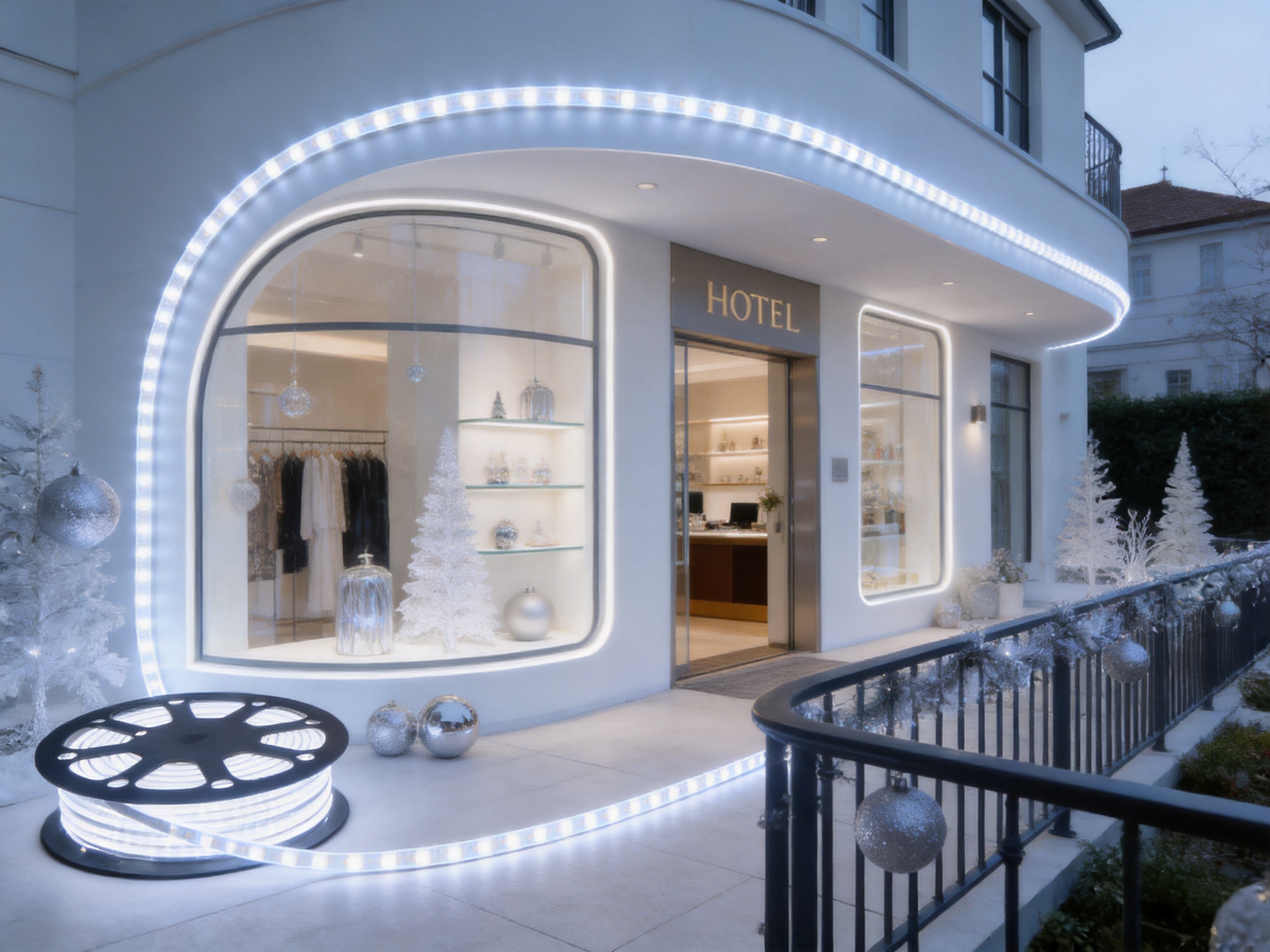
Cool white is also effective in holiday and winter-themed decoration. It can complement silver ornaments, white trees, metallic decorations, snow-inspired displays, glass surfaces, and reflective materials. In outdoor settings, it can define pathways, railings, garden structures, building edges, and temporary festive installations without introducing the yellow tone associated with many warm-white sources.
Light appearance is a design decision rather than a simple technical detail. Cool white may be preferable for modern or commercial settings, while warm white may be chosen for intimate residential spaces. Because this product is listed in cool white, importers and project designers should request a sample before approving a large order. A physical sample helps evaluate brightness, color consistency, LED spacing, diffuser appearance, and compatibility with the intended décor.
For displays that require a seamless visual line, the buyer should also ask about LED spacing and the degree of light diffusion produced by the silica-gel covering. A diffused exterior can soften points of light, while a more transparent construction may produce brighter individual LED points. The appropriate appearance depends on whether the product will be viewed directly or used as concealed accent lighting.
Advantages Compared with Conventional Decorative Lighting
Greater Design Freedom Than Rigid Fixtures
Rigid light bars and fixed-profile fixtures can provide clean illumination, but they are less adaptable when a project includes curves, irregular outlines, rounded furniture, arches, or changing dimensions. Flexible lamp tape can be shaped to suit these details, which gives designers more freedom and may reduce the need for custom-cut rigid components.
More Continuous Visual Coverage Than Separate String Segments
Traditional string lights are useful for festive decoration, but their individual bulbs and hanging wires create a distinctive dotted appearance. Flexible lamp tape can provide a more organized linear effect, especially when installed along an edge or inside a concealed channel. This makes it suitable for projects that require a clean outline rather than a scattered string-light pattern.
Compact Installation in Narrow Spaces
The product’s flexible form allows it to fit into locations where larger luminaires cannot. Examples include narrow display borders, cabinet undersides, sign recesses, furniture edges, small architectural gaps, and decorative channels. The compact format can help designers achieve accent lighting without adding visually dominant hardware.
Lower Listed Power for Decorative Operation
With a listed power of 15W, the product is positioned as a relatively efficient decorative-lighting solution. Lower power consumption can be advantageous for displays that operate for extended periods, particularly in retail, hospitality, event, and seasonal applications. Energy savings should be assessed using the actual configured length and operating schedule rather than the product title alone.
More Practical Protection Than Bare LED Wiring
The silica-gel material provides a protective exterior that is more suitable for handling and general installation than uncoated LED wire. It can help reduce exposure of the internal lighting structure to ordinary dust and contact. Outdoor performance, however, depends on the complete system, including end caps, connectors, power supplies, junctions, and installation practices.
Scalability for Commercial Projects
The minimum order quantity is listed as 500 units. Although this quantity may be more appropriate for wholesalers, distributors, project contractors, seasonal retailers, and private-label buyers than for individual consumers, it also indicates that the product is intended for organized commercial supply. Larger purchasers can potentially standardize a lighting style across multiple stores, venues, product lines, or seasonal campaigns.
Indoor Applications
In residential interiors, the lamp tape can be used beneath cabinets, around media units, along bookshelves, behind headboards, inside display furniture, around mirrors, and along decorative wall features. Its cool-white output is well suited to contemporary interiors, home offices, kitchens, and display-oriented spaces. It can also be used as indirect illumination when positioned behind a ledge or within a recess.
Retail stores can apply flexible lamp tape to window displays, merchandise platforms, shelving, counters, signage, and seasonal installations. A clean line of cool-white light can draw attention to products without requiring a large standalone fixture. Because flexible tape can follow the shape of a frame or display structure, it can support frequent visual changes in a merchandising environment.
Hotels and restaurants may use it to emphasize reception desks, bar fronts, banquettes, wall panels, columns, corridors, and event backdrops. The product can help create consistent decorative treatment across multiple areas, especially when the same color and installation style are repeated throughout a property.
Exhibition designers and event planners can use the product for booths, temporary partitions, stage borders, branded structures, photo backdrops, and themed displays. Its flexible format supports rapid creative adaptation, while the cool-white color can coordinate with graphic panels, product packaging, metallic frames, and reflective surfaces.
Outdoor and Seasonal Applications
For outdoor decoration, possible applications include roofline accents, storefront outlines, balcony rails, garden structures, fences, pergolas, patios, entryways, and temporary event installations. The product is identified for indoor and outdoor use, making it relevant to both permanent-looking decorative schemes and seasonal lighting programs.
Holiday retailers and commercial decorators may incorporate flexible lamp tape into Christmas displays, winter scenes, shopping-center décor, hotel entrances, public venues, and community events. It can complement spiral trees, curtain lights, garland lights, LED string lights, and copper-wire lighting products. Used as an outline or border, it can provide a visual framework around other decorative elements.
Outdoor installations require additional planning. The lighting assembly should be kept away from standing water, sharp edges, excessive heat, and areas where vehicles or pedestrians may damage it. Connections should be elevated or sealed as appropriate, and the power supply should be protected in accordance with local electrical requirements. The product should not be installed outdoors solely on the assumption that the silicone-like exterior makes every connection waterproof.
Weather conditions can also affect installation. Cold temperatures may reduce flexibility, while strong sunlight, heavy rain, snow, wind, and temperature changes may influence long-term durability. Project managers should request outdoor-use instructions and any available environmental testing information before specifying the product for demanding permanent installations.
Manufacturing Strengths of the Supplier
Taizhou Mingde Decorative Lighting Co., Ltd. is described as a major Chinese decorative-lighting manufacturer with an annual production capacity of 10 million strings of festive lights. This scale can be valuable to importers and distributors that need repeatable production, standardized quality, coordinated packaging, and dependable supply for seasonal demand.
The company was founded in 1968 and was formerly associated with Zhejiang Festival Lighting General Factory. Its long history indicates extensive experience in festive and decorative lighting, a product sector that requires careful attention to electrical assemblies, visual consistency, seasonal deadlines, packaging, and export documentation.
The company is also described as one of China’s largest export bases for festive lighting. Experience in international markets can support communication regarding regional requirements, product documentation, packaging preferences, shipping coordination, and buyer-specific specifications. The company’s stated market coverage includes the United States and Central and South America, which are important destinations for seasonal and decorative lighting products.
According to the supplied company information, the manufacturer was among the first domestic companies in its industry to obtain United States UL certification. While this historical achievement should not automatically be interpreted as certification of every current model, it demonstrates a longstanding focus on formal safety requirements and international market access. Buyers should request the current certificates applicable specifically to model MDFL006 and to the intended electrical configuration.
The company established an ISO 9001 quality system in 1997. A quality-management system can provide a structured framework for purchasing, production, inspection, corrective action, document control, and continuous improvement. For a product such as flexible lamp tape, systematic quality management is especially relevant because reliability depends on the interaction of materials, LED components, conductors, insulation, connectors, assembly processes, and final testing.
The supplied product information lists CE, REACH, and BSCI. CE relates to conformity requirements for applicable European-market products, REACH addresses chemical-substance controls in the European Union, and BSCI is associated with social-compliance assessment. Buyers should verify the scope, validity, issuing organization, and product applicability of each document. Certification claims are most useful when they are connected to the exact model, electrical version, factory, and shipment configuration.
Integrated Production and Quality Control
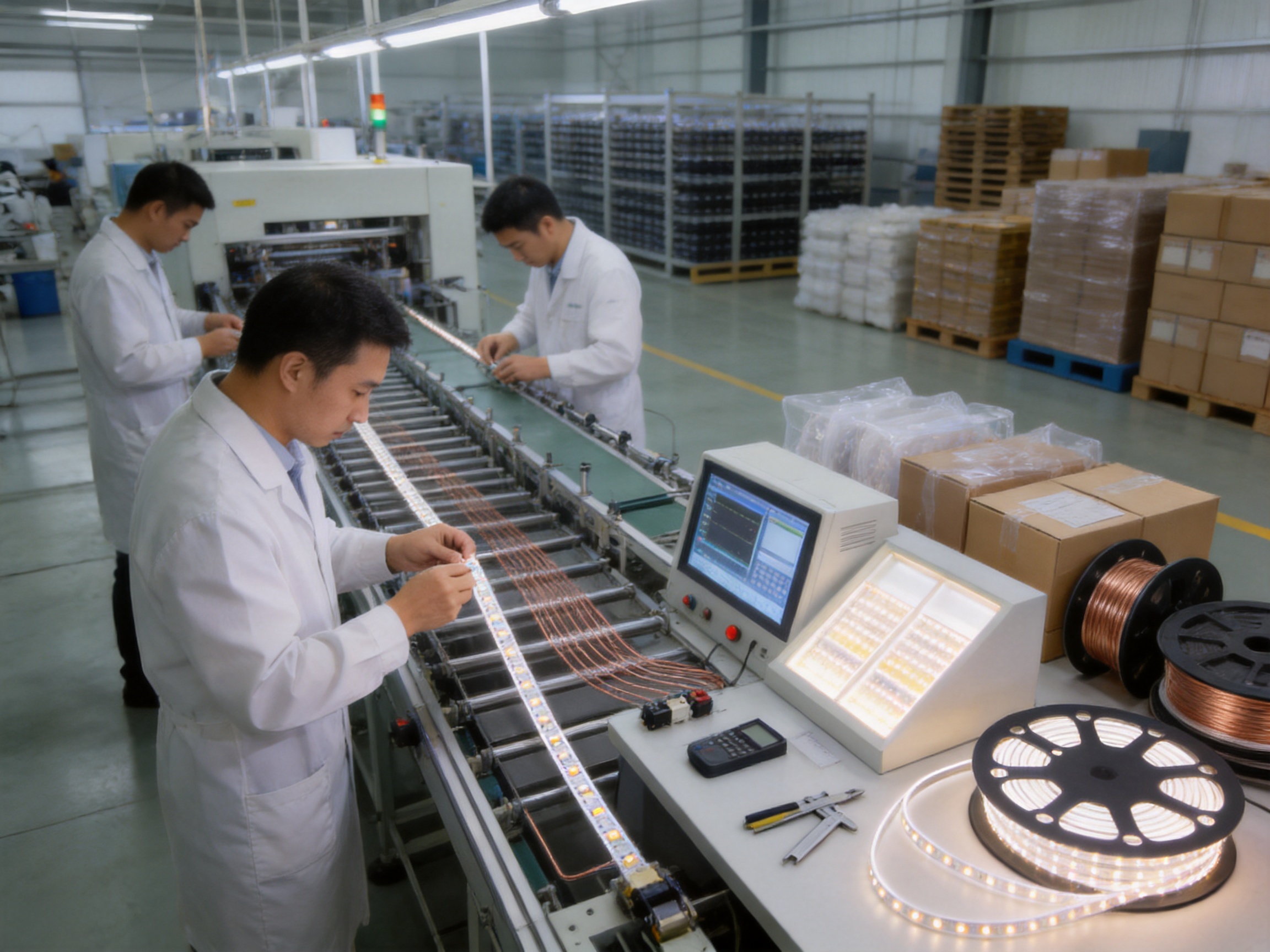
The company is described as operating an integrated and standardized lighting enterprise, with quality control extending from component manufacturing through final assembly and shipment. Integrated production can offer several advantages over a fragmented supply chain. It may improve coordination between material selection, LED placement, conductor assembly, protective covering, testing, packaging, and order scheduling.
Control over more production stages can also make it easier to investigate defects and implement corrective actions. If a lighting product shows inconsistent brightness, loose connections, surface defects, or packaging damage, an integrated manufacturer may be able to trace the issue to a specific process more efficiently than a company that outsources every stage.
A disciplined manufacturing process for flexible lamp tape typically begins with incoming inspection. Copper conductors, LED components, silica gel, connectors, wire, controllers, power supplies, and packaging materials should be checked against approved specifications. Incoming quality checks may include dimensional inspection, appearance inspection, electrical sampling, material verification, and supplier documentation review.
The next stages can include conductor preparation, LED assembly, circuit connection, insulation or encapsulation, forming, curing, cutting, connector installation, and functional testing. Each stage needs controlled conditions. For example, poor conductor preparation can affect electrical continuity; inconsistent LED placement can affect visual uniformity; inadequate encapsulation can reduce environmental protection; and improper curing can influence flexibility or surface quality.
Final inspection may include illumination testing, power measurement, continuity checks, appearance review, dimensional verification, connector inspection, packaging inspection, and sampling under operating conditions. Commercial buyers should ask whether the manufacturer performs 100 percent lighting tests or sampling inspections, what test duration is used, how defects are classified, and how batch traceability is maintained.
Shipment control is another important part of quality. Flexible products must be wound, protected, labeled, and packed in a way that reduces tangling, crushing, abrasion, and connector damage. Proper carton design can also help prevent deformation during long-distance transport. Since decorative lighting is often ordered for fixed seasonal deadlines, accurate quantity control and shipment scheduling are essential.
How the Product Can Support Wholesale and Private-Label Buyers
The listed minimum order quantity of 500 units makes this product relevant to wholesale and project-based purchasing. Distributors may use it as part of a broader decorative-lighting catalog, while retailers can offer it for home decoration, event use, seasonal projects, and small commercial installations. Contractors may purchase larger quantities for standardized work across multiple sites.
Private-label buyers can discuss packaging design, carton markings, instruction sheets, barcode labels, color descriptions, reel formats, and product naming with the manufacturer. Before confirming a private-label order, the buyer should establish the exact product configuration, electrical system, length tolerance, connector type, color temperature, packaging quantity, warranty terms, and inspection standard.
Large projects should be supported by a sample-approval process. A practical approval sequence includes review of a pre-production sample, confirmation of the final artwork and packaging, inspection of a production sample, and approval of shipping documentation. This process helps prevent misunderstandings about light color, length, cable arrangement, accessories, and printed specifications.
Buyers should also consider after-sales support. Important questions include whether replacement sections or connectors are available, how defective units are handled, whether technical installation guidance is provided, and how warranty claims are documented. A strong supply relationship involves more than unit price; it includes communication, consistency, lead-time management, documentation, and problem resolution.
Specification Verification Before Ordering
The supplied information contains a notable length inconsistency. The product title identifies the item as “50 Meter Flexible Lamp Tape,” while the technical table states “16.4 feet in length OR MORE.” Since 16.4 feet is approximately 5 meters, these descriptions do not identify the same nominal length. This may be a typographical error, a template issue, a minimum length statement, or an indication that several configurations are available.
For this reason, buyers should request written confirmation of the following points:
1. The exact nominal length per reel or unit.
2. The permitted length tolerance.
3. Whether 50 meters refers to one continuous reel, a total order length, or a product family name.
4. The rated voltage and current.
5. Whether a power supply, controller, rectifier, connector, end cap, or mounting accessory is included.
6. The maximum recommended continuous run.
7. The LED spacing and total LED quantity.
8. The color temperature range for cool white.
9. The outdoor protection rating of the complete assembled product.
10. The approved cutting points, if the product can be cut.
11. The operating temperature range and storage requirements.
12. The certificate scope and applicable market.
These details are important because a lighting system must be evaluated as a complete electrical and mechanical assembly. A product’s headline name alone does not provide enough information for safe installation, accurate costing, or regulatory review.
Installation Recommendations
Before installation, inspect the lamp tape for cuts, crushed sections, exposed conductors, damaged connectors, or irregular surfaces. Do not energize a visibly damaged product. Confirm that the power supply matches the product’s voltage and current requirements, and use a qualified electrician when local regulations require professional installation.
Measure the installation path before unrolling the product. Plan the route, corners, power-entry position, access points, and mounting locations in advance. Avoid pulling the tape tightly around corners or stretching it to compensate for an incorrect measurement. A gradual curve is generally safer than a sharp crease.
Keep the product away from direct contact with hot surfaces, heating equipment, open flames, abrasive materials, and locations where it may be pinched. If installed in a channel, ensure that the channel dimensions and heat dissipation are suitable for the product. Although LEDs are efficient, all electrical products generate some heat, and restricted airflow may influence service life.
For outdoor use, protect every connection and transition point. The most vulnerable area may not be the main silica-gel body but the plug, connector, splice, controller, or power supply. Use compatible sealing accessories and position electrical components where they are protected from water accumulation. Installation should follow the manufacturer’s instructions and applicable local codes.
After installation, test the entire system before final concealment or opening the display to the public. Check for consistent illumination, flicker, overheating, loose connections, unexpected voltage drop, and mechanical stress. For large projects, record the batch number, installation date, circuit layout, and inspection results for future maintenance.
Maintenance and Service Life Considerations
Regular maintenance can help preserve the appearance and performance of decorative lighting. Indoor lamp tape can be inspected for dust, loose sections, discoloration, and cable damage. Outdoor installations should be checked more frequently, especially after storms, freezing conditions, strong winds, or heavy public use.
Cleaning should be performed with the power disconnected. Use a soft, dry or lightly damp cloth when appropriate, and avoid solvents or abrasive cleaners that may affect the silica-gel covering, labels, or connectors. Do not immerse the lighting assembly unless the manufacturer has specifically confirmed that the complete system is designed for immersion.
Flickering, partial illumination, unusual heat, discoloration, or a burning smell should be treated as warning signs. The affected section should be disconnected and inspected by qualified personnel. Repeatedly operating a damaged product may create additional faults or safety risks.
Service life depends on operating hours, electrical stability, ambient temperature, humidity, ultraviolet exposure, mechanical stress, installation quality, and component selection. LEDs commonly offer a long operating life, but the life of the complete product is determined by the weakest part of the assembly. Power supplies, connectors, solder joints, insulation, and protective coverings all contribute to overall reliability.
Environmental and Compliance Considerations
The listed REACH qualification is relevant to buyers concerned about restricted chemical substances in products supplied to European markets. A responsible purchasing process should request the relevant declaration or test documentation and confirm that it applies to the exact material and product configuration.
Energy-efficient LED operation can support lower electricity consumption during long decorative-lighting schedules. The environmental impact of a lighting product, however, also includes manufacturing, packaging, transport, maintenance, and end-of-life disposal. Buyers can improve sustainability by selecting appropriate lengths, avoiding unnecessary overproduction, using durable installation methods, and following applicable electronic-waste procedures.
Product packaging should be evaluated as part of the purchasing process. Efficient carton dimensions can reduce transport volume, while protective packaging can reduce damage and waste. Importers may request recycled or recyclable packaging materials, reduced plastic use, printed recycling instructions, or packaging optimization for container shipments.
Social compliance is another consideration in responsible sourcing. The listed BSCI qualification indicates that social-performance assessment is part of the supplier’s stated credentials. Buyers should verify current documentation and evaluate whether the supplier’s labor, health and safety, environmental, and ethical practices meet their own procurement standards.
Why Manufacturer Experience Matters
Decorative lighting is highly seasonal and often deadline-sensitive. A delayed shipment can cause a retailer or event organizer to miss an entire sales period. A manufacturer with long-term experience and substantial annual capacity may be better prepared to manage seasonal forecasts, raw-material planning, production scheduling, quality inspection, and export packing.
Experience also supports product diversification. The company’s described product range includes linear lights, icicle lights, net lights, circular lights, spiral trees, LED string lights, copper-wire lights, and cord lights. This broad portfolio can help buyers source coordinated products from one supplier instead of managing numerous factories for related decorative installations.
A broad product range can also support visual consistency. For example, a buyer may combine flexible lamp tape with curtain lights, garland lights, spiral trees, and string lights in one seasonal display. A supplier familiar with multiple decorative formats may be able to advise on color coordination, packaging, accessory compatibility, and installation planning.
The company’s stated mission emphasizes nature-friendly home ambient lighting and its vision focuses on building a long-lasting enterprise that brings warmth to households. For buyers, such statements are most meaningful when supported by measurable practices, including documented quality systems, transparent material information, responsible production, effective testing, and consistent customer service.
Recommended Buyer Profile
This flexible lamp tape is a good candidate for importers, distributors, decorative-lighting wholesalers, retail chains, event-production companies, hospitality groups, seasonal decorators, and project contractors. It is particularly relevant to buyers seeking a cool-white, flexible, low-power product for repeated commercial use.
It may be less suitable for buyers who need a fully self-contained battery product, a high-brightness professional architectural system, a color-changing controller platform, or a permanently submerged outdoor light. Those requirements should be discussed separately with the manufacturer, since the supplied specification does not identify battery operation, RGB color control, immersion protection, or advanced architectural dimming functions.
Residential consumers can also benefit from the product, but the listed minimum order quantity of 500 units suggests that direct retail purchase may not be the main supply model. Individual users may need to purchase through a distributor or specialized lighting retailer that can provide smaller quantities, compatible power supplies, and installation assistance.
Commercial Value and Total Cost of Ownership
Unit price is only one part of the commercial value of flexible lamp tape. Buyers should evaluate the total cost of ownership, including power consumption, installation labor, mounting accessories, replacement rates, packaging, shipping volume, storage, maintenance, and disposal.
A flexible product may reduce labor when it can be installed along complex shapes without extensive custom fabrication. A lower listed power rating may reduce ongoing electricity expenses. A reliable protective covering may reduce premature replacement caused by ordinary handling or environmental contact. These potential benefits should be assessed through samples, test installations, and a comparison with competing products using equivalent specifications.
Competitor comparisons should be based on measurable criteria rather than appearance alone. Important comparison points include actual length, voltage, wattage per meter, LED density, light output, color consistency, bending radius, protective rating, connector quality, warranty, certificates, packaging, and factory inspection procedures. A cheaper product may become more expensive if it has inconsistent brightness, higher failure rates, inadequate connectors, or poor documentation.
For large-scale seasonal programs, procurement teams should calculate the required quantity with a reasonable replacement allowance. They should also reserve time for sample testing, certification review, production, inspection, freight, customs clearance, and local distribution. Early planning is especially important when products are needed for major holiday campaigns.
Q&A
What is the main use of this product?
The product is designed for decorative lighting in indoor and outdoor environments. It can be used for architectural outlines, retail displays, window decoration, furniture accents, event décor, seasonal installations, garden structures, and other applications where a flexible line of cool-white light is required.
What materials are used?
The listed materials are copper, LED components, and silica gel. Copper supports electrical conductivity and flexible construction, LEDs provide illumination, and silica gel forms a flexible protective exterior.
What color light does it produce?
The listed color is cool white. Buyers who require a specific color temperature should request the Kelvin range and approve a physical sample before mass production.
Is the product suitable for outdoor use?
The product is identified for indoor and outdoor use. Buyers should still confirm the exact ingress-protection rating, connector protection, power-supply requirements, environmental limits, and installation instructions for the intended outdoor location.
How much power does it use?
The supplied specification lists 15W. Buyers should verify whether this rating applies to the complete reel, a specified length, or a particular electrical configuration, especially because the supplied length information contains an inconsistency.
Is the product really 50 meters long?
The product title identifies it as a 50-meter product, but the provided table states 16.4 feet in length or more. Since these measurements are different, the exact reel length must be confirmed directly with the manufacturer before ordering.
What is the minimum order quantity?
The listed minimum order quantity is 500 units. This makes the product more suitable for wholesalers, distributors, contractors, retailers, and commercial projects than for one-time household purchases.
Which certificates are listed?
The supplied specification lists CE, REACH, and BSCI. Buyers should request current documentation and confirm that it applies to model MDFL006, the relevant voltage version, and the intended destination market.
Can the lamp tape be cut?
The supplied information does not state whether the product can be cut or where cutting is permitted. Buyers must request written cutting instructions before modifying the product. Cutting at an incorrect point may damage the circuit or create a safety risk.
Does it include a power supply?
The supplied specification does not confirm whether a power supply, controller, connector, end cap, or mounting accessory is included. These items should be specified in the quotation and purchase contract.
What makes it different from ordinary string lights?
Flexible lamp tape is designed to create a more continuous linear appearance and can follow curved or irregular surfaces. Ordinary string lights are often more suitable for scattered bulb effects, while flexible tape is useful for borders, outlines, concealed accent lighting, and narrow installation spaces.
Can it be used for permanent outdoor installation?
The product is listed for indoor and outdoor use, but permanent outdoor installation requires confirmation of environmental ratings and connection protection. Buyers should not assume that the main flexible body and all accessories have identical weather resistance.
Who manufactures the product?
The product is supplied by Taizhou Mingde Decorative Lighting Co., Ltd., located in Taizhou City, Zhejiang Province, China. The company is described as a long-established decorative-lighting manufacturer with large annual production capacity and export experience.
How should buyers evaluate a sample?
A sample should be evaluated for brightness, color consistency, LED spacing, surface finish, flexibility, bend performance, power consumption, connector quality, heat generation, packaging, and compatibility with the planned power system. Outdoor buyers should also review sealing and installation requirements.
Ordering and Communication Checklist
When requesting a quotation, provide the intended market, required quantity, target delivery date, installation environment, desired packaging, electrical system, color preference, and expected length per unit. Clear information allows the manufacturer to recommend a suitable configuration and reduces the chance of receiving an incompatible product.
Ask for a formal quotation that separates product cost, packaging cost, tooling or artwork charges, accessories, inspection fees, and shipping terms where applicable. Confirm whether the quoted price is based on a particular reel length or electrical version.
Request technical documents before approval. These may include a product data sheet, wiring diagram, installation guide, certificate copies, material declarations, packing list format, carton dimensions, and test report. The documents should identify the exact model and configuration.
For quality assurance, agree on an inspection standard before production. The standard may cover acceptable brightness variation, surface marks, dimensional tolerance, connector appearance, electrical performance, packaging condition, labeling, and quantity accuracy. A mutually understood inspection standard creates a clearer basis for acceptance or corrective action.
For direct communication, the supplied company contact information includes the email address zd@zflgf.com.cn and telephone number +86-576-82467401. Additional listed contacts include Ms. Zhang, Mr. Tan, and Mr. Cheng. Buyers should confirm contact details through official business correspondence and use written documentation for specifications, approvals, and changes.
Conclusion
The 50 Meter Flexible Lamp Tape is positioned as a versatile cool-white decorative-lighting product built from copper, LED components, and silica gel. Its flexible structure can offer greater installation freedom than rigid fixtures, a cleaner linear effect than many conventional string-light arrangements, and practical coverage for indoor and outdoor decorative projects. The listed 15W power rating, commercial order quantity, and CE, REACH, and BSCI credentials add value for professional buyers, subject to verification of the final configuration and documentation.
The supplier’s major strengths include a history dating back to 1968, annual production capacity of 10 million strings of festive lights, export experience, a broad decorative-lighting portfolio, an ISO 9001 quality system established in 1997, and described quality control from component manufacturing through shipment. These capabilities can support wholesalers, distributors, retailers, contractors, and seasonal project buyers seeking an experienced manufacturing partner.
The most important purchasing issue is the discrepancy between the 50-meter product title and the listed length of 16.4 feet or more. This detail should be resolved in writing before any order is placed. Buyers should also confirm voltage, LED density, color temperature, waterproofing, maximum run length, accessories, packaging, certificates, warranty, and inspection procedures.
With those specifications clearly verified, the product can serve as a practical component for commercial displays, residential accents, hospitality environments, events, holiday decoration, and architectural outlining. Its value is strongest when the flexible form, cool-white appearance, low-power design, and manufacturer’s production capabilities are matched carefully to the requirements of the intended project.
References
1. Product specification supplied for model MDFL006, 50 Meter Flexible Lamp Tape.
2. Manufacturer-provided company information for Taizhou Mingde Decorative Lighting Co., Ltd.
3. General principles of LED decorative-lighting design, installation, maintenance, and electrical safety.
4. ISO 9001 quality-management principles for manufacturing organizations.
5. General CE conformity, REACH chemical-compliance, and BSCI social-compliance guidance.
Product: 50 Meter Flexible Lamp Tape


Don't Miss New Releases & Subscriber Exclusives
Sign up for our newsletter to stay in the holidy spirit all year.
Further Questions? Contact Us
-
Useful Links
Home Products About Us Production Services News Contact Us -
Classification
Mini String Light LED Light Set Garland Light Light-up Spiral Trees LED Curtain Lights Battery Light LED Copper Wire Light Decorative Light -
Contact Info
zd@zflgf.com.cn+86-576-82467401
+86-13968612122 ( Ms. Zhang )
+86-13505747679 ( Mr. Tan )
+86-15062835074 ( Mr. Cheng )No.270 Zhenxi Road, Xinqiao Town, Luqiao District, Taizhou City, Zhejiang Province, China -


Holiday Lights Supplier