

 中文简体
中文简体

Why Do C9 LEDs Dominate Roofline Displays
C9 LED Christmas Lights have become a dominant choice for roofline decoration in residential neighborhoods, commercial plazas, and seasonal installations. User discussions across lighting communities repeatedly highlight the same pattern: visibility distance, structural clarity, and consistent spacing matter more than decorative complexity.
Unlike smaller bulb formats, C9 lighting is engineered to define architectural outlines rather than simply decorate surfaces. This shift explains why they appear so frequently on rooftops, gutters, and building edges during holiday seasons.
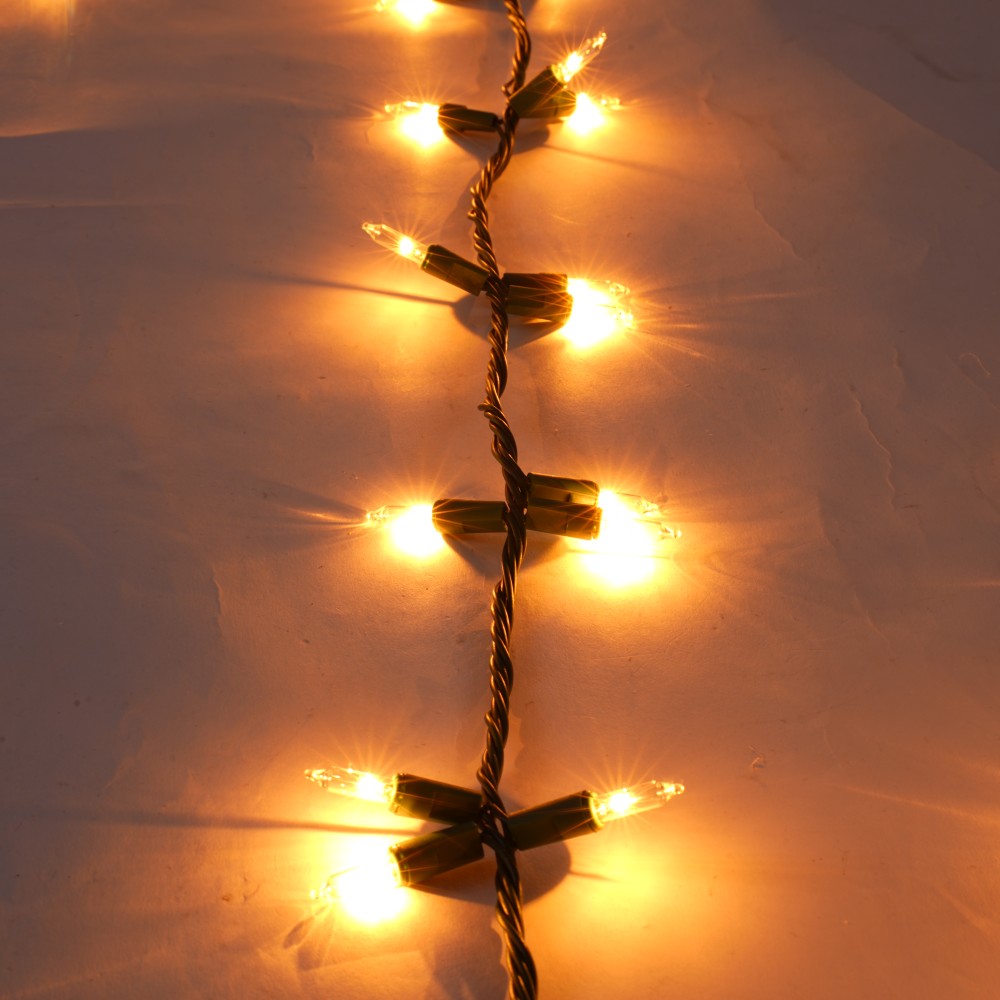
Why Roofline Lighting Relies on C9 LED Structure
Strong outline visibility from distance
C9 LED Christmas Lights are widely used because their larger lens size creates a clear silhouette effect even at long viewing distances. This makes them suitable for houses positioned along roads or commercial buildings seen from parking lots.
Key visual characteristics:
- Bulb diameter around 1.1 inches (approx. 2.8 cm)
- Spacing typically 6–12 inches
- High directional brightness for edge definition
- Stable color output without visual fragmentation
These properties allow buildings to maintain recognizable shapes even in complex lighting environments.
Architectural contour enhancement
Roofline lighting is less about decoration density and more about structural framing. C9 bulbs naturally align with roof edges, gables, and ridgelines, reinforcing building geometry.
Design effects include:
- Emphasized roof angles
- Highlighted symmetry lines
- Separation between roof and wall surfaces
- Visual elevation of building height perception
This explains why modern installers often treat C9 LEDs as architectural tools rather than holiday accessories.
Technical Profile Behind C9 LED Performance
C9 LED systems are not only larger but also optimized for durability and energy efficiency.
Core technical parameters
| Feature | Specification Range | Functional Role |
| LED power consumption | 0.5W – 1W per bulb | Low energy usage |
| Operating voltage | 120V / 24V / 12V | Installation flexibility |
| Lifespan | 25,000 – 50,000 hours | Multi-season use |
| Waterproof rating | IP65 – IP67 | Outdoor resilience |
| Viewing angle | 180°–270° | Wide visibility |
These parameters allow consistent operation even in cold winter environments and prolonged nightly usage.
Series vs parallel wiring behavior
C9 LED strings are often designed in parallel circuit architecture, meaning:
- One bulb failure does not disable the entire string
- Voltage distribution remains stable
- Maintenance becomes simpler during long installations
This reliability is one of the reasons they are favored for large-scale roofline projects.
Why C9 LEDs Outperform Smaller Light Formats
Reduced visual noise
Smaller bulbs often create dense visual clusters that blur architectural edges. C9 LEDs avoid this issue by spacing light points further apart, creating a clean linear outline.
Improved viewing hierarchy
Roofline displays require clarity at a glance. C9 lights naturally guide the eye along building edges without overwhelming detail.
Higher installation efficiency
Because fewer bulbs are required per linear meter, installation becomes:
- Faster
- More structured
- Easier to maintain alignment
Comparison of Roofline Lighting Types
| Lighting Type | Visual Strength | Ideal Usage |
| C9 LED bulbs | Strong outline definition | Roof edges, ridges |
| C7 LED bulbs | Medium brightness structure | Small homes |
| Mini string lights | Dense decorative texture | Trees, shrubs |
| Icicle lights | Vertical motion effect | Eaves and gutters |
| Rope lights | Continuous glow line | Architectural tracing |
C9 LEDs consistently stand out in scenarios where structural clarity outweighs decorative density.
Common User Questions About C9 Roofline Lighting
Do C9 LEDs consume too much power?
Modern LED versions use significantly less energy than incandescent predecessors. A full roofline installation often draws less power than a single traditional outdoor spotlight.
Are C9 bulbs too large for small houses?
Scale perception matters more than size alone. Even compact homes benefit from C9 outlines when spacing is adjusted properly.
Why do C9 lights look more “professional”?
The perceived professionalism comes from:
- Even spacing control
- Strong geometric alignment
- Reduced visual clutter
- Uniform brightness output
Installation Patterns That Affect Visual Impact
Roofline lighting performance is heavily influenced by layout strategy rather than bulb type alone.
Common installation patterns include:
- Continuous ridge outlining for symmetry emphasis
- Alternating color sections for rhythm variation
- Single-color full perimeter framing for clean architectural definition
- Layered roof + window combination for depth enhancement
Each pattern changes how viewers interpret building structure at night.
Why C9 LEDs Remain a Long-Term Roofline Standard
C9 LED Christmas Lights continue to dominate because they align with how people visually process buildings at night. Instead of competing with architectural form, they reinforce it.
Their effectiveness is rooted in:
- Distance readability
- Structural emphasis
- Maintenance simplicity
- Consistent visual rhythm
As holiday lighting trends evolve toward cleaner and more intentional design language, C9 LEDs maintain relevance by focusing on clarity rather than complexity.

Don't Miss New Releases & Subscriber Exclusives
Sign up for our newsletter to stay in the holidy spirit all year.
Further Questions? Contact Us
-
Useful Links
Home Products About Us Production Services News Contact Us -
Classification
Mini String Light LED Light Set Garland Light Light-up Spiral Trees LED Curtain Lights Battery Light LED Copper Wire Light Decorative Light -
Contact Info
zd@zflgf.com.cn+86-576-82467401
+86-13968612122 ( Ms. Zhang )
+86-13505747679 ( Mr. Tan )
+86-15062835074 ( Mr. Cheng )No.270 Zhenxi Road, Xinqiao Town, Luqiao District, Taizhou City, Zhejiang Province, China -


Holiday Lights Supplier